

The religion of values
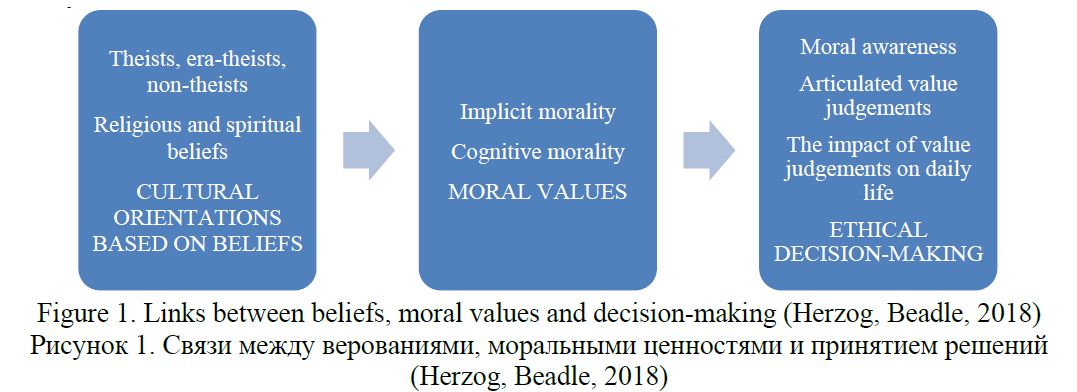
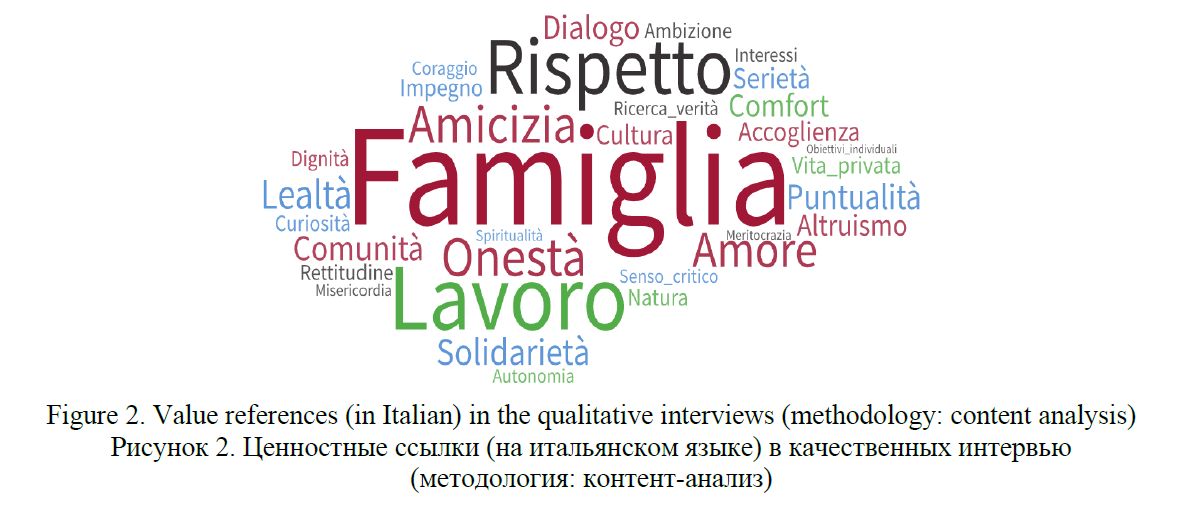
The role of values in religious phenomenology has been extensively emphasised on numerous occasions. Such a complexity of attitudes and behaviours represents a skilful and effective attempt at a schematic and didactic re-presentation of a whole series of diversifications and stratifications relating to religious (and conversely non-religious) reality. The golden rule would be not to do unto others what one would not wish to be done unto oneself; in short, a practical, everyday maxim, a precept that is easily identifiable and applicable. In practice, values relating to the emotional and relational sphere (family, respect, friendship, love) are complemented by practical and moral values (work, honesty, loyalty, solidarity). Among the 428 value-related responses identified in the qualitative interviews, there is a clear hierarchy, confirming the primary importance of the family (18%) and, to a slightly lesser extent, respect and justice (14.7%), followed by solidarity, hospitality and sharing (10.7%); further behind are work (7.7%), friendship and love (7.2%), education, culture and respect for traditions (6.8%), religiosity and devotion (5.8%), and freedom (4.2%). Now, in our qualitative survey, the values of autonomy, tradition, benevolence (as altruism) and universalism are found, albeit under different names, but those of conformity, power, security, success, stimulation and hedonism do not seem to feature prominently, at least not in an overt and declared form.
Figures
Cipriani, R. (2026), “The religion of values”, Research Result. Sociology and Management, 12 (3), 6-14. DOI: 10.18413/2408-9338-2026-12-3-0-1.















While nobody left any comments to this publication.
You can be first.
Ammerman, N. T. (1997), “Golden Rule Christianity: Lived Religion in the American Mainstream”, Lived Religion in America, D. D. Hall (ed.), Princeton University Press, Princeton, 196-216.
Beck, U. (2009), Il Dio personale. La nascita della religiosità secolare, Laterza, Roma-Bari.
Beck, U. (2008), Der eigene Gott. Von der Friedensfähigkeit und dem Gewaltpotential der Religionen, Verlag der Weltreligionen im Insel Verlag, Frankfurt am Main-Leipzig.
Beck, U. (2014), A God of One’s Own: Religion’s Capacity for Peace and Potential for Violence, Polity Press, Cambridge.
Belardinelli, S., Gattamorta, L. (a cura di) (2012), I valori hanno bisogno della religione?, Rubbettino. Soveria Mannelli.
Cacciari, M. (2018), “L’aut-aut sull’Europa di Romano Guardini”, Vita e Pensiero, CI, 2, 87-96.
Cipriani, R. (1993), “De la religion diffuse à la religion des valeurs”, Social Compass, 40, 91-100.
Cipriani, R. (2012), “La religione dei valori”. In S. Belardinelli, L. Gattamorta (a cura di), I valori hanno bisogno della religione?, Rubbettino, Soveria Mannelli, 87-105.
Cipriani, R. (2021), L’incerta fede. Un’indagine quanti-qualitativa in Italia, FrancoAngeli, Milano.
Heinich, N. (2017), Des valeurs. Une approche sociologique, Gallimard, Paris.
Heinich, N. (2020), “A pragmatic redefinition of value(s): Toward a general model of valuation”, Theory, Culture & Society, 37 (5), 75-94.
Herzog, P., Beadle, De A. T. (2018), “Emerging Adult Religiosity and Spirituality: Linking Beliefs, Values, and Ethical Decision-Making”, Religions, 9 (3), 84, 1-18.
Inglehart, R., Basáñez, M., Díez-Medrano, J., Halman, L., Luijkx, R. (2004), Human Beliefs and Values: A Cross-Cultural Sourcebook Based on the 1999-2002 Values Surveys, Siglo XXI, Mexico City.
Lévy-Bruhl, L. (1903), La morale et la science des mœurs, Alcan, Paris.
Lévy-Bruhl, L. (1905), Ethics and Moral Science, Constable, London. Kessinger Publishing, Whitefish, Mt, 2008; Ulan Press, Ulan Bator, 2012; Nabu Press, New York, 2013; HardPress, Lenox, Ma, 2019; Wentworth Press, London, 2019; Legare Street Press, s. l., 2022; Hudson Street Press, New York, 2025.
Schwartz, S. H., Bilsky, W. (1987), “Toward a Universal Psychological Structure of Human Values”, Journal of Personality and Social Psychology, 53, 551.