

The religion of values
Abstract
The role of values in religious phenomenology has been extensively emphasised on numerous occasions. Such a complexity of attitudes and behaviours represents a skilful and effective attempt at a schematic and didactic re-presentation of a whole series of diversifications and stratifications relating to religious (and conversely non-religious) reality. The golden rule would be not to do unto others what one would not wish to be done unto oneself; in short, a practical, everyday maxim, a precept that is easily identifiable and applicable. In practice, values relating to the emotional and relational sphere (family, respect, friendship, love) are complemented by practical and moral values (work, honesty, loyalty, solidarity). Among the 428 value-related responses identified in the qualitative interviews, there is a clear hierarchy, confirming the primary importance of the family (18%) and, to a slightly lesser extent, respect and justice (14.7%), followed by solidarity, hospitality and sharing (10.7%); further behind are work (7.7%), friendship and love (7.2%), education, culture and respect for traditions (6.8%), religiosity and devotion (5.8%), and freedom (4.2%). Now, in our qualitative survey, the values of autonomy, tradition, benevolence (as altruism) and universalism are found, albeit under different names, but those of conformity, power, security, success, stimulation and hedonism do not seem to feature prominently, at least not in an overt and declared form.
Introduction. The role of values in religious phenomenology has been extensively emphasised on numerous occasions (Cipriani, 1993; 2012). The findings of our national survey in Italy on uncertain faith (Cipriani, 2021) highlight the centrality of values as the fundamental basis for sustaining a religiosity that transcends the waning influence of institutional religion and manages to maintain a widespread sentiment which, however unstable, retains religious and spiritual content (Herzog, Beadle, 2018), which intermingle, overlap and juxtapose with one another, creating a complex and highly combinatorial landscape. According to Herzog and Beadle, the configurations of three universes – the theistic, the extra-theistic and the non-theistic – are structured along distinct yet converging planes, resulting in doctrinal theists, hybrid theists (because they are connected with extra-theists and other religions), therapeutic theists (who derive benefit from their belief, without reference to doctrinal aspects, commitment or religious institutions) and hereditary theists; nature-oriented extra-theists, self-oriented extra-theists and community-oriented extra-theists; non-theists, without belief or affiliation, who are non-religious, non-religious agnostics and non-religious atheists. Such a complexity of attitudes and behaviours represents a skilful and effective attempt at a schematic and didactic re-presentation of a whole series of diversifications and stratifications relating to religious (and conversely non-religious) reality. The whole is suffused and imbued with a cultural aura that encompasses theism, extra-theism and non-theism.
Methodology and methods. Morality and values. Even more intriguing is the discussion on morality and values, as it takes up to some extent the idea of the golden rule proposed by Ammerman (Ammerman, 1997), who speaks of a Christianity that is almost fuzzy, indistinct, and frayed, which is more pragmatic than dogmatic and more oriented towards respecting moral rules than particular religious beliefs. The golden rule would be not to do unto others what one would not wish to be done unto oneself; in short, a practical, everyday maxim, a precept that is easily identifiable and applicable. Thus, the link between religion and morality, between religious spirit and practical conduct, becomes clearer (Belardinelli, Gattamorta, 2012). This teaching has Jewish and biblical origins and becomes very concrete, indeed even mundane, with little metaphysical content, aimed above all at respect for others. In short, the common denominator would be precisely the living of a virtuous life.
Ulrich Beck (Beck, 2009: 155) speaks of a “school of morality”: “this is evident, not least, in the fact that parents not affiliated with any Church, who consider themselves exponents of the culture of doubt (residents, for example, of the Prenzlauer Berg district in Berlin), prefer to send their children to Church-run nursery schools, so that they may be introduced to the social morality of individualisation: not only ‘look after yourself’, but also ‘respect the dignity of others’. In this way, the distinction between individualisation and selfishness is taught, the model for a ‘responsible self’, which includes, that is, responsibility for one’s neighbour”.
Furthermore, still according to Beck (Beck, 2009: 157), with regard to Churches and sects, “the personal God of individualised religiosity, by contrast, knows no unbelievers, because he knows no absolute truths, nor hierarchies, heretics, pagans or atheists. In the subjective polytheism of the ‘personal God’, there is room for many deities. Here, what religions and churches – bound by their claim to truth – consider not only morally reprehensible but also logically unthinkable is put into practice: in their nomadic search for religious transcendence, individuals are both believers and non-believers. Indeed, the meaning of the personal God lies precisely in this ‘love for the enemy’ as a means of broadening the religious horizon”. It follows that “one can start from the admission that the new religious movements are ‘rightly’ global religions. They represent the pluralism of modernity” (Beck, 2009: 157-158). Here Beck echoes a thought by Peter Clarke (Clarke, 2006: 51). It is a sort of “religious hybridisation”.
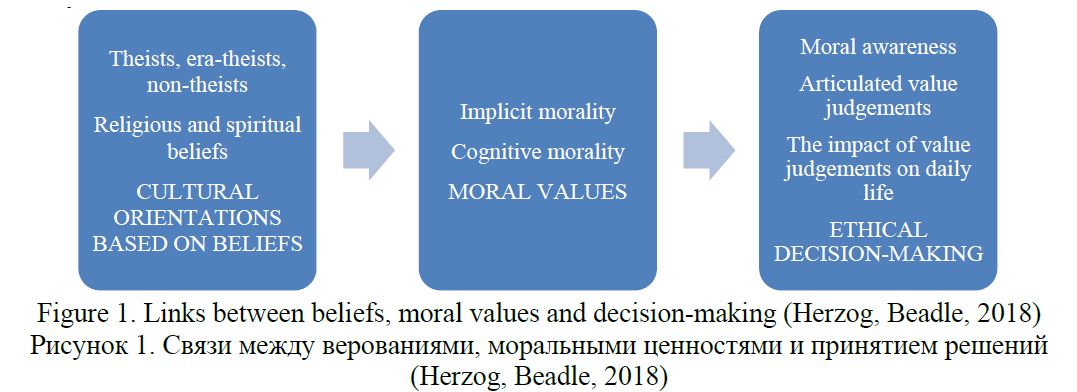
Beliefs and values. Herzog and Beadle argue that it is ethical spirituality that drives individuals in their life choices. The concepts proposed are those of tacit morality and cognitive morality. The former is said to be based on a sort of visceral, spontaneous, immediate feeling, which leads to instantly discerning what is right from what is wrong. The latter is more reflective, rational, critical and independent of traditional and magisterial religious doctrines, so that the decisions are not swayed by emotional considerations.
The following diagram illustrates the flowchart, which, starting from the threefold distinction between theists, extra-theists and non-theists, passes through the two aforementioned forms of morality before arriving at the final idea of implementing a resolution:
It is no coincidence that, among the values mentioned in the transcripts of our 164 qualitative interviews (with 81 men and 83 women) conducted in various Italian cities in 2017, spirituality (alongside mercy) also features as one of the most frequently recurring concepts, almost as if to underpin the predominant values of family and work, respect and friendship, honesty and love, loyalty and solidarity, dialogue and community, punctuality and altruism, seriousness and comfort, culture and hospitality, commitment and autonomy, integrity and dignity, ambition and curiosity, nature and private life, courage and interests, the search for truth and critical thinking. This is a broad range of values that underpin life’s most important actions and the choices we make.
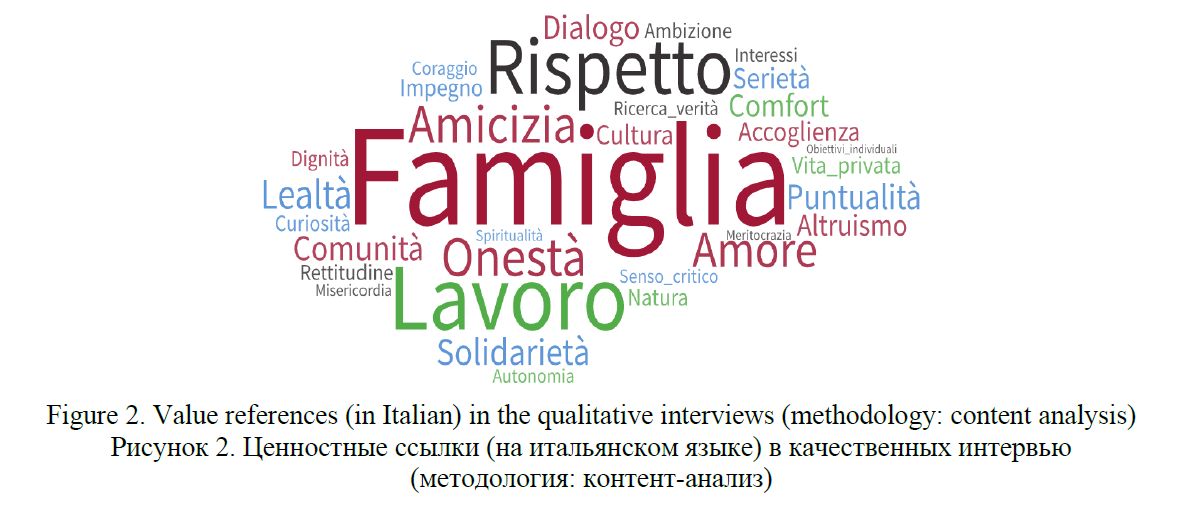
The conceptual map drawn up through content analysis reveals a five-tiered classification of values, ranging from the key value to the more peripheral ones, via the pillar values, the core values and the supplementary values, as shown in the diagram below, in order of importance:
Key value: Family
Pillar values: Work, Respect
Core values: Honesty, Friendship, Love, Loyalty, Solidarity
Supplementary values: Community, Punctuality, Dialogue, Comfort, Altruism, Seriousness, Hospitality, Culture
Peripheral values: Private life, Ambition, Curiosity, Commitment, Nature, Integrity, Courage, Dignity, Interests, Search for truth, Critical thinking, Autonomy, Compassion, Spirituality, Meritocracy, Individual goals
In practice, values relating to the emotional and relational sphere (family, respect, friendship, love) are complemented by practical and moral values (work, honesty, loyalty, solidarity). All of this is then underpinned by integrative values (community, punctuality, dialogue, comfort, altruism, seriousness, hospitality, culture) and peripheral values (ambition, curiosity, commitment, nature, integrity, courage, dignity, interests, the search for truth, critical thinking, autonomy, compassion, spirituality, meritocracy, individual goals).
Research Results and Discussion. Empirical findings. Among the 428 value-related responses identified in the qualitative interviews, there is a clear hierarchy, confirming the primary importance of the family (18%) and, to a slightly lesser extent, respect and justice (14.7%), followed by solidarity, hospitality and sharing (10.7%); further behind are work (7.7%), friendship and love (7.2%), education, culture and respect for traditions (6.8%), religiosity and devotion (5.8%), and freedom (4.2%).
Using a different method, which extracts the emerging values from each interview, whatever they may be, the results are fairly similar and more detailed, amounting to 208 concepts, each of which relates to one or more interviews, as shown in the list below, where each concept-value is followed by the number of interviews in which it appears: family 47; work 25; sport 18; respect 16; friendship 14; honesty 9; love 7; school, study 6; culture, ethics, children, travel, volunteering 5; art, home, education, loyalty, music, sacrifice 4; independence, walking, dialogue, happiness, husband, hospitality, sincerity, solidarity 3; consistency, dignity, faith, generosity, gratitude, commitment, legality, freedom, mother, merit, forgiveness, politics, relationships, humility 2; contentment, agnosticism, help, openness, community involvement, charity, well-being, kindness, dogs, Catholicism, asking permission, cinema, sharing, social control, fairness, correction, cooking, destiny, duty, emigration, balance, aesthetics, boyfriend, trust, philosophy, young people, justice, globalisation, meeting, independence, nursing, inter-ethnic relations, sign language, nature, grandchildren, horoscope, peace, inner peace, Pope Francis, Parsifal, patience, person, positivity, prayer, prudence, reincarnation, responsibility, rebellion, apologising, seriousness, service, dreams, hope, theatre, leisure, tradition, transparency, university, Urbino, vegetarianism, truth, social life. Just Parsifal and Urbino appear to be out of the ordinary.
It comes as no surprise that the concepts of family and work occupy the top two spots in the list above; what is surprising, however, is the case of sport as a value-based element. It seems clear, therefore, that a significant number of respondents attach considerable importance to sport as a point of reference in terms of attitude and behaviour. The rankings of respect, friendship, honesty and love fall within the norm and are predictable. We then move on to more concrete aspects, such as school and study, or family relationships, such as children, which are matched in frequency by culture and ethics, as well as travel and volunteering. These are followed by both typically value-based concepts often abstract or general in nature – such as education, loyalty and sacrifice, or art and music and by an emphasis on aspects not usually counted as values in the strict sense, such as home. With an even smaller number of occurrences, values such as autonomy, dialogue, happiness, hospitality, sincerity, solidarity, or other concepts considered values – such as walking and husband – are listed. At this point, the range of values expands almost excessively and records varying frequencies relating to consistency, dignity, faith, generosity, gratitude, commitment, legality, freedom, merit, forgiveness and humility, but also to terms such as mother, politics and relationship. The list concludes with a myriad of other values – or at least those deemed as such – since they are improperly and broadly included within the set of positive qualities that lead to consequent actions. These are concepts that can be regarded, on the one hand, as values in their own right or with some stretching of the term, namely help, openness, charity, well-being, goodness, sharing, fairness, duty, balance, trust, justice, encounter, independence, inter-ethnicity, nature, peace, inner peace, patience, personhood, positivity, prudence, responsibility, rebellion, seriousness, service, hope, tradition, transparency, vegetarianism, truth, destiny, reincarnation; on the other hand, these values can also be traced back to experiences such as social life, dreams, theatre, leisure, cinema, aesthetics, community involvement, prayer, cooking, nursing, sign language, horoscopes, emigration, globalisation, social control, correction, but also agnosticism, Catholicism, philosophy, making do, asking permission, apologising. Even people are transformed into values: grandchildren, Pope Francis, a boyfriend, young people, Parsifal. The same applies to certain places: university, Urbino. Last but not least, some people like dogs so much that they become a value in their own right.
What is most striking is the significant number of all these values found in the interviewees’ accounts; thus, although they do not explicitly describe themselves as religious or spiritual, they nevertheless demonstrate a strong sensitivity towards certain fundamental principles that effectively govern their lives, not sporadically but with continuity and a general consistency.
It is the interviewees themselves, through the qualitative approach, who express their views on the subject of values, which they consider crucial to their own existence and that of others.
The family is at the heart of the dynamics of values, affections and feelings repeatedly expressed by the subjects in the qualitative universe of the research (the interview number is indicated in brackets; transcripts of the interviews are available in Italian at the following link: https://www.ciprianiroberto.it/2021/06/16/intervistequalitative/).
- yes, values, let’s say, I have lived by family values (interview № 15);
- the bond with the family comes first (17);
- I care about my family, my children (28);
- the family’s influence is the most important value (42);
- I am a person devoted to the family; I know family values (65);
- our upbringing is shaped by this, by this strictness which ultimately shapes us (82);
- the value of the family is fundamental to me (83);
- for me, the family comes first (93);
- family is the most important thing (98);
- children come first, they come first (157);
- I have a special relationship with my father; he always taught me the value of things, the value of money, of work, of sacrifice, and my mother too; my mother is someone who has always given me so much strength to face the most challenging moments of my life (61);
- but for me, hospitality comes first; it’s a bit like the first virtue we should all have, and unfortunately, it’s a bit lacking today (9);
- people need hospitality, understanding, to feel understood and loved and helped with what they need; even if we don’t offer material charity, they still need to feel understood (89);
- upbringing, respect – respect in the broadest sense, whether towards oneself or others, towards people (18);
- values have always been those of solidarity and generosity (39);
- there is sacrifice, sacrificing oneself for the team, helping others (115);
- values are based on the principle, … on the principle of respect for oneself, for one’s husband, for one’s child, for everyone, for society (145);
- my values are becoming, even though there’s a lot of work to be done on them, precisely these: finding greater inner peace, helping society as far as one can and as one’s strength allows, reflection, and then the common good (46);
- certainly, feelings – in short, the relationship we are able to establish with others, whether it be our brother or a friend, or any person we meet on our, on our journey through life (91);
- the environment I’m in has to be comfortable for me (11);
- material possessions are a source of satisfaction; I buy a car, but it’s fleeting (49);
- then various… consequences arose… buying a house… a car, that is, having those… [long pause] of, of things that are… yes, satisfactions, but then also of, of things that are actually important, aren’t they? (63).
The following testimony is an example of the tendency towards self-referentiality:
- even in the most difficult moments, to have a bit of patience, to be strong-willed. To work hard on my own goodness, to always find the best in myself (149).
There are a few interview excerpts that contain a direct reference to religious values.
- moral values… devoting oneself to the Church (114);
- some fundamental values which can be family, love. Health and, for me, clearly faith too. We have different ways of approaching things (111);
- to be mindful every day of staying true to what you’ve been taught, to what you believe in – for me, prayer is also about this: promising yourself not to speak ill of others, not to harm others, and in this way, not to tell lies, perhaps to be as honest as possible, not to take advantage of others, not to... if someone needs a hand, perhaps lend a hand; never expect the other person to repay you in any way, or expect from them something they can never give you... even at work... still try to work in a fair, honest way, and help others (21).
References to work as a value pursued and lived out are equally scarce.
- I believe that an important value is working in the sense of keeping oneself busy (16);
- working, let’s say, in the right way. Being generally useful to other people through your work. And, in short, understanding that the work you do is useful, that it has value and serves other people (29);
- the working environment, which then, of course, also impacts all the values you hold… having a minimum code of conduct… commitment… keeping up to date (127).
The anthology of quotations relating to values concludes with a number of transcriptions containing clear and direct expressions of interest in and practice of qualities that are valued because they are considered positive for oneself and for others.
- so surely the values are honesty, loyalty, charity (12);
- self-awareness and honesty towards myself are perhaps my core values… I accept my limitations (67);
- my character is based on transparency, being loyal, and respecting everyone from the greatest to the smallest (72);
- for example, it doesn’t follow 100% as our prophet said; if someone organises crime, organises… if they do wrong things, then I must first and foremost condemn them (5).
Conclusion. It is no coincidence that Nathalie Heinich (Heinich, 2017; Heinich, 2020) has advocated the need for a shift from moral sociology to the sociology of morality, drawing on Lucien Lévy-Bruhl (Lévy-Bruhl, 1903). The aim is to promote a social science of values as sociological methods (Heinich, 2017: 174). This involves “drawing on the intentions or attitudes of actors, gathered through empirical research, to articulate the principles by virtue of which they favour both individualism (autonomy, authenticity, individuality, interiority…) and holism (solidarity, cohesion, community, humility…); to observe the historical and cultural variations of these principles; to explain, where possible, such choices and variations using socio-demographic parameters; and to attempt, finally, to understand the reasons that drive actors to activate these principles” (Heinich, 2017: 174-175). Heinich further rightly observes that “the problem is that this shift towards empiricism took place in a context dominated by statistical methods based on opinion polls, which had proven their worth in commercial marketing or electoral forecasting, but which are not necessarily suited to other types of sociological issues and, in particular, to the question of values. For this reason, significant methodological biases undermine the validity of such surveys” (Heinich, 2017: 179).
As for the universal structure of values, Heimlich (Heimlich, 2017: 182-183) cites the work of Schwartz and Bilsky (Schwartz and Bilsky, 1987), who identified ten fundamental values generally present in many international surveys: autonomy, achievement, hedonism, success, power, security, conformity, tradition, benevolence and universalism. Benevolence, autonomy and universalism usually rank highest in the hierarchy of preferences, whilst power, tradition and stimulation rank lowest.
Now, in our qualitative survey, the values of autonomy, tradition, benevolence (as altruism) and universalism are found, albeit under different names, but those of conformity, power, security, success, stimulation and hedonism do not seem to feature prominently, at least not in an overt and declared form. Can we therefore legitimately consider this to be a uniquely Italian exception in this regard? Perhaps some doubts may arise, however, regarding the methodology used by Schwartz and Bilsky, which runs the risk of reduced reliability – a shortcoming already noted in other similar international studies on the very topic of values (Inglehart, Basáñez, Díez-Medrano, Halman, Luijkx, 2004).
It is likely that the true reason for the differences just observed regarding the issue of values lies precisely in the different methodology, which is qualitative as well as quantitative. Heinich also highlights the qualitative shift in the field of value research, recalling the impetus provided by Max Weber in this regard and the need to employ a “comprehensive sociology” (verstehende Soziologie) to ascertain the mechanisms by which values are activated, the consistencies and inconsistencies, the logics, and the decision-making processes, of which social actors are not always fully aware and are therefore unable to respond adequately to the questions in a questionnaire, in a generic and off-the-cuff manner. Indeed, it can be said that values “are not directly accessible to observation, unlike opinions and attitudes, which the explanatory perspective allows us to trace back to external causes thanks to large-scale quantitative research” (Heinich, 2017: 185).
In conclusion, one cannot but agree with Nathalie Heinich (2017, 186) when she forcefully asserts the “fundamental characteristic of values: that they are plural and, often, contradictory, causing heterogeneous – that is, antagonistic – principles to coexist, whether through compromise or, at times, through conflict: solidarity with the weakest and the protection of acquired assets, autonomy and attachment, authenticity and modesty, creativity and security, and so on. This pluralism of values – or their ‘polytheism’ according to Weber’s expression, modified by Bouglé to ‘polytelism’ – constitutes the focal point, even if not always defined as such by the authors, of many significant contributions from the late 20th century”. But, as Cacciari (Cacciari, 2018: 93) writes, drawing on Romano Guardini, “the polytheism of values characteristic of secularised societies could represent the prologue to a far more dangerous form of paganism, a paganism that expresses itself in the worship of a single salvific Power – and when Technology and political Power are united within it, then it is ‘simply’ the advent of the Antichrist”. According to another variant, that proposed by Ulrich Beck (Beck, 2009), there is rather a subjective polytheism of the personal God, which is better suited to the existential journey of individuals and leads to “imagined communities”, that is, communities “of a transnational nature, which integrate, compete and clash with the institutionalised forms linked to national societies and institutions” (Beck, 2009: 53).















Reference lists
Ammerman, N. T. (1997), “Golden Rule Christianity: Lived Religion in the American Mainstream”, Lived Religion in America, D. D. Hall (ed.), Princeton University Press, Princeton, 196-216.
Beck, U. (2009), Il Dio personale. La nascita della religiosità secolare, Laterza, Roma-Bari.
Beck, U. (2008), Der eigene Gott. Von der Friedensfähigkeit und dem Gewaltpotential der Religionen, Verlag der Weltreligionen im Insel Verlag, Frankfurt am Main-Leipzig.
Beck, U. (2014), A God of One’s Own: Religion’s Capacity for Peace and Potential for Violence, Polity Press, Cambridge.
Belardinelli, S., Gattamorta, L. (a cura di) (2012), I valori hanno bisogno della religione?, Rubbettino. Soveria Mannelli.
Cacciari, M. (2018), “L’aut-aut sull’Europa di Romano Guardini”, Vita e Pensiero, CI, 2, 87-96.
Cipriani, R. (1993), “De la religion diffuse à la religion des valeurs”, Social Compass, 40, 91-100.
Cipriani, R. (2012), “La religione dei valori”. In S. Belardinelli, L. Gattamorta (a cura di), I valori hanno bisogno della religione?, Rubbettino, Soveria Mannelli, 87-105.
Cipriani, R. (2021), L’incerta fede. Un’indagine quanti-qualitativa in Italia, FrancoAngeli, Milano.
Heinich, N. (2017), Des valeurs. Une approche sociologique, Gallimard, Paris.
Heinich, N. (2020), “A pragmatic redefinition of value(s): Toward a general model of valuation”, Theory, Culture & Society, 37 (5), 75-94.
Herzog, P., Beadle, De A. T. (2018), “Emerging Adult Religiosity and Spirituality: Linking Beliefs, Values, and Ethical Decision-Making”, Religions, 9 (3), 84, 1-18.
Inglehart, R., Basáñez, M., Díez-Medrano, J., Halman, L., Luijkx, R. (2004), Human Beliefs and Values: A Cross-Cultural Sourcebook Based on the 1999-2002 Values Surveys, Siglo XXI, Mexico City.
Lévy-Bruhl, L. (1903), La morale et la science des mœurs, Alcan, Paris.
Lévy-Bruhl, L. (1905), Ethics and Moral Science, Constable, London. Kessinger Publishing, Whitefish, Mt, 2008; Ulan Press, Ulan Bator, 2012; Nabu Press, New York, 2013; HardPress, Lenox, Ma, 2019; Wentworth Press, London, 2019; Legare Street Press, s. l., 2022; Hudson Street Press, New York, 2025.
Schwartz, S. H., Bilsky, W. (1987), “Toward a Universal Psychological Structure of Human Values”, Journal of Personality and Social Psychology, 53, 551.