

The impact of digital technologies on the efficiency of public administration in Uzbekistan and Tajikistan: students' view
The article examines the normative perceptions of students from Uzbekistan and Tajikistan concerning the quality of public administration and the role of digital technologies in ensuring this quality. The article demonstrates the role of digital technologies in the public administration system, their impact on the rate of economic growth and competitiveness of the state. The problems of introducing digital technologies into the public administration system of the Republic of Uzbekistan and the Republic of Tajikistan and their impact on its efficiency are raised. The empirical basis of the study was data obtained through a survey of students from Central Asia in the form of essay texts (n = 103). The object of this study is students in Uzbekistan and Tajikistan as a potential cohort of civil servants. The subject is students' normative perceptions of the quality of public administration and the role of digital technologies in ensuring it. The goal is to identify the structure of these perceptions and document cross-country differences in understandings of governance quality. To process the obtained data, the method of content analysis of student essay texts was used. In preparing the article, the authors used cross-cultural and interdisciplinary approaches, which helped to show the modern challenges and problems of digitalization and the attitude of the youth audience towards it. It was established that digitalization has a significant impact on the requirements for the qualifications of civil servants. The analysis draws on the Quality of Government framework, which links impartial institutions to trust, transparency and lower corruption risks. The introduction of digital technologies expands the arsenal of tools available to civil servants. This, in turn, requires a revision of the qualification criteria for applicants for civil service positions by expanding the list of required competencies. The article offers practical implications for digital public services, civil-service competencies and public communication.
Figures
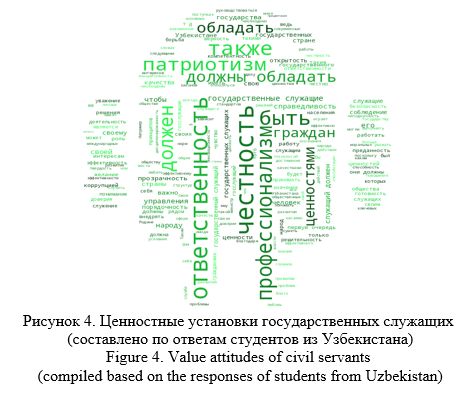
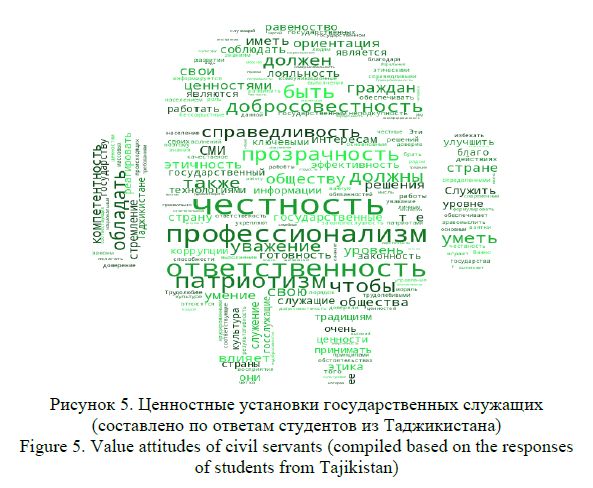
Rybakova, M. V., Ivanova, N. A. (2026), “The impact of digital technologies on the efficiency of public administration in Uzbekistan and Tajikistan: students' view”, Research Result. Sociology and Management, 12 (4), 215-232. DOI: 10.18413/2408-9338-2026-12-4-1-4.














While nobody left any comments to this publication.
You can be first.
Alimov, B. B., Rakhimova, D. N., Khamidulin, M. B. (2022), “Evolution of public administration in the post-Soviet countries. Republic of Uzbekistan”, Gosudarstvennaya sluzhba, 24 (4), 103-118, DOI: 10.22394/2070-8378-2022-24-4-103-118, EDN: ALBGFT. (In Russian)
Vasilieva, E. V., Mirzoyan, M. V. (2017), “Problems of Forming the Human Resources Potential of the Civil Service in the Context of the Implementation of the New Public Management”, Upravlencheskie nauki, 7 (4), 80-89, EDN: YMAQID. (In Russian)
Gafurov, A. D. (2022), “Evolution of public administration in the post-Soviet countries. Republic of Tajikistan”, Gosudarstvennaya sluzhba, 24 (1), 93-118, DOI: 10.22394/2070-8378-2022-24-1-93-118, EDN: ASWJRO. (In Russian)
Demura, N. A. and Putivtseva, N. P. (2021), “Digitalization: the essence and role in the development of the economy of the country and the region”, Research Result. Economic Research, 7 (1), 22-31, DOI: 10.18413/2409-1634-2021-7-1-0-3, EDN: GBRGYS. (In Russian)
Dobrolyubova, E. I., Yuzhakov, V. N., Starostina, A. N. (2021), Otsenka kachestva gosudarstvennogo upravleniya: obosnovannost, rezultativnost, effektivnost [Assessment of the quality of public administration: validity, effectiveness, efficiency], Izdatelsky dom «Delo» RANXiGS, Moscow, Russia. (In Russian)
Krasilnikov, D. G., Sivintseva, O. V., Troitskaya, E. A. (2014), “Modern Western Management Models: A Synthesis of New Public Management and Good Governance”, Ars Administrandi, (2), 45-62, EDN: SLJNWL. (In Russian)
Kupryashin, G. L. (2018), “Kaleidoscope of Administrative Reforms in Europe: Experience and Assessments of the Civil Service Elite”, Voprosy gosudarstvennogo i munitsipalnogo upravleniya, (1), 197-205, EDN: YTZIBE. (In Russian)
Latour, B. (2014), Peresborka sotsialnogo: vvedenie v aktorno-setevuyu teoriyu [Reassembling the Social: An Introduction to Actor-Network Theory], Translated by Polonskaya, I., Publishing House of the Higher School of Economics, Moscow, Russia, ISBN: 978-5-7598-0819-0, EDN: SYZVMJ. (In Russian)
Likhtin, A. A. (2021), “Transformation of Public Administration in the Context of Digitalization”, Upravlencheskoe konsultirovanie, (4), 18-26, DOI: 10.22394/1726-1139-2021-4-18-26, EDN: TZTKPZ. (In Russian)
Migranyan, A. and Krishtal, I. (2024), “The Economy of Tajikistan: Growth Factors against the Background of Low Living Standards”, Rossiya i novye gosudarstva Evrazii, (IV), 120-132, DOI: 10.20542/2073-4786-2024-4-120-132, EDN: EPRVOH. (In Russian)
Orlova, S. Yu. (2022) “Current Problems of Improving the Quality of Public Administration”, Gosudarstvennaya sluzhba, 24 (1), 39-45, DOI: 10.22394/2070-8378-2022-24-1-39-45, EDN: XMUIHK. (In Russian)
Rybakova, M. V. and Ivanova, N. A. (2024), “Digital Transformation of Civil Service in Uzbekistan in the Context of the New Globalization: Students Opinions”, Research Result. Sociology and Management, 10 (3), 217-228, DOI: 10.18413/2408-9338-2024-10-31-4, EDN: CHCNVY. (In Russian)
Samorukov, A. A. (2022), “Digital Transformation of Public Administration”, Bulletin of the Volga Region Institute of Management, 22(1), 4-13, DOI: 10.22394/1682-2358-2022-1-4-13, EDN: EMFFIO. (In Russian)
Wellman, B. and Frank, K. (2001), Setevoj kapital v mnogourovnevom mire: poluchenie podderzhki v lichnyh soobshchestvah [Network Capital in a Multi-Level World: Gaining Support in Personal Communities], Chicago, Aldine DeGruyter. (In Russian)
Chmuth, G. A. (2022), “Digital Transformation of Public Administration at the Current Stage”, Vestnik universiteta, (12), 30-36, DOI: 10.26425/1816-4277-2022-12-30-36, EDN: KCBJEX. (In Russian)
Agnafors, M. (2013), “Quality of Government: Toward a More Complex Definition”, American Political Science Review, 107(3), 433-445.
Andersen, T. B. (2009) “E-Government as an Anti-Corruption Strategy”, Information Economics and Policy, 21(3), 201-210, DOI: 10.1016/j.infoecopol.2008.11.003.
Hesse, J. (2000), Public Sector Report 2000. Central and Eastern Europe. Report to the XVth Meeting of Experts on the United Nations Programme in Public Administration and Finance, Paris, 8.
Holmberg, S., Rothstein, B., Nasiritousi, N. (2009), “Quality of Government: What You Get”, Annual Review of Political Science, 12, 135-161, DOI: 10.1146/annurev-polisci-100608-104510.
Pollitt, C. (2001), “Convergence: The Useful Myth?”, Public Administration, 79(4), 942, DOI: 10.1111/1467-9299.00287.
Rothstein, B. (2011), The Quality of Government: Corruption, Social Trust, and Inequality in International Perspective, University of Chicago Press, Chicago, DOI: 10.7208/chicago/9780226729589.001.0001.
Rothstein, B., Stolle, D. (2008), “The State and Social Capital: An Institutional Theory of Generalized Trust”, Comparative Politics, 40 (4), 441-459, DOI: 10.5129/001041508X12911362383354.
Rothstein, B., Teorell, J. (2008), “What Is Quality of Government? A Theory of Impartial Government Institutions”, Governance, 21 (2), 165-190, DOI: 10.1111/j.1468-0491.2008.00391.x.