

Sociological assessment of the specifics of the formation of socio-technological security of large cities in Northern Eurasia
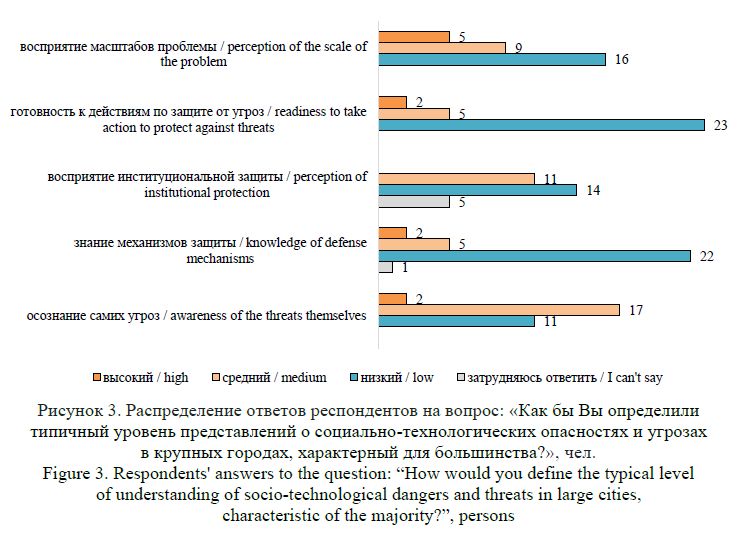
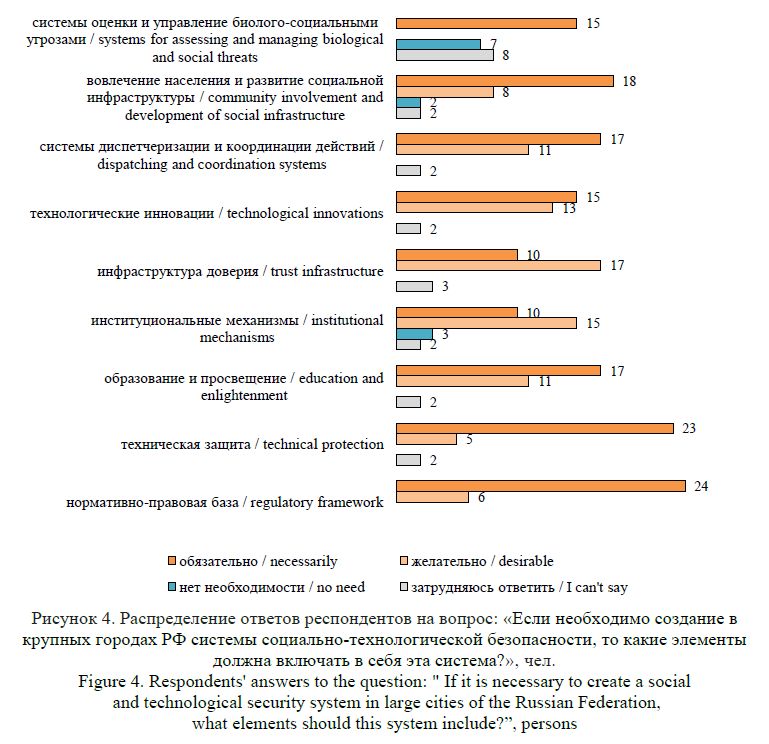
The relevance of this article is determined by the fact that modern large cities can increasingly be viewed as relatively stable administrative-territorial units and increasingly act as complex socio-technological systems operating in a state of constant uncertainty. This problem is particularly acute in large Russian cities in Northern Eurasia, where harsh climatic conditions, dependence on centralized heating, extensive infrastructure, digitalization of governance, and heterogeneity of the urban population increase the likelihood of cascading failures. The scientific problem of the study lies in the insufficient development of an integrated concept of urban socio-technological security. Existing approaches often analyze social, technical, informational, and managerial risks separately, whereas in the real urban environment they form a unified system of mutual reinforcement. The methodological basis of the article is the interdisciplinary framework of the sociology of instability, combining ideas from the sociology of risk, the theory of reflexive modernity, systems analysis, urban studies, and security studies. This paper utilizes a conceptual analysis of the categories of “social instability”, “social turbulence”, “social chaos”, “social risks”, “danger”, and “threat”, as well as elements of systemic and institutional approaches. The research's scientific results, firstly, clarify the distinction between socio-technological danger and socio-technological threat. Danger is understood as the potential for a social actor to fail to achieve its intended results due to the unprofessional application of social technologies or the inability to adequately interpret the actions of other actors. Threat, in contrast, implies a targeted destructive impact carried out by a specific actor using organizational, information, digital, or manipulative technologies. Secondly, it is shown that the key vulnerability of a large city is associated with the gap between the high interdependence of infrastructures and the fragmentation of institutional governance. Thirdly, it was revealed that the expert community considers the public's and institutions' understanding of socio-technological hazards to be inadequate. This emphasises the need for systemic education, specialist training and the development of a safety culture. The findings substantiate the need to create an urban socio-technological security system as a multi-layered institutional framework, including a regulatory framework, technical protection, digital monitoring, dispatching systems, risk communication, educational programs, a framework for countering disinformation, independent expertise, and public participation mechanisms. Such a system should be focused not only on eliminating the consequences of crises but also on the early detection of pre-crisis signs, maintaining reliable feedback, and enhancing the urban community's capacity for rational, collaborative action in unstable conditions.
Figures
Gaidukova, G. N. (2026), “Sociological assessment of the specifics of the formation of socio-technological security of large cities in Northern Eurasia”, Research Result. Sociology and Management, 12 (4), 146-170. DOI: 10.18413/2408-9338-2026-12-4-1-0.
















While nobody left any comments to this publication.
You can be first.
Babintsev, V. P. (2026), “Social technologies in the sociological and “nonsociological” dimensions”, RUDNJournalofSociology, 26 (1), 215-223, DOI: 10.22363/2313-2272-2026-26-1-215-223, EDN: QEKZOB. (In Russian)
Vildanov, Kh. S. and Khabibullin, I. G. (2025), “Social Security and Spiritual Sovereignty of Modern Russian Society in the Context of Mental Wars”, Society: Philosophy, History, Culture, (12), 14-22, DOI: 10.24158/fik.2025.12.1, EDN: QTFNKH. (In Russian)
Delez, Zh., Gvattari, P.-F. (2025), Anti-Edip. Kapitalizm i shizofreniya [Anti-Oedipus. Capitalism and Schizophrenia], 1, Ripol-Klassik, Moscow, Russia. (In Russian)
Delez, Zh., Gvattari, P.-F. (2025), Tysyacha plato. Kapitalizm i shizofreniya [A Thousand Plateaus. Capitalism and Schizophrenia], 2, Ripol-Klassik, Moscow, Russia. (In Russian)
Kazun, A. D. (2025), “To Tarnish the Pure and Illuminate the Tainted: Russian Perceptions of the Potential Risks of Fake News”, Interaction. Interview. Interpretation, 17 (3), 35-54, DOI: 10.19181/inter.2025.17.3.2, EDN: ZQUXKW. (In Russian)
Kastels, M. (2000), Informatsionnaya epoлрa: ekonomika, obshhestvo i kultura [The Information Age: Economy, Society, and Culture], GU VShE, Moscow, Russia. (In Russian)
Liotar, Zh.-F. (1998), Sostoyanie postmoderna [The state of postmodernism], In-t eksperim. sociologii, Moscow, Russia. (In Russian)
Pashentsev, E. N., Kuznetsov, P. V. and Chebykina, V. A. (2025), “Malicious Use of Artificial Intelligence and Threats to Iran’s Psychological Security: A Multi-Level Reality”, Vostok (Oriens), (3), 125-136, DOI: 10.31696/S086919080033177-1, EDN: ZMIMPA. (In Russian)
Toffler, E. (2025), Shok budushhego [Future shock], AST, Moscow, Russia. (In Russian) Toffler, E. (2004), Tretya volna [The third wave], AST, Moscow, Russia. (In Russian)
Toffler, E. (2003), Metamorfozy vlasti [Метаморфозы власти], AST, Moscow, Russia, ISBN: 5-17-004183-7, EDN: QOCCFP. (In Russian)
Shtompka, P. (1996), Sotsiologiya sotsialnykh izmeneniy [Sociology of social change], Aspekt-press, Moscow, Russia. (In Russian)
Bauman, Z. (2000), Liquid Modernity, Polity Press, Cambridge.
Basol, M., Roozenbeek, J., Berriche, M., Uenal, F., McClanahan, W. and van der Linden, S. (2021), “Towards psychological herd immunity: Cross-cultural evidence for two prebunking interventions against COVID-19 misinformation”, Big Data & Society, 8, DOI: 10.1177/20539517211013868, EDN: NQUVWB.
Batty, M. (2018), “Digital twins”, Environment and Planning B: Urban Analytics and City Science, 45 (5), 817-820, DOI: 10.1177/2399808318796416.
Beck, U. (1992), Risk Society: Towards a New Modernity, Sage, London.
Buldyrev, S., Parshani, R., Paul, G. et al. (2010), “Catastrophic cascade of failures in interdependent networks”. Nature, 464, 1025-1028, DOI: 10.1038/nature08932.
Buzan, B., Wаеver, O., and de Wilde, J. (1998), Security: A New Framework for Analysis, Lynne Rienner Publishers, Boulder.
Chambers, R. (2009), “Vulnerability, Coping and Policy (Editorial Introduction)”, IDS Bulletin, 37, 33-40.
Collier, S. J. (2011), Post-Soviet Social Neoliberalism Social Modernity Biopolitics, Princeton University Press, Princeton NJ, DOI: 10.23943/princeton/9780691148304.001.0001.
Cutter, S. (2003), “The Vulnerability of Science and the Science of Vulnerability”, Annals of The Association of American Geographers – ANN ASSN AMER GEOGR, 93, 1-12, DOI: 10.1111/1467-8306.93101, EDN: MEUSTY.
Douglas, M. and Wildavsky, A. (1982), Risk and Culture: An Essay on the Selection of Technological and Environmental Dangers, University of California Press, Berkeley.
Giddens, A. (1990), The Consequences of Modernity, Stanford University Press, Stanford. Giddens, A. (1991), Modernity and Self-Identity, Stanford University Press, Stanford.
Golovchenko, Y., Hartmann, M. and Adler-Nissen, R. (2018), “State, media and civil society in the information warfare over Ukraine: Citizen curators of digital disinformation”, International Affairs, 94, 975-994, DOI: 10.1093/ia/iiy148, EDN: ERFBWD.
Hjort, J., Karjalainen, O., Aalto, J. et al. (2018), “Degrading permafrost puts Arctic infrastructure at risk by mid-century”, Nat Commun, 9, 5147, DOI: 10.1038/s41467-018-07557-4, EDN: ANNAYC.
Holling, C. S. (1973), “Resilience and Stability of Ecological Systems”, Annual Review of Ecology, Evolution, and Systematics, 4, 1-23, DOI: 10.1146/annurev.es.04.110173.000245.
Luhmann, N. (1993), Risk: A Sociological Theory, De Gruyter, Berlin, New York.
Meerow, S., Newell, J. P., and Stults, M. (2016), “Defining urban resilience: A review”, Landscape and urban planning, 147, 38-49, DOI: 10.1016/j.landurbplan.2015.11.011.
Moser, C. (1997), Confronting Crisis in Angyalföld, Budapest, Hungary. World Bank, Michigan. Ostrom, E. (2010), “Beyond Markets and States: Polycentric Governance of Complex Economic
Systems”, American Economic Review, 100 (3), 641-72, DOI: 10.1257/aer.100.3.641.
Pennycook, G., Epstein, Z., Mosleh, M., Arechar A. A., Eckles, D., and Rand, D. G. (2021), “Shifting attention to accuracy can reduce misinformation online”, Nature, 592, 590-595, DOI: 10.1038/s41586-021-03344-2, EDN: VQQDWP.
Perrow, C. (1999), Normal Accidents: Living with High-Risk Technologies, Princeton University Press, Princeton.
Renn, О. and Walker, К. (2010), Global Risk Governance: Concept and Practice Using the IRGC Framework, Springer Netherlands, Dordrecht.
Reeves, M. (2013), “Clean Fake: Authenticating Documents and Persons in Migrant Moscow”, American Ethnologist, 40, DOI: 10.1111/amet.12036.
Rinaldi, S. M., Peerenboom, J. P. and Kelly, T. K. (2001), “Identifying, understanding, and analyzing critical infrastructure interdependencies”, IEEE Control Systems, 21(6), DOI: 10.1109/37.969131.
Roozenbeek, J., van der Linden, S. and Nygren, Th. (2020), “Prebunking interventions based on the psychological theory of “inoculation” can reduce susceptibility to misinformation across cultures”, HKS Misinfo Rev, 1, DOI: 10.37016/mr-2020-008, EDN: QESJPI.
Rosa, H. (2013), Social Acceleration: A New Theory of Modernity, Columbia University Press, New York.
Streletskiy, D. A., Suter, L. J., Shiklomanov, N. I. [et al.] (2019), “Assessment of climate change impacts on buildings, structures and infrastructure in the Russian regions on permafrost”, Environmental Research Letters, 14 (2), 025003, DOI: 10.1088/1748-9326/aaf5e6, EDN: AHATIK.
Stukal, D., Sanovich, S., Bonneau, R. and Tucker, J. (2017), “Detecting Bots on Russian Political Twitter”, Big Data, 5, 310-324, DOI: 10.1089/big.2017.0038.
Zhelnina, A. (2020), “The apathy syndrome: How we are trained not to care about politics”, Social Problems, 67 (2), 358-378, DOI: 10.1093/SOCPRO/SPZ019, EDN: SRIGCY.
The research was supported by Russian Science Foundation grant 25-28-02281, https://rscf.ru/project/25-28-02281/.