

Non-traditional religious views among Moscow and Belgorod residents of different marital statuses
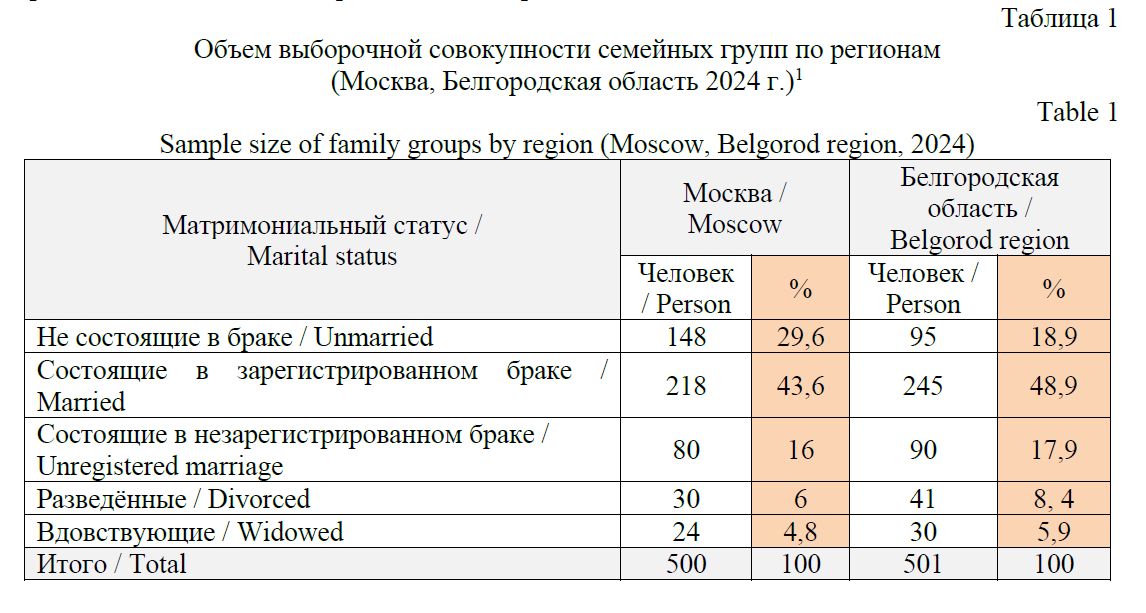
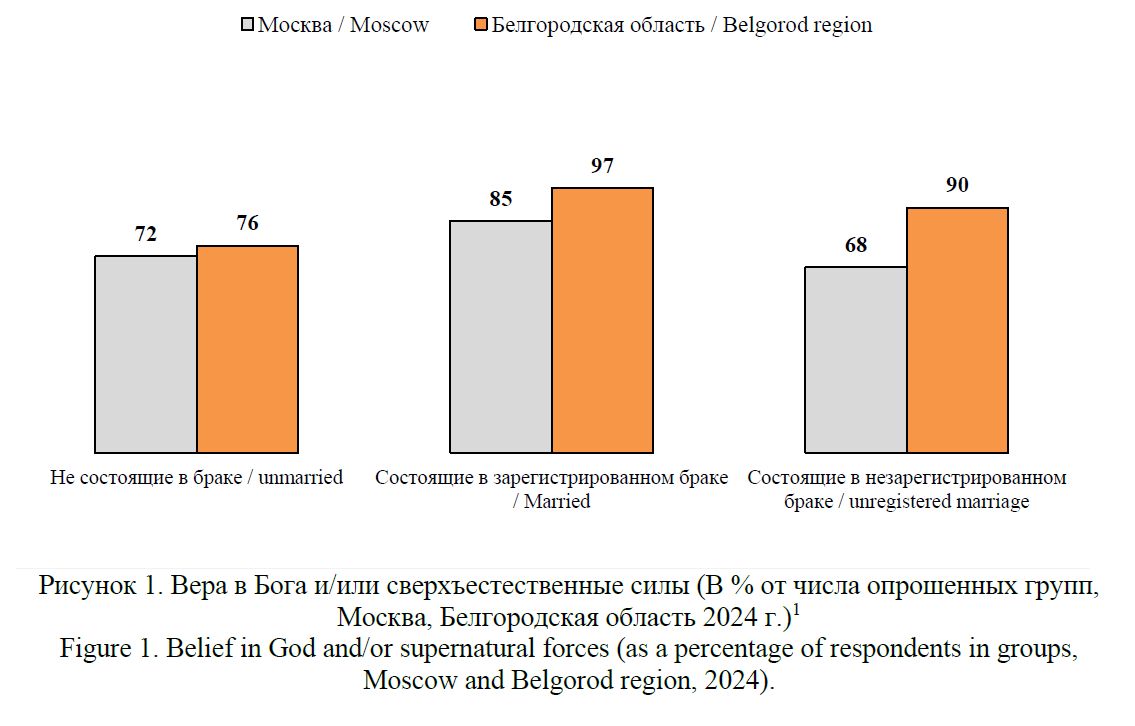
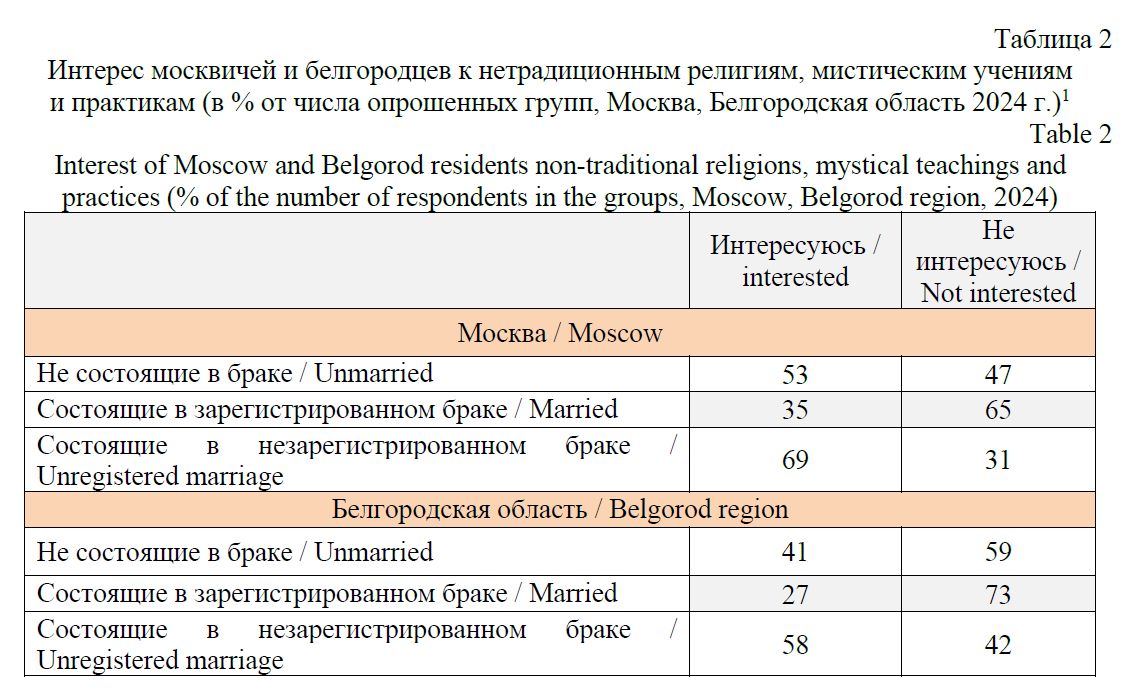
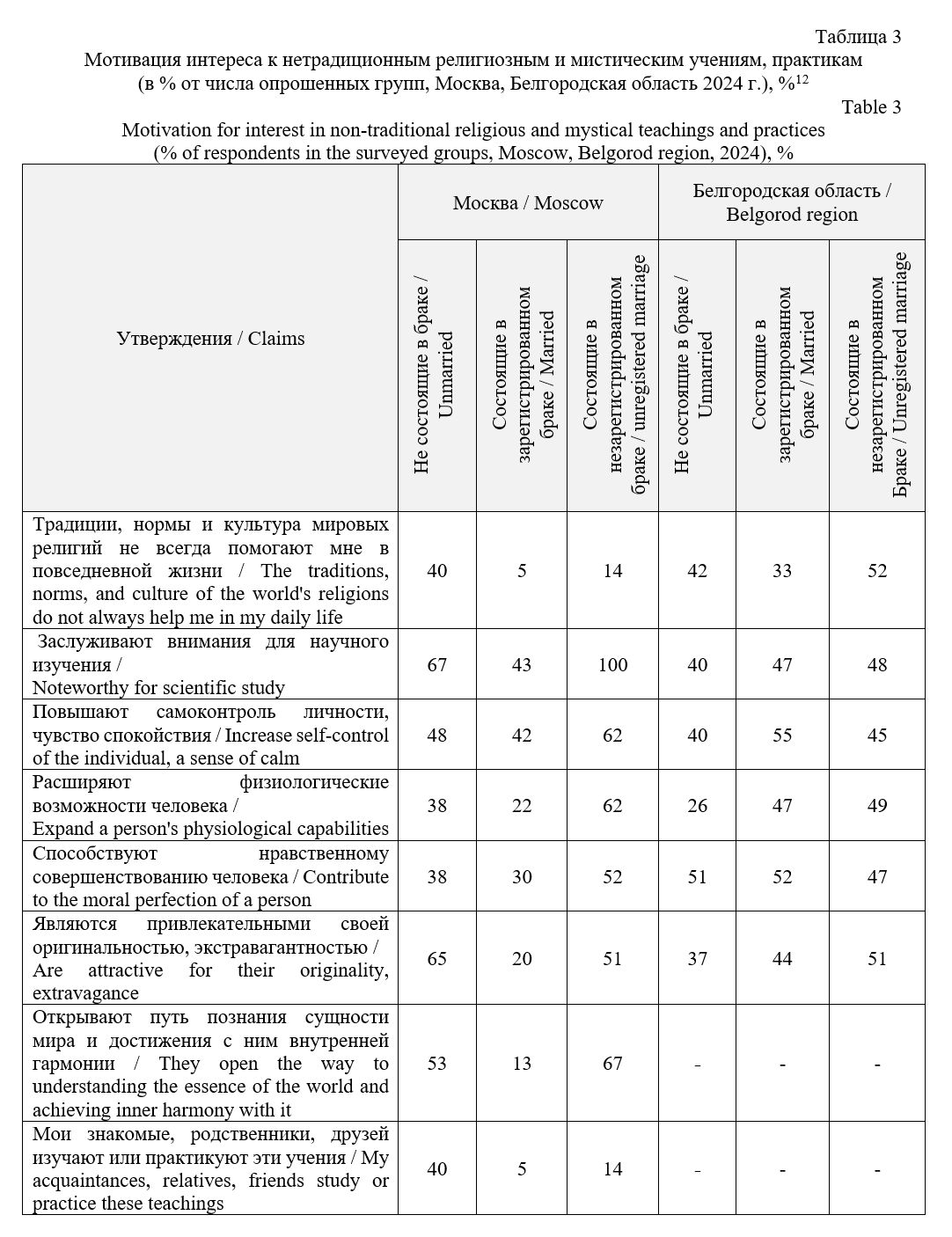
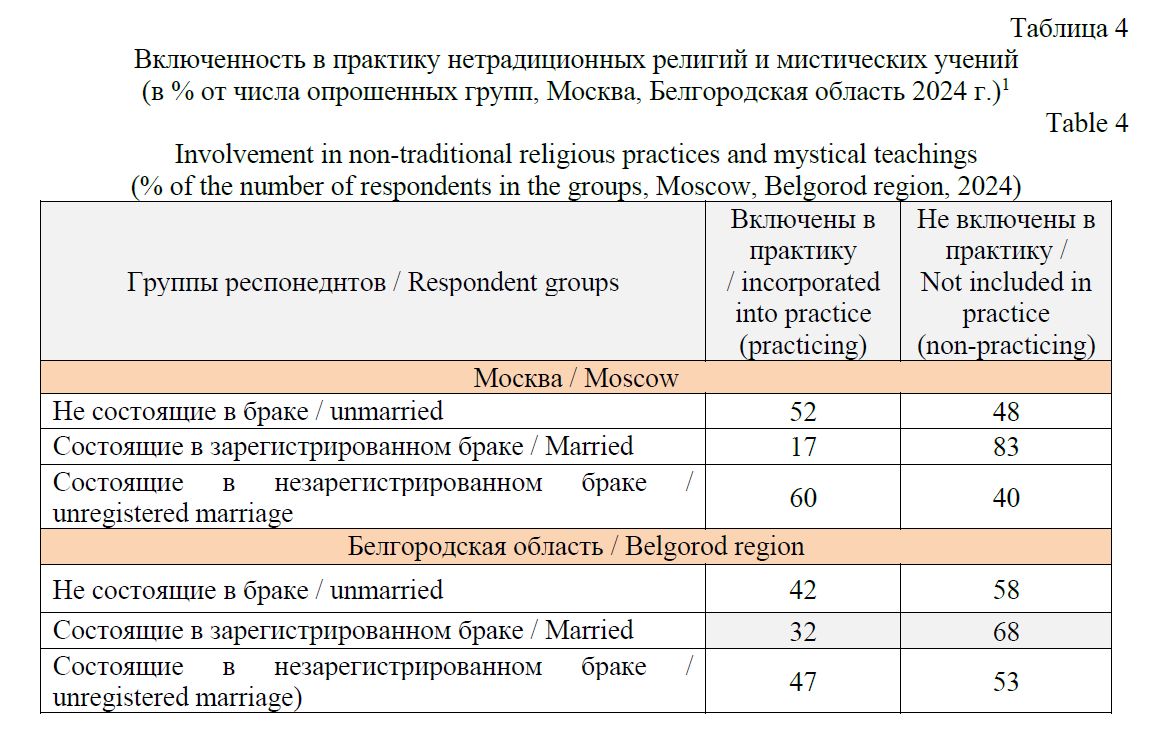
The article examines the relationship between the marital status of the population and their non‑traditional religious views and practices, using Moscow and the Belgorod region as case studies. The relevance of this sociological research stems from the transformation of social institutions in the context of globalisation and the growing popularity of non‑traditional religious and mystical movements – including in traditionally Orthodox regions of Russia. Studying this relationship helps to better understand the processes of cultural and religious transformation in society. The aim of this work is to study the characteristics of non‑traditional religiosity among populations with different marital statuses (the groups are: “not married”, “in a registered marriage”, and “in an unregistered marriage”) in two regions: the multi‑confessional metropolis of Moscow and the Belgorod region, where Orthodoxy dominates. The methodology is based on a comprehensive approach to operationalising the concept of “non‑traditional religiosity” through two components: the religious consciousness and cultic behaviour of respondents. In 2024, a questionnaire survey was conducted at the Institute of Social Demography of the Federal Research Sociological Center of the Russian Academy of Sciences (ISD FNSC RAS) among the population (N=500 in Moscow, N=501 in the Belgorod region). The “in a registered marriage” group demonstrates the highest level of belief in God (85-97%) coupled with minimal interest in alternative beliefs (27-35 %), which confirms the role of institutional marriage as a guardian of traditional attitudes. Respondents in the “in an unregistered marriage” group show the greatest interest in non‑traditional religions: 69% in Moscow and 58% in the Belgorod region. In Moscow, the involvement of this group in non‑traditional cultic activities reaches 60%, which is 3.5 times higher than among those in an official marriage (17%). Although the motivation to turn to non‑traditional religions and mystical teachings varies by region, no correlation with marital status is observed. Empirical results of the sociological research show that marital status influences religious consciousness and cultic practice among non‑traditional believers: most respondents who are in an official marriage uphold traditional values, while those who prefer alternative forms of family relationships are more open to accepting non‑traditional religious and mystical teachings.
Figures
Lyutenko, I. V. (2026), “Non-traditional religious views among Moscow and Belgorod residents of different marital statuses”, Research Result. Sociology and Management, 12 (3), 47-64. DOI: 10.18413/2408-9338-2026-12-3-0-4.















While nobody left any comments to this publication.
You can be first.
Balagushkin, E. G. (1999), Netradiеыionnye religii v sovremennoy Rossii: morfologichesky analiz [Non‑traditional religions in modern Russia: A Morphological Analysis], Russian Academy of Sciences, Institute of Philosophy, Institute of Philosophy, Russian Academy of Sciences, Moscow, Russia. (In Russian)
Golod, S. I. (1998), Semya i brak: istoriko‑sotsiologichesky analiz [Family and Marriage: A Historical and Sociological Analysis], Petropolis, St. Petersburg, Russia, ISBN: 5-86708-113-3, EDN: YQXVEN. (In Russian)
Giddens, A. (2004), Transformatsiya intimnosti: Seksualnost, lyubov i erotizm v sovrem. o‑vakh [The transformation of intimacy: sexuality, love and eroticism in modern societies], translated by V. Angurin, Piter, St. Petersburg, Russia, ISBN: 5-469-00133-4. (In Russian)
Durkheim, E. (2018), Elementarnye formy religioznoy zhizni: totemicheskaya sistema v Avstralii [Elementary Forms of Religious Life: The Totemic System in Australia], translated from French by A. Apollonov and T. Kotelnikova], Delo Publishing House: RANEPA, Moscow, Russia, DOI: 10.17323/1728-192X-2018-2-122-154, EDN: XYZJOP. (In Russian)
Zagirova, E. M. (2017), “The Influence of the Type of Religiosity on the Attitude to the Traditional Family”, Zhurnal sotsiologii i sotsialnoy antropologii, 20(2), 82-103, EDN: ZSRATF. (In Russian)
Zimova, N. S., Nerobeeva, T. S. (2025), “The Influence of Religiosity on Marriage and Family Attitudes of Modern Youth”, Research Result. Sociology and Management, 11(1), 91-109, DOI: 10.18413/2408-9338-2025-11-1-0-6. EDN: TPNOFC. (In Russian)
Kalachikova, O., Kozlova, O., Arkhangelsky, V. (2022), “The religious determinant of reproductive intentions of Russians”, Gosudarstvo, religiya, Tserkov v Rossii i za rubezhom, 40(4), 105-138, DOI: 10.22394/2073-7203-2022-40-4-105-138. EDN: KBEZCZ. (In Russian)
Kublitskaya, E. A. (1990), “Traditional and non‑traditional religiosity: an experience of sociological study”, Sociological Research, (5), 95-103, EDN: BGWJUG. (In Russian)
Kublitskaya, E. A., Lebedev, S. D. (2022), “On the analysis of the religious situation in the Belgorod region”, Mir nauki. Sotsiologiya, filologiya, kulturologiya, 13(3), DOI: 10.15862/46SCSK322, EDN: VRBQAI. (In Russian)
Lebedev, S. D. (2025), “Religious and worldview strategies of Russian youth”, Science. Culture. Society, 31(3), 26-40, DOI: 10.19181/nko.2025.31.3.2. EDN: CRMDWE. (In Russian)
Lyutenko, I. V. (2025), “Non‑traditional religious views of Belgorod students”, Research Result. Sociology and Management, 11(3), 44-60, DOI: 10.18413/2408-9338-2025-11-3-0-3, EDN: HVVULV. (In Russian)
Martinovich, V. A. (2015), Netraditsionnaya religioznost: vozniknovenie imigratsya: Materialy k izuchenyu netraditsionnoy religioznosti [Non-traditional religiosity: emergence and migration: Materials for studying unconventional religiosity], 1, Minsk Theological Academy, Minsk, Belarus, ISBN: 978-985-7028-11-5. (In Russian)
Martinovich, V. A. (2024), Sotsialnaya identifikatsiya novykh religioznykh dvizheny v Respublike Belarus [Social identification of new religious movements in the republic of Belarus], RIVSh, Minsk, Belarus, ISBN: 978-985-586-794-5. (In Russian)
Mitrokhin, L. M. (1985), Religii «novogo veka» [Religions of the ‘New Age’], Sovetskaya Rossiya, Moscow, USSR. (In Russian)
Prutskova, E. V., Pavlyutkin, I. V., Borisova, O. N. (2023) “Religiosity and Fertility in Russia and Other European Countries: The Effect of Social Context”, Monitoring of Public Opinion: Economic and Social Changes, (2), 103-126, DOI: 10.14515/monitoring.2023.2.2359. (In Russian)
Amato, P., Booth, A., Johnson, D., Rogers, S. (2007), Alone Together: How Marriage in America Is Changing, MA: Harvard University Press, Cambridge.
Barker, A. (1997), New religious movements, Russian Christian Humanitarian Institute, St. Petersburg, Russia.
Campbell, C. (1972), “The cult, the cultic milieu and secularization”, A Sociological Yearbook of Religion in Britain, (5), 119-136.
Campbell, C. (2010), “The Easternisation of the West: Or, How the West Was Lost”, Asian Journal of Social Science, 38(5), 738-757.
Coontz, S. (1992). The Way We Never Were: American Families and the Nostalgia Trap, New York.
Davie, G. (1994), Religion in Britain since 1945: believing without belonging, Blackwell, Oxford.
Giddens, A. (1991), Modernity and self‑identity: self and society in the late modern age, stanford, Stanford University Press, Calif.
Heelas, P. (1996), The New Age movement: religion, culture and society in the age of postmodernity, Wiley‑Blackwell.
Inglehart, R. (1997), Modernization and postmodernization: cultural, economic, and political change in 43 societies, NJ: Princeton University Press, Princeton.
Inglehart, R., Welzel, C. (2005), Modernization, cultural change, and democracy: the human development sequence, Great Britain: Cambridge University Press, Cambridge.
Luckmann, T. (1967), The invisible religion: the problem of religion in modern society, Macmillan, New York.
Schewel, S. (2019), “Understanding immobility: moving beyond the mobility bias in migration studies”, International Migration Review, 54(2), 328-355.
Stark, R., Bainbridge, W. S. (1987), A Theory of кeligion, Peter Lang, New York.
Wallis, R. (1984), The Elementary forms of the new religious life, Routledge & Kegan Paul, London.
Wilson B. R. (1976), Contemporary Transformations of Religion, Macmillan, London.
Whitehouse, H. (2004), Modes of religiosity: a cognitive theory of religious transmission, Bloomsbury Academic.
Wilson B. R. (1976), Contemporary Transformations of Religion, Macmillan, London.