

Fertility and poverty rates in the regions of the Siberian Federal District
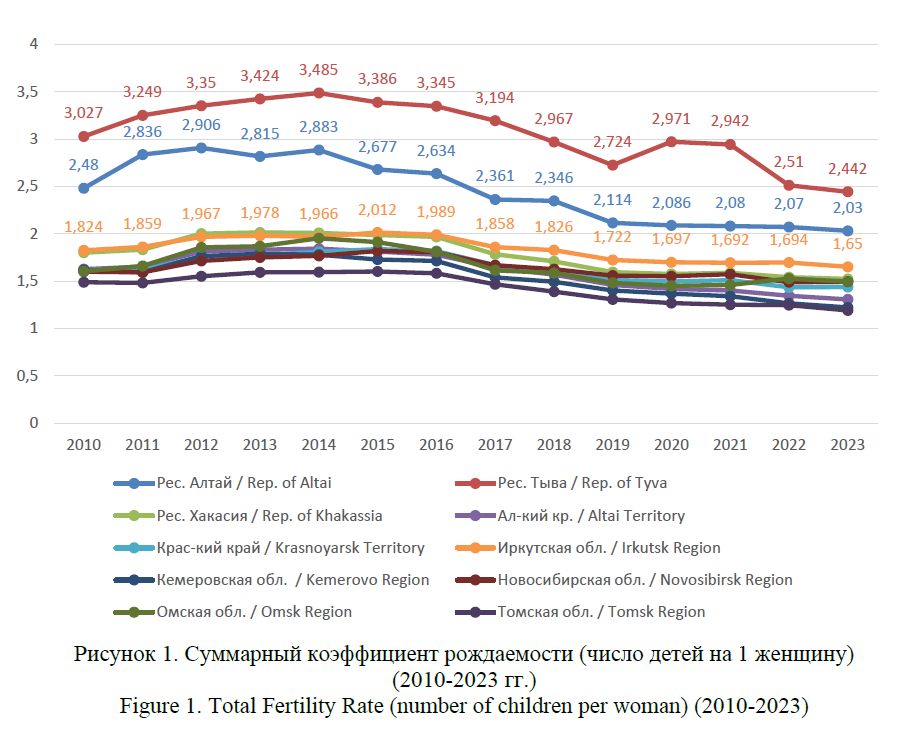
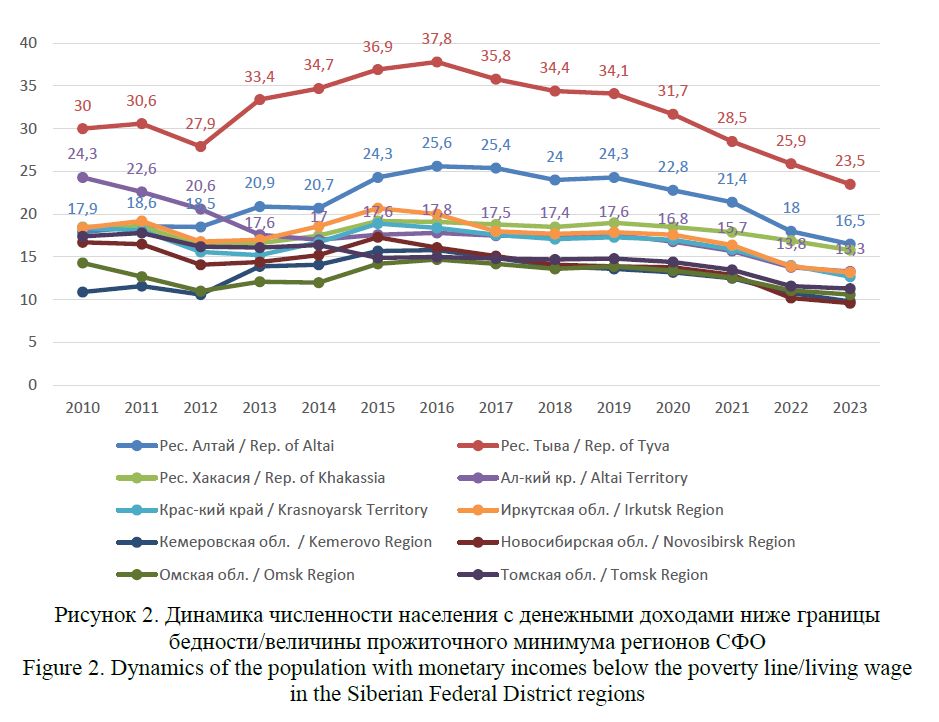
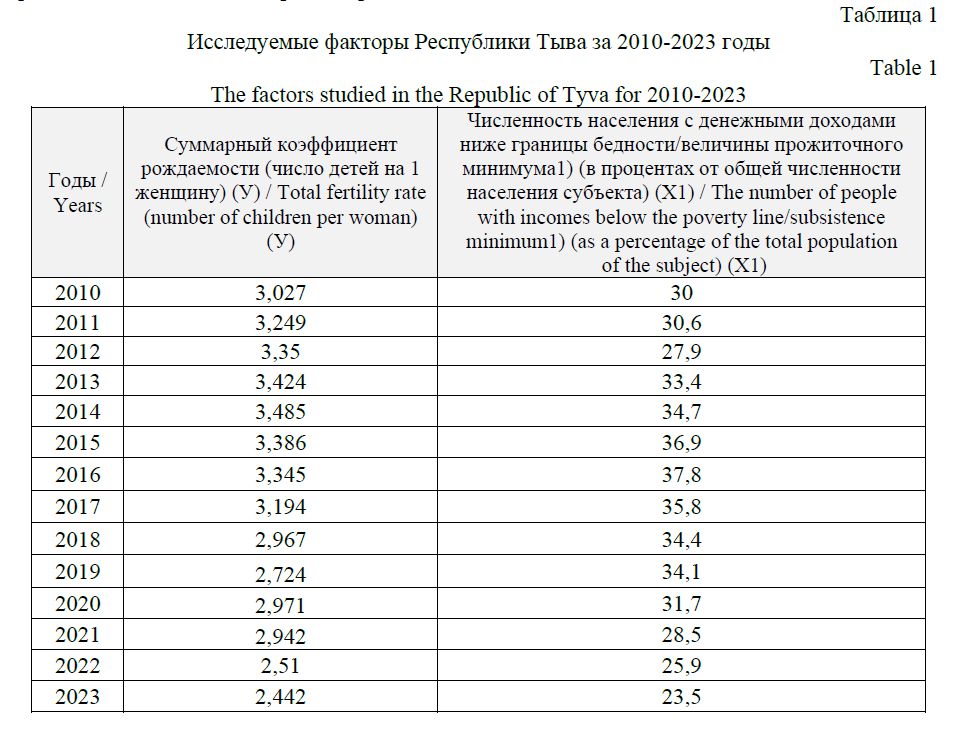
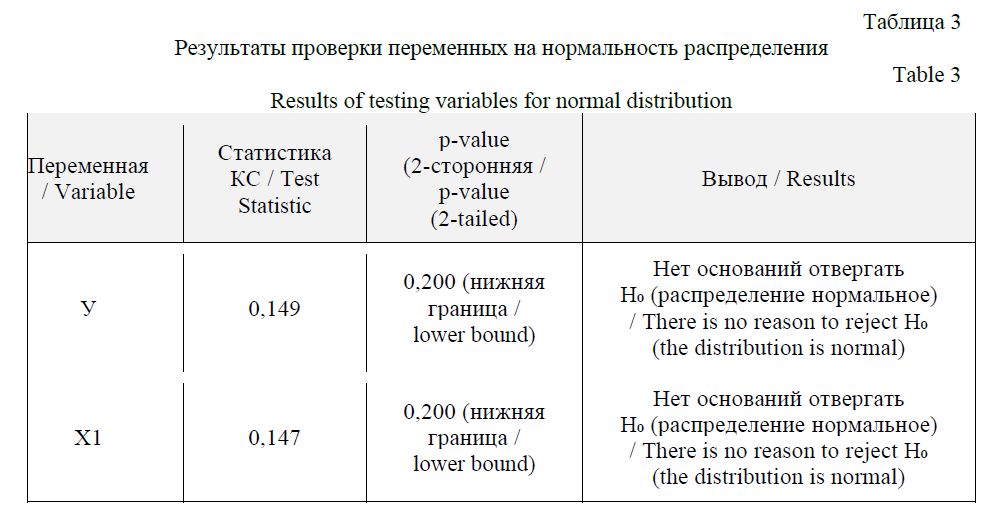
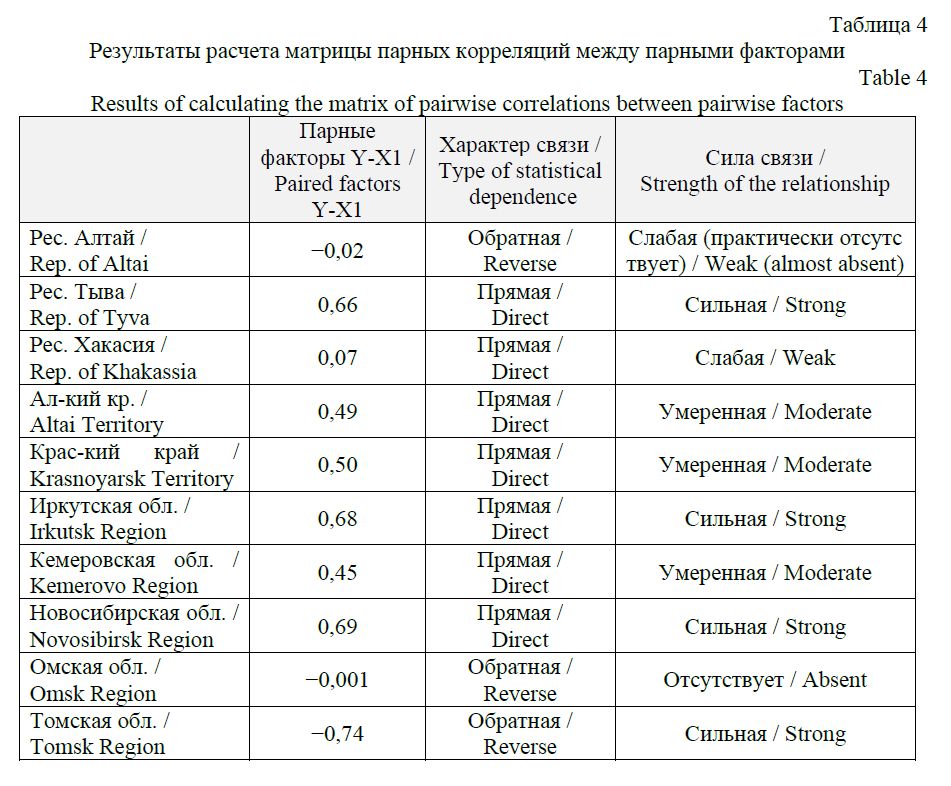
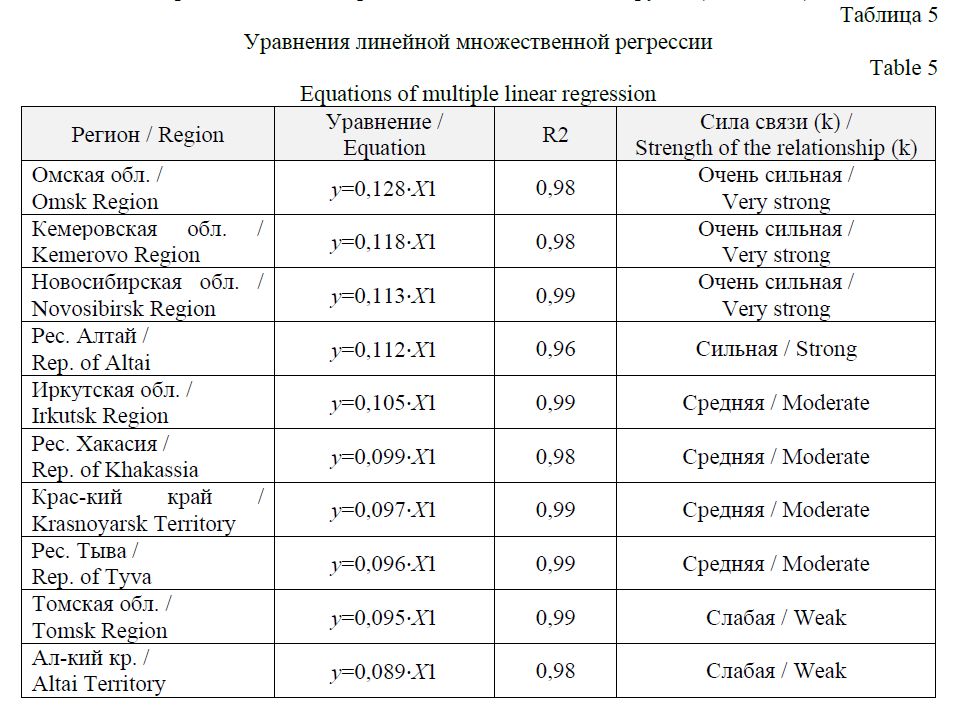
The article is devoted to the analysis of the relationship between the birth rate and the poverty rate of the population in the regions of the Siberian Federal District (SFD), with an emphasis on the Republic of Tuva. The purpose of the study was to identify statistical links between the birth rate and the proportion of residents living below the poverty line. The object of the study was the demographic situation in the regions of the Siberian Federal District (hereinafter referred to as the Siberian Federal District), the subject was the ratio of demographic and socio-economic indicators. The empirical database is based on Rosstat data for 2010-2023. In the theoretical part, the main concepts explaining the influence of economic factors on fertility are considered: from the theory of deprivation to regional studies that take into account ethnocultural specifics. The contradictory conclusions in the modern scientific literature are shown, especially on the role of income and poverty as factors of childbearing. Special attention is paid to the specifics of Tuva as a region with high fertility and poverty rates. The research methodology includes correlation and regression analysis for two variables: the total fertility rate (number of children per woman) and the population with monetary incomes below the poverty line/subsistence level. According to the results, a statistically significant positive relationship was found between the proportion of the poor population and fertility. Even in regions with average poverty rates, the link between fertility and poverty is stronger than in regions with a large proportion of the poor. The conclusions emphasize the need for regional adaptation of demographic measures and focus on the potential of poor households as a demographic resource. The work can be useful for improving social and demographic policy in socially heterogeneous regions of Russia.
Figures
Rostovskaya, T. K., Oydup, T. M., Rostovsky, R. V. (2026), “Fertility and poverty rates in the regions of the Siberian Federal District”, Research Result. Sociology and Management, 12 (1), 127-142. DOI: 10.18413/2408-9338-2026-12-1-0-7.
















While nobody left any comments to this publication.
You can be first.
Zyryanova, M. A. and Popova, L. A. (2018), “Factor analysis of fertility processes in the northern regions of Russia”, Sever i rynok: formirovanie ekon. poryadka, (3), 111-121, DOI: 10.25702/KSC.2220-802X.3.2018.59.111-121. (In Russian)
Kozlova, O. A., Makarova, N. M. and Arkhangelsky, V. N. (2024), “A methodological approach to assessing the factor impact on fertility in Russia”, Uroven zhizni naseleniya regionov Rossii, 20 (1), 76-9, DOI: 10.52180/1999-9836_2024_20_1_7_76_90, EDN HUISTQ. (In Russian)
Koreva, O. V. and Boitsova, T. E. (2013), “Analysis and assessment of the influence of individual factors on the current demographic situation in the Russian Federation” , Vestnik evraziyskoj nauki, (6), 47-59, EDN: SAKQDH. (In Russian)
Kumo, K. (2023), “Does the probability of having a child depend on the level of well-being and its subjective perception in Russian households: in search of answers to age-old questions”, Demograficheskoe obozrenie, (10), 44-78, DOI: 10.17323/demreview.v10i1.17260. (In Russian)
Makarentseva, A. O. and Biryukova, S. S. (2023), “Factors, sustainability and realization of reproductive intentions in Russia”, Monitoring of public opinion: economic and social changes, (2), 31-56. DOI: 10.14515/monitoring.2023.2.2379. (In Russian)
Makarova, N. V. and Trofimets, V. Ya. (2006), Statistika v Excel [Statistics in Excel], Finance and Statistics, Moscow, Russia, ISBN: 978-5-279-02282-3, EDN: QOORJJ. (In Russian)
Natsak, O. D. (2024), “Problems of poverty of single-parent families in Tuva”, Novye issledovaniya Tuvy, (4), 204-220, DOI: 10.25178/nit.2024.4.14. (In Russian)
Rodina, O. A. (2023), “Regional variation in fertility and its relation to the socio-economic situation of Russian regions”, Demograficheskoe obozrenie, (10), 63-103, DOI: 10.17323/demreview.v10i2.17766. (In Russian)
Rostovskaya, T. K., Zolotareva, O. A. and Davletshina, L. A. (2023), “Peculiarities of fertility in the Republic of Tuva (1991-2021”, Novye issledovaniya Tuvy, (2), 34-49, DOI: 10.25178/nit.2023.2.3. (In Russian)
Roshchina, Ya. M. and Boikov, A. V. (2005) Faktory fertilnosti v sovremennoy Rossii [Fertility factors in modern Russia], EERC, Moscow, Russia, available at: https://reallib.org/reader?file=525281&pg=1 (Accessed: 14 May 2025). (In Russian)
Roshchina, Ya. M. and Cherkasova, A. G. (2009), “Differentiation of fertility factors for various socio-economic categories of Russian women”, SPERO, (10), 159-181. (In Russian)
Rybakovsky, O. L. (2025), “Economic factors in the demography of Russian regions (2017-2023)”, Narodonaselenie, 28 (1), 4-16, DOI: 10.24412/1561-7785-2025-1-4-16, EDN: RASPFZ. (In Russian)
Trynov, A.V., Kostina, S. N. and Bannykh, G. A. (2020), “A study of the socio-economic determination of fertility based on the analysis of regional panel data”, Ekonomika regiona, 16 (3), 807-819, DOI: 10.17059/ekon.reg.2020-3-10. (In Russian)
Durbin-Watson statistic (2024), Wikipedia, available at: https://en.wikipedia.org/wiki/Durbin–Watson_statistic (Accessed 05 June 2025).
Easterlin, R. A. (1976), “The conflict between aspirations and resources”, Population and development review, (2), 417-425.
Grogan, L. (2006), “An Economic Examination of the Post-Transition Fertility Decline in Russia”, Post-Communist Economies, (18), 363-397.
Iwasaki, I., Kumo, K. (2020), “Determinants of regional fertility in Russia: a dynamic panel data analysis”, Post-Communist Economies, (32), 176-214, DOI: 10.1080/14631377.2019.1678333.
Karabchuk, T. (2017), “Factors Affecting the Birth of Second and Third Children”, Demography of Russia: From the Past to the Present, Palgrave Macmillan, United Kingdom, 187-218, DOI: 10.1057/978-1-137-51850-7; 10.1057/978-1-137-51850-7_6.
Kohler, H. P., Billari, F. C., Ortega, J. A. (2002), “The emergence of lowest-low fertility in Europe during the 1990s”, Population and development review, (28), 641-681.
Kohler, H. P., Kohler, I. (2002a), “Fertility Decline in Russia in the Early and Mid 1990s: The Role of Economic Uncertainty and Labour Market Crises”, European Journal of Population, (18(3)), 233-262.
Kohler, H.-P., Rodgers, J.L., Christensen, K. (2002b), “Between nurture and nature: the shifting determinants of female fertility in Danish twin cohorts 1870-1968”, Social biology, (49), 218-248.
Kumo, K. (2012), “Determinants of Childbirth in Russia: A Micro-Data Approach”, Hitotsubashi Journal of Economics, (53), 49-70.
Neels, K. (2010), “Temporal variation in unemployment rates and their association with tempo and quantum of fertility: some evidence for Belgium, France and the Netherlands, Paper presented at the Annual meeting of the Population association of America, Dallas, 17 April”, Demographic research, available at: https://www.demographic-research.org/articles/volume/31/23/references (Accessed: 05 May 2025).
Oppenheimer, V. K. (1988), “A theory of marriage timing”, American journal of sociology, (94), 563-591.
Oppenheimer, V. K. (2003), “Cohabiting and marriage during young men’s career-development process”, Demography, (40), 127-149.
Oppenheimer, V. K., Kalmijn, M., Lim, N. (1997), “Men’s career development and marriage timing during a period of rising inequality”, Demography, (3), 311-330.
Puig-Barrachina, V., Rodríguez-Sanz, M., Domínguez-Berjón, M. F., Martín, U., Luque, M. A., Ruiz, M., Perez, G. (2020), “Decline in fertility induced by economic recession in Spain”, Gaceta Sanitaria, (34), 238-244, DOI: 10.1016/j.gaceta.2019.05.011.
Sobotka, T., Skirbekk, V., Philipov, D. (2011), “Economic recession and fertility in the developed world”, Population and development review, (2), 267-306.