

Migration strategies of youth: factors of migration of different professional groups
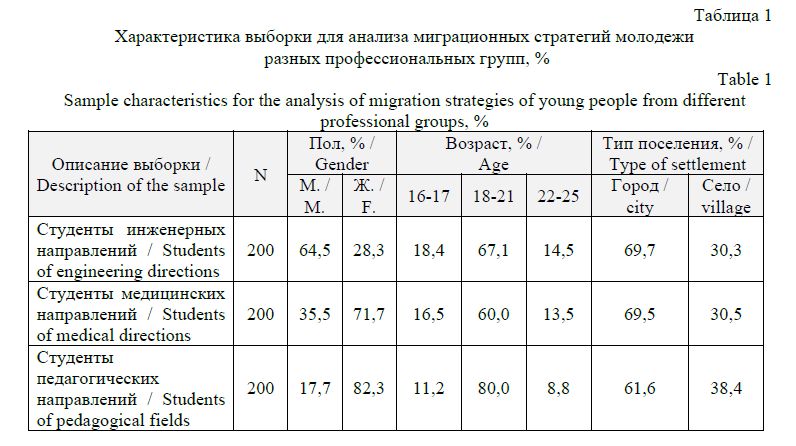
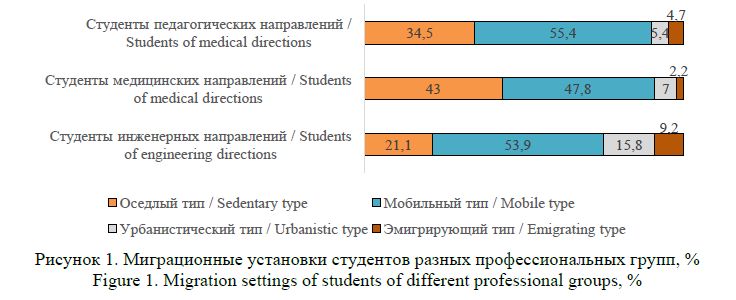
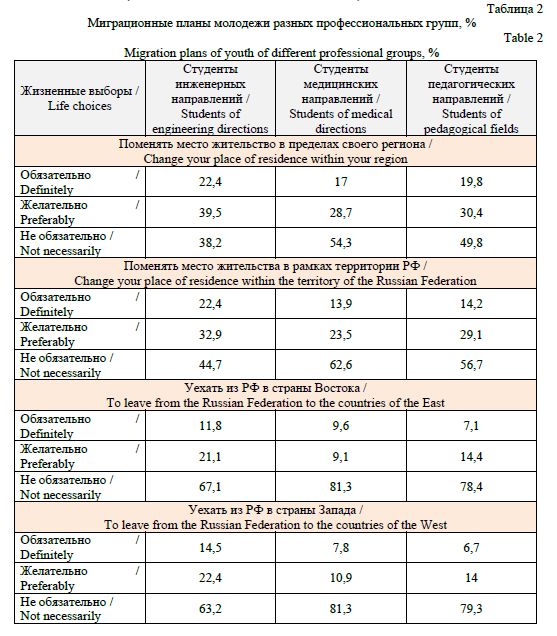
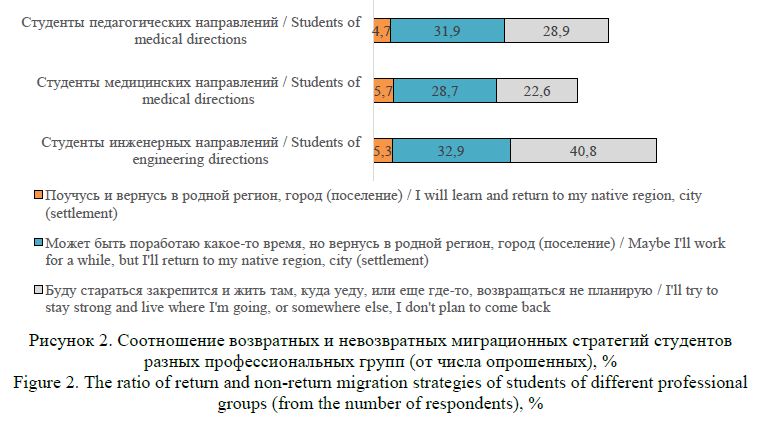
Under the conditions of intensifying spatial polarization and the compression of habitable space across Northern Eurasia, the migration attitudes of student youth acquire the character of a system-forming factor that determines not only individual life trajectories but also the macro-regional dynamics of human capital. Methods: the empirical basis of the study comprised data from a regional monitoring of migration strategies among student youth in the Belgorod region, conducted in 2025 (sample N=1269 respondents, quota-sampled by year of study and area of residence). Three professional cohorts characterized by the greatest personnel significance for regional economies were placed in the analytical focus (engineering, medical, and pedagogical). Research results: a stable intergroup differentiation of migration potential was empirically verified: the engineering cohort demonstrates maximum mobility (aggregate migration potential of 78.9%), whereas the medical group is characterized by pronounced local attachment (57%), and the pedagogical group occupies an intermediate position (65.4%). It was established that the structure of factors influencing migration decisions is invariant with respect to the field of study: economic determinants play a dominant role, while institutional-status and existential factors act as moderators. The phenomenon of multi-vector engineering migration strategies was identified, oriented simultaneously toward domestic Russian centers and international markets (both Eastern and Western), which contrasts with the unidirectional local conservatism of the medical and pedagogical groups, conditioned by high institutional barriers (nostrification, licensing, language certification). An extremely low level of return migration readiness was recorded across all professional groups, with the highest refusal to return to the territory of residence observed among engineers. Conclusions: the migration potential of student youth is structurally mediated not so much by macroeconomic conditions as by the internal logic of professional fields: the higher the degree of institutional standardization of a profession and the stricter the entry barriers in external labor markets, the lower the spatial mobility, and vice versa. The obtained data indicate the need for a shift in regional personnel policy from image-building campaigns to targeted economic incentive instruments (increasing wages, housing programs, contractual retention mechanisms), as well as to the formation of a comfortable urban environment and infrastructural accessibility as mandatory conditions for the implementation of economic incentives. Otherwise, the growing centripetal migration of engineering and technical personnel will deepen interregional disparities and perpetuate personnel shortages in peripheral territories, which objectively leads to further compression of the habitable space of Northern Eurasia.
Figures
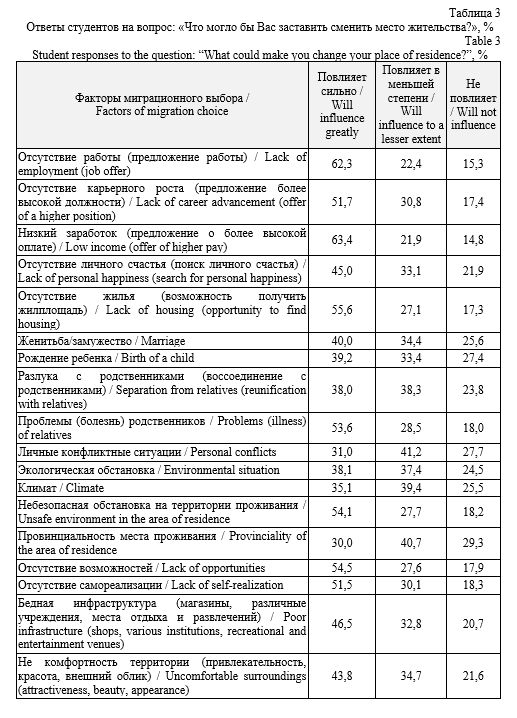
Shapovalov, D. A. (2026), “Migration strategies of youth: factors of migration of different professional groups”, Research Result. Sociology and Management, 12 (4), 130-145. DOI: 10.18413/2408-9338-2026-12-4-0-9.
















While nobody left any comments to this publication.
You can be first.
Airapetyan, E. M., Pokrovskaya, N. N., Chernykh, A. B. (2020), “Sociological Analysis of Labor and Intellectual Migration of Young People in the Context of the Knowledge Economy”, Sotsiologiya i pravo, (2), 27-37, DOI: 10.35854/2219-6242-2020-2-27-37, EDN: NSVYII. (In Russian)
Ataeva, A. G., Ulyaeva, A. G. (2018), “Interregional Youth Migration as a Threat of Loss of a Territory's Human Capital (Based on Materials from the Republic of Bashkortostan and Regions of the Volga Federal District)”, Vestnik Tomskogo gosudarstvennogo universiteta. Ekonomika, (44), 38-57, DOI: 10.17223/19988648/44/2, EDN: YUNJOP. (In Russian)
Badmaeva, N. V. (2021), “Educational Migration of Rural Youth in the Republic of Kalmykia, Byulleten Kalmytskogo nauchnogo tsentra RAN, (1), 135-145, DOI: 10.22162/2587-6503-2021-1-17-135-145, EDN: JHQKOX. (In Russian)
Balabanova, E. S., Lazenkova, A. P. (2026), “External Migration of Russian IT Specialists: Motives, Practices, Consequences”, Mir Rossii. Sotsiologiya. Etnologiya, 35 (2), 68-94, DOI: 10.17323/1811-038X-2026-35-68-94, EDN: JPNAEQ. (In Russian)
Dozhdikov, A. V. (2024), “Interregional migration of youth in the Russian Federation, DEMIS. Demograficheskie issledovaniya, 4 (3), 119-137, DOI: 10.19181/demis.2024.4.3.8, EDN: ZPVQJZ. (In Russian)
Yesikova. V. O., Soloviev I. A., Zolnikova Yu. F. (2023), “Regional features of youth migration in Russia”, InterKarto. InterGIS, 29 (2), 88-105, DOI: 10.35595/2414-9179-2023-2-29-88-105, EDN:SDCEAW. (In Russian)
Kartseva, M. A., Mkrtchyan, N. V., Florinskaya, Yu. F. (2021), “Interregional Migration of Young People in Russia and Building Life Strategies”, Zhurnal Novoj ekonomicheskoy assotsiatsii, (4), 162-180, DOI: 10.31737/2221-2264-2021-52-4-7, EDN: OTYELE. (In Russian)
Odintsov, A. V., Shipitsyn, A. I., Marchenko, A. Yu. (2020), “Centripetal Migration of Young People from the Russian Provinces: Causes and Trends (using the Volgograd Region as an Example)”, Monitoring obshchestvennogo mneniya: ekonomicheskie i sotsialnye peremeny, (3), 335-354, DOI: 10.14515/monitoring.2020.3.788, EDN: UNPAVV. (In Russian)
Rostovskaya, T. K., Vasilyeva, E. N. (2023), “Challenges of Educational Migration of Young People in Tuva: A Demographic Aspect”, Novye issledovaniya Tuvy, (3), 207-219, DOI: 10.25178/nit.2023.3.13, EDN: OCKNNK. (In Russian)
Ryazantsev, S. V., Ryazantsev, N. S. (2024), “Migration of “Digital Nomads”: Global Trends and Countries' Positions”, Mirovaya ekonomika i mezhdunarodnye otnosheniya, 68 (2), 116-126, DOI: 10.20542/0131-2227-2024-68-2-116-126, EDN: HRMPVT. (In Russian)
Serkina, Ya. I., Myagkaya, A. S. (2018), “Youth Labor Migration as a Threat to Regional Security (Based on the Belgorod Region)”, Rossiya: tendentsii i perspektivy razvitiya, (13-2), 727-729, EDN: YPKIGD. (In Russian)
Ulmyasbaeva, A. O. (2020), “Modern Trends in Interregional Educational Migration of Russian Youth”, Teoriya i praktika obshchestvennogo razvitiya, (12), 33-37, DOI: 10.24158/tipor.2020.12.5, EDN: LCKRGA. (In Russian)
Fedorova, A. V., Khoroltseva E. B. (2020), “Interregional Youth Migration in the Context of the Saratov Region Development Strategy Implementation”, Vestnik Povolzhskogo instituta upravleniya, 20 (1), 73-82, DOI: 10.22394/1682-2358-2020-1-73-82, EDN: LRHOFQ. (In Russian)
Shapovalova, I. S., Bovkunova, A. V., Shapovalov, A. A. (2021), “The Problem of Regional Reproduction of Medical Personnel”, In the book: Natsionalnye sotsialno-ekonomicheskie sistemy v usloviyah perekhoda k novomu tekhnologicheskomu ukladu. Belgorod, 263-276, EDN: LCQRWS. (In Russian)
Shapovalova, I. S., Khashaeva, S. V., Chernysheva, E. A., Blagorozheva, Zh. O., Valieva, I. N. (2023), “Labor Strategies of Graduates of Medical Educational Institutions: Predicted Risks of the Medical Industry, Problems of Social Hygiene”, Problemy sotsialnoy gigieny, zdravookhraneniya i istorii meditsiny, 31 (S1), 774-783, DOI: 10.32687/0869-866X-2023-31-s1-774-783, EDN: BXRXBO. (In Russian)
Shapovalova, I. S. (2026), “Urban and Rural Youth: Analysis of Life Strategies”, Regionologiya, 34 (1), 181-209, DOI: 10.15507/2413-1407.134.034.202601.181-209, EDN: FXLLRF. (In Russian)
Shapovalova, I. S., Zavodyan, I. S. (2024), “Youth Social Selfie: Social Strategies of Regional Youth”, Regionologiya, 32 (4), 768-792, DOI: 10.15507/2413-1407.129.032.202404.768-792, EDN: ZBBIWU. (In Russian)
Shapovalova, I. S., Chernysheva, E. A., Zavodyan, I. S. (2026), “Life Strategies of Young Russian Women (Regional Aspect)”, Zhenshchina v rossiyskom obshchestve, (1), 116-136, DOI: 10.21064/WinRS.2026.1.8, EDN: AXZYNF. (In Russian)
The study was supported by the Russian Science Foundation grant № 26-78-00135, https://rscf.ru/project/26-78-00135/.