

Social security in the context of the transformation of the geopolitical space of Northern Eurasia:
heoretical and methodological approaches to sociological analysis
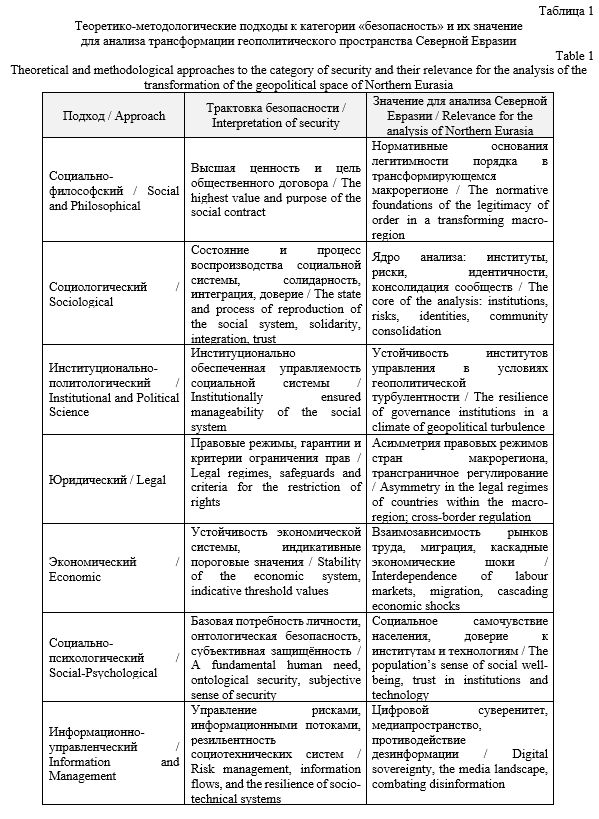
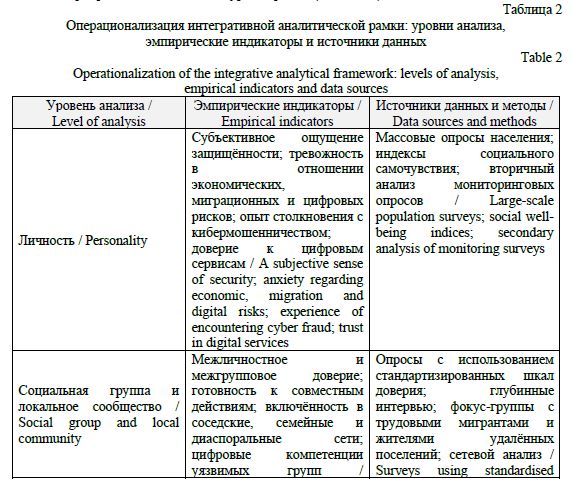
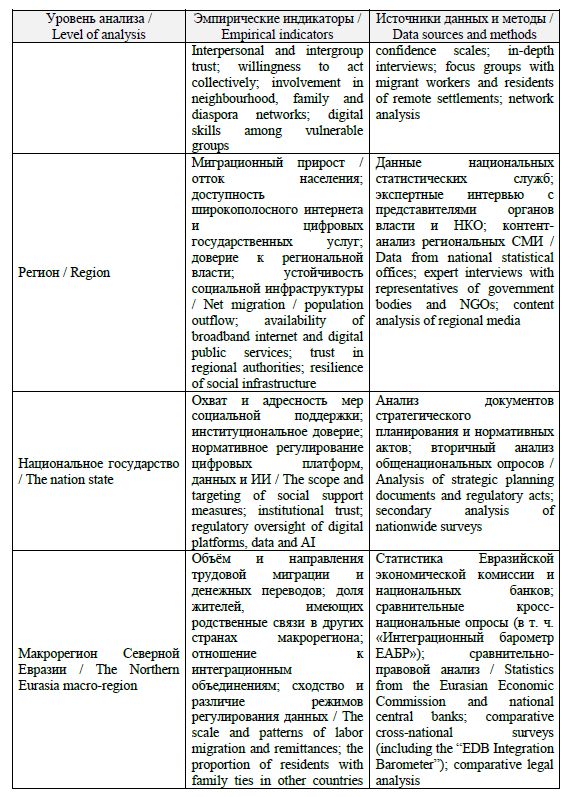
Relevance. The transformation of the geopolitical space of Northern Eurasia – the emergence of a polycentric world order, the reconfiguration of integration, economic and humanitarian ties, sanctions pressure, the intensification of migration flows and accelerated digitalization – is substantially changing the conditions for ensuring the social security of Russian society and of the neighbouring societies of the macro-region. Geopolitical shifts are no longer a subject of purely international political analysis: they penetrate people's everyday lives, transforming labour markets, migration strategies, identity structures, communication channels and the level of social trust. Scientific problem. The categorical apparatus of the theory of social security was formed predominantly within a nation-state analytical framework and insufficiently takes into account, first, the macro-regional (Eurasian) dimension of social risks and threats and, second, digitalization as a cross-cutting factor restructuring both the geopolitical space itself and the content of social security. Methods. The study employs theoretical analysis and synthesis, comparative analysis of scientific approaches, institutional and systems analysis; the study is interdisciplinary and relies on the principles of the sociology of management, the theory of regional security complexes, the sociology of space and the risk-society tradition. Research results. Seven complementary approaches to the category of security are systematized (socio-philosophical, sociological, institutional-political, legal, economic, socio-psychological and informational-managerial) and their analytical potential for studying macro-regional transformations is demonstrated; the evolution of the Russian tradition of social security from a protective paradigm to a paradigm of proactive risk management is traced; Northern Eurasia is substantiated as a regional complex of social security linked by common infrastructure, migration and communication interdependencies; an integrative multi-level analytical framework for the sociological analysis of the social security of the macro-region is proposed, together with a procedure for its sociological operationalization and a system of empirical indicators for each level of analysis. Conclusions. The sociological perspective makes it possible to translate the analysis of geopolitical transformations from the language of inter-state relations into the language of social institutions, risks, solidarity, trust and managerial practices; the proposed framework can serve as a theoretical and methodological basis for empirical research on social security in Northern Eurasia and for the development of social technologies for managing it under digitalization.
Figures
Bagdasaryan, D. A. (2026), “Social security in the context of the transformation of the geopolitical space of Northern Eurasia: theoretical and methodological approaches to sociological analysis”, Research Result. Sociology and Management, 12 (4), 67-82. DOI: 10.18413/2408-9338-2026-12-4-0-5.















While nobody left any comments to this publication.
You can be first.
Babintsev, V. P., Gaidukova, G. N. and Shapoval, Zh. A. (2023), “Consolidation of the regional community in glocal social reality: socio-cultural constraints”, Ekonomicheskie i sotsialnye peremeny: fakty, tendentsii, prognoz, 16 (1), 186-207, DOI: 10.15838/esc.2023.1.85.10. EDN: CWAPHE. (In Russian)
Weber, M. (2016), Khozyaistvo i obshchestvo: ocherki ponimayushchei sotsiologii [Economy and Society: An Outline of Interpretive Sociology], I, HSE Publishing House, Moscow, Russia. (In Russian)
Hobbes, T. (1991), “Leviathan, or the Matter, Forme and Power of a Common-Wealth Ecclesiasticall and Civil”, Sochineniya [Works], 2, Mysl, Moscow, Russia. (In Russian)
Gubanov, V. M., Smetankina, L. V., Byrylova, E. A. and Kudrin, A. A. (2024), Sotsialnaya bezopasnost v kontekste sovremennykh transformatsionnykh protsessov v Rossii [Social security in the context of contemporary transformation processes in Russia], Assotsiatsiya vuzov, St. Petersburg, Russia. (In Russian)
Durkheim, E. (1996), O razdelenii obshchestvennogo truda [The Division of Labour in Society], Kanon, Moscow, Russia. (In Russian)
Zakharov, N. L. (2002), Sotsialnye regulyatory deyatelnosti rossiiskogo gosudarstvennogo sluzhashchego [Social regulators of the activity of the Russian civil servant], RAGS Publishing House, Moscow, Russia. (In Russian)
Zakharov, N. L. (2024), Teoriya sotsialnykh regulyatorov [Theory of social regulators], in Perfilieva, M. B. (ed.), INFRA-M, Moscow, Russia, DOI: 10.12737/2119965, ISBN: 978-5-16-019447-9, EDN: PPJZER. (In Russian)
Kaira, Yu. V., Junjie, L. and Zhuravleva, A. S. (2025), “Social stability in the conditions of digitalization of the modern information society”, Research Result. Sociology and Management, 11 (1), 198-211, DOI: 10.18413/2408-9338-2025-11-1-1-3, EDN: ZIKQYS. (In Russian)
Kashnik, O. I. and Bryzgalina, A. A. (2013), “Social security: theoretical aspects”, Obrazovanie i nauka, 3 (102), 98-110, EDN: PWXHVL. (In Russian)
Kuznetsov, V. N. (2002), Sotsiologiya bezopasnosti: Formirovanie kultury bezopasnosti v transformiruyushchemsya obshchestve [Sociology of security: Formation of a culture of security in a transforming society], Respublika, Moscow, Russia. (In Russian)
Locke, J. (1988), “Two Treatises of Government”, Sochineniya [Works], 3, Mysl, Moscow, Russia. (In Russian)
Margulyan, Ya. A. (2012), Sotsialnaya politika po obespecheniyu bezopasnosti sovremennogo rossiiskogo obshchestva [Social policy for ensuring the security of contemporary Russian society], SPbGIEU, St. Petersburg, Russia. (In Russian)
Rousseau, J.-J. (1969), “On the Social Contract, or Principles of Political Right”, Traktaty [Treatises], Nauka, Moscow, Russia. (In Russian)
Filippov, A. F. (2008), Sotsiologiya prostranstva [Sociology of space], Vladimir Dal, St. Petersburg, Russia, ISBN: 978-5-93615-078-4, EDN: QOIBHX. (In Russian)
Shipunova, T. V. (2016), “Social security: thematization of the discussion field”, Zhurnal sotsiologii i sotsialnoi antropologii, 19 (2), 101-112, EDN: WHFWHL. (In Russian)
Yanovsky, R. G. (2003), Sotsialnaya bezopasnost Rossii v period stabilizatsii [Social security of Russia in the period of stabilization], Moscow, Russia. (In Russian)
Beck, U. (2005), Power in the Global Age: A New Global Political Economy, Polity Press, Cambridge, UK.
Beck, U. (1992), Risk Society: Towards a New Modernity, Sage, London, UK.
Buzan, B. (1991), People, States and Fear: An Agenda for International Security Studies in the Post-Cold War Era, 2nd ed., Lynne Rienner Publishers, Boulder, CO, USA.
Buzan, B. and Wæver, O. (2003), Regions and Powers: The Structure of International Security, Cambridge University Press, Cambridge, UK.
Buzan, B., Wæver, O. and de Wilde, J. (1998), Security: A New Framework for Analysis, Lynne Rienner Publishers, Boulder, CO, USA.
Giddens, A. (1991), Modernity and Self-Identity: Self and Society in the Late Modern Age, Polity Press, Cambridge, UK.
Hollnagel, E., Woods, D. D. and Leveson, N. (2006), Resilience Engineering: Concepts and Precepts, Ashgate, Aldershot, UK.
Lefebvre, H. (1991), The Production of Space, Blackwell, Oxford, UK.
Luhmann, N. (1993), Risk: A Sociological Theory, Walter de Gruyter, Berlin, Germany. Parsons, T. (1951), The Social System, Free Press, Glencoe, IL, USA.
UNDP (1994), Human Development Report 1994, Oxford University Press, New York, NY, USA.