

Value-motivational determinants of labor migration to Russia: a comparative country analysis
on the example of Armenia, Belarus and Tajikistan
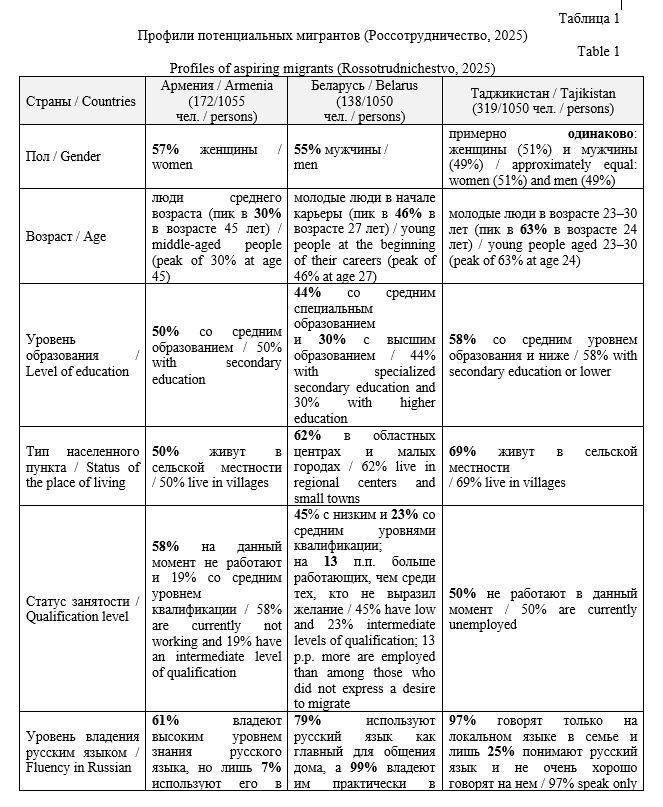
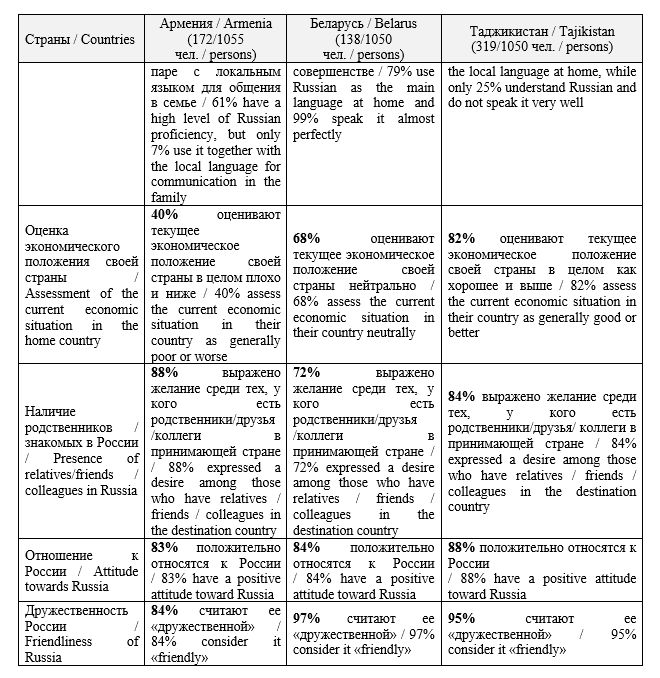
Modern demographic and economic changes, labor shortages, and shifts in international migration flows have reinforced the role of labor migration in the development of the Eurasian region. As the largest destination for migrants within the post-Soviet space, Russia has become a key example for understanding the factors that shape migration intentions among citizens from the Commonwealth of Independent States (CIS). Previous research has mainly focused on macro (economic) factors, but there has been less attention paid to value-based micro-foundations. This article provides a comparative analysis of labor migration drivers to Russia among residents from Armenia, Belarus, and Tajikistan, which represent three different models of migration within the Eurasian area. The empirical analysis is based on international survey data collected by Rossotrudnichestvo (2022 and 2025) and the Eurasian Development Bank (2012 and 2015). These datasets introduce nationally representative samples of the adult populations of Armenia, Belarus, and Tajikistan, allowing to examine both the current determinants of migration intentions and their evolution over more than a decade. The study carries out descriptive statistics, correlation analysis and binary logistic regression to assess the influence of socio-demographic characteristics, perceptions of Russia, social capital and other value-motivational factors on the likelihood of expressing an intention to migrate to Russia for work. Despite a shared integration framework, the findings show that migration intentions are shaped by different combinations of factors across the three studied countries. In Armenia, attitudinal drivers, for instance, perceptions of Russia as the destination country, are considered as the strongest determinants of migration intentions. In Belarus mobility intentions are primarily associated with the perceived opportunities offered by the Russian labor market. In Tajikistan community influences and household economic conditions interplay a more prominent role. At the same time, the presence of relatives, friends or other social contacts in Russia comes up as a common factor across all three countries, facilitating adaptation to the host society and reducing the perceived risks of migration. The comparative analysis also reveals a gradual diversification of preferred migration destinations, although Russia continues to be one of the principal centers of labor attraction in the Eurasian region. These findings contribute to a better understanding of migration dynamics in the Eurasian space and provide an empirical basis for migration policy and regional cooperation strategies that account for country-specific migration patterns.
Figures
Yurgelas, A. L. (2026), “Value-motivational determinants of labor migration to Russia: a comparative country analysis on the example of Armenia, Belarus and Tajikistan”, Research Result. Sociology and Management, 12 (4), 52-66. DOI: 10.18413/2408-9338-2026-12-4-0-4.















While nobody left any comments to this publication.
You can be first.
Adsera, A. and Pytlikova, M. (2012), “The role of language in shaping international migration”, IZA Discussion Paper, (6333), Institute for the Study of Labor (IZA), [Online], available at: https://www.iza.org/publications/dp/6333/the-role-of-language-in-shaping-international-migration (Accessed 01.07.2026).
Agadjanian, V. and Sevoyan, A. (2014), “Embedding or uprooting? The effects of international labour migration on rural households in Armenia”, International Migration, 52 (5), 29-46, DOI: 10.1111/imig.12058.
Al Ariss, A., Cascio, W. F. and Paauwe, J. (2014), “Strategic human resource management, migrations and international HR management in the 21st century”, Human Resource Management Review, 24 (1), 1-6.
Bellak, C., Leibrecht, M. and Liebensteiner, M. (2014), “Short-term labour migration from the Republic of Armenia to the Russian Federation”, Journal of Development Studies, 50 (3), 349-366, DOI: 10.1080/00220388.2013.858125, EDN: YEOTAN.
Cheskin, A. and Kachuyevsky, A. (2019), “The Russian-speaking populations in the post-Soviet space: Language, politics and identity”, Europe-Asia Studies, 71 (1), 1-23, DOI: 10.1080/09668136.2018.1529467, EDN: UTRATT.
Czaika, M. and de Haas, H. (2014), “The globalization of migration: Has the world become more migratory?”, International Migration Review, 48 (2), 283-323, DOI: 10.1111/imre.12095.
Foss, N. J. and Pedersen, T. (2019), “Microfoundations in international business research: The virtual issue”, Journal of International Business Studies, 50, 1594-1602, DOI: 10.1057/s41267-019-00270-4, EDN: OFHBGY.
Goss, J. and Lindquist, B. (1995), “Conceptualizing international labor migration: A structuration perspective”, International Migration Review, 29 (2), 317-351, DOI: 10.1177/019791839502900201, EDN: HIDYXT.
Lami, B., Tarasenko, I., Shyshova, O., Voropayeva, T. and Verhun, A. (2022), “International migration of human resources in the conditions of social transformations”, Economies, 10 (9), Art. 216, DOI: 10.3390/economies10090216, EDN: GECRRU.
Lanati, M. and Venturini, A. (2021), “Cultural change and the migration choice”, Review of World Economics, 157 (4), 799-852, DOI: 10.1007/s10290-021-00418-1, EDN: ASYLXR.
Massey, D. S., Arango, J., Hugo, G., Kouaouci, A., Pellegrino, A. and Taylor, J. E. (1993), “Theories of international migration: A review and appraisal”, Population and Development Review, 19 (3), 431-466, DOI: 10.2307/2938462.
Zakharov, V., Ivanova, A. and Suzdaleva, T. (2023), “Labor migration in modern Russia: Features, problems and ways to solve them”, Revista Amazonia Investiga, 12 (64), 19-30, DOI: 10.34069/AI/2023.64.04.19, EDN: HVMATT.