

Possibilities of combining regression models and simulation modeling in the study of emigration attitudes of Russian youth
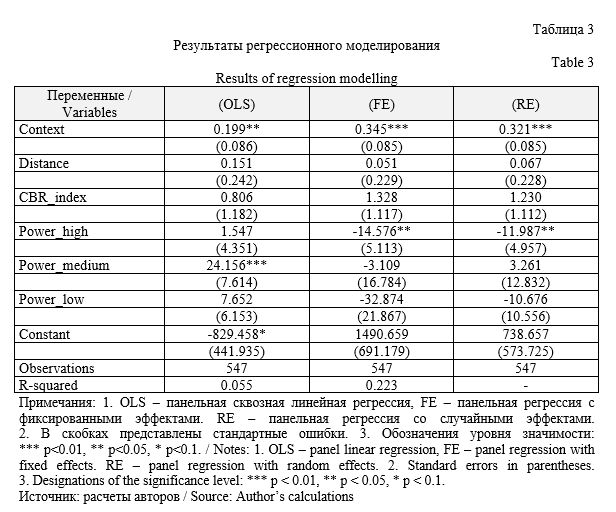
The study aimed to define the correlation between social, economic and political events in Russia and the scale of narratives about Russian youth emigration on social media. The authors explore the potential of combining social media analysis and surveys to understand the factors shaping emigration attitudes among Russian youth. Its scientific relevance stems from the need to advance methodological debates on integrating new and traditional approaches in socio-political research, as well as to address the negative societal effects of emigration-related media narratives circulating in the Russian segment of new media. The core scientific problem lies in the necessity of integrating diverse methodological tools to achieve a comprehensive analysis of youth emigration potential. Methods. The authors employ regression modeling based on the relevant social media panel data and multimodal simulation modeling of informal interview with Russian youth data. The regression analysis reveals a significant link
between the dynamics of emigration-related social media discourse, youth engagement in these flows, and socio-economic indicators in Russia. Meanwhile, simulation modeling uncovers the subjective meanings and motivations – both rational and irrational – that drive young people to consider relocating abroad. Conclusions. The combined use of these methods identifies the external factors that influence attitudes towards emigration and sheds light on the internal motivational structure of these attitudes. This offers new ways to mitigate the negative effects of digital emigration discourse. Based on these findings, the study suggests ways to reduce the negative impact of emigration narratives on Russian social media.
Figures

Mukhametov, D. R., Dombrovskaya, A. Yu., Ognev A. S. (2026), “Possibilities of combining regression models and simulation modeling in the study of emigration attitudes of Russian youth”, Research Result. SociologyandManagement, 12 (4), 32-51. DOI: 10.18413/2408-9338-2026-12-4-0-3.
















While nobody left any comments to this publication.
You can be first.
Akhiezer, A. S. (1999), “Emigration as an indicator of the state of Russian society”, Mir Rossii. Sotsiologiya. Etnologiya, (4), 163-174, EDN: RWMJJS. (In Russian)
Brodovskaya, E. V., Dombrovskaya. A. Yu., Karzubov, D. N., Sinyakov, A. V. (2017), “Development of methodology and approaches for the intelligent search for digital markers of political processes in social media”, Monitoring obshchestvennogo mnenia: Economicheskie i Sotsialnye Peremeny, (141), 79-104, DOI: 10.14515/monitoring.2017.5.06, EDN: YLYNYL. (In Russian)
Wallerstein, I. (2020), Mirovaya sistema: vvedenie [World-systems analysis: an introduction], LENAND, Moscow, Russia. (In Russian)
Gabdulkhakov, N. K., Orlova, V. V., Aleksandrova, Y. K. (2021), “Migration behavior of students at Russian universities based on digital trace data”, Vestnik Tomskogo Gosudarstvennogo Universiteta, (467), 106-114, DOI: 10.17223/15617793/467/14, EDN: IJYMZD. (In Russian)
Grebenyuk, A. A., Subbotin, A. A. (2021), “Studying migration processes in electronic Social networks”, Tsifrovaya Sotsiologiya, (2), 23-31, DOI: 10.26425/2658-347X-2021-4-2-23-31, EDN: FVKNMY. (In Russian)
Dombrovskaya, A. Y. (2025), “Mobilization of emigration attitudes among Russians in Social media: scale, dynamics, and structure of impact” Izvestiya Tulskogo Gosudarstvennogo Universiteta. Gumanitarnye Nauki, (2), 103-117, DOI: 10.24412/2071-6141-2025-2-103-117, EDN: SSWRBT. (In Russian)
Dombrovskaya, A. Yu., Brodovskaya, E. V. (2025), “Assessing the Relevance of Identifying Texts about Emigration Using Large Language Models for Social Media”, Vestnik Moskovskogo Universiteta. Seria 10: Zhurnalistika, 50 (5), 209-232, DOI: 10.55959/msu.vestnik.journ.5.2025.209232, EDN: FNANCP. (In Russian)
Dombrovskaya, A. Y., Kovalenko, D. S., Buslaeva, M. V. (2025), “Social media mobilization of emigration attitudes among Russian youth”, Vlast, (2), 167-173, DOI: 10.24412/2071-5358-2025-2-167-173, EDN: RBXJRI. (In Russian)
Dombrovskaya, A. Y., Ognev, A. S., Davydova, M. A., Kashchenko, T. L. (2022), “Technologies and techniques of value-based influence on Russian users in regional networks of Social discontent”, Vlast, (4), 37-42, DOI: 10.31171/vlast.v30i4.9120, EDN: GASLIM. (In Russian).
Maksimova, A. S., Grebenyuk, A. A., Aleshkovskiy, I. A. (2024),“Using big data from Social networks to analyze internal population migration”, Sotsiologiya: Metodologiya, Metody, Matematicheskoe Modelirovanie, (59), 31-55, DOI: 10.19181/4m.2024.33.2.2, EDN: HARLRA. (In Russian)
Maksimova, A. S., Chernov, P. A. (2025), “Emigration from Russia based on electronic Social network data: methodology development and qualitative analysis”, Teoriya i Praktika Obshchestvennogo Razvitiya, (1), 34-42, DOI: 10.24158/tipor.2025.1.3, EDN: XEGMRZ. (In Russian)
Ognev, A. S., Brodovskaya, E. V., Davydova, M. A. (2022), “Identifying triggers for the intensification of Social discontent networks in Russian regions”, Vlast, (5), 98-106, DOI: 10.31171/vlast.v30i5.9244, EDN: NLCEAS. (In Russian):
Semikalenova, A. I. (2019), “Digital traces: purpose and production of expert assessments”, Vestnik Universiteta imeni O.E. Kutafina, (5), 115-120, DOI: 10.17803/2311-5998.2019.57.5.115-120, EDN: UIYDWP. (In Russian)
Inglehart, R., Welcel, C. (2005), Modernization, cultural change, and democracy: the human development sequence, Cambridge University Press, New York.
Haas de, H. (2021), “A theory of migration: the aspirations-capabilities framework”, Comparative Migration Studies, 9 (1), 8-20.
Harre, R. (2009), The second cognitive revolution, Springer, London, DOI: 10.1007/978-1-4020-9992-2_11.
Massey, D. S., Arango, J., Hugo, G., Kouaouci, A., Pellegrino, A., Taylor, J. E. (1993), “Theories of International Migration: A Review and Appraisal”, Population and Development Review, (19), 431-466, DOI: 10.2307/2938462.
Massey, D. S. (1990), “Social structure, household strategies, and the cumulative causation of migration”, Population Index, 56 (1), 3-26, DOI: 10.2307/3644186.
Portes, S. (2008), Migration and Social Change: Some Conceptual Reflections, Princeton University, Princeton.
Potter, J., Wetherell, M. (1987), Discourse and Social Psychology: Beyond Attitudes and Behavior, Sage, London.
Stark, O. (1991), The migration of labor, Blackwell Publishers, Cambridge, MA.
Tjaden, J. (2021), “Measuring migration 2.0: a review of digital data sources”, Comparative Migration Studies, (9).
The article was prepared based on the results of research carried out using budgetary funds under the Financial University's state assignment.