

Value-motivational profile of the informally employed population in the context of the transformation of the socio-professional sphere in the regions of Northern Eurasia
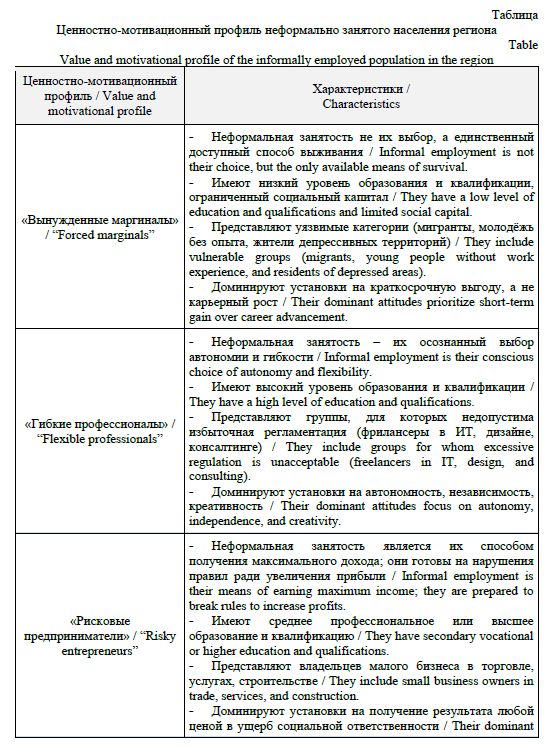
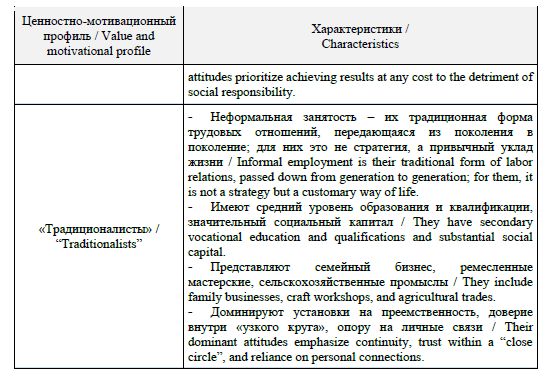
This article uses qualitative analysis to identify and categorise the values and motivations of people in informal employment in the context of socio-professional transformation in Northern Eurasian regions. A regional perspective study of informal employment profiles helps us identify local characteristics of its main forms and understand the logic behind behavioral practices of people in this social category. The following profiles are distinguished: “forced marginals” – informal employment is not their choice, but the only available means of survival, with a dominant focus on short-term gain rather than career advancement; “flexible professionals”– informal employment is their conscious choice of autonomy and flexibility, with a dominant focus on autonomy, independence, and creativity; “risky entrepreneurs” – informal employment is their way of maximizing income, with a dominant focus on achieving results at any cost to the detriment of social responsibility. “Traditionalists”– informal employment is their traditional form of labor relations, passed down from generation to generation. The dominant values are continuity, trust within a “close circle”, and reliance on personal connections. The identified profiles allowed us to differentiate the main areas of government regulation for representatives of each profile of the informally employed population, as well as to identify key areas for improving informal employment regulation policy, taking into account regional specifics.
Figures
Alekseenok, Ye. A. (2026), “Value-motivational profile of the informally employed population in the context of the transformation of the socio-professional sphere in the regions of Northern Eurasia”, Research Result. Sociology and Management, 12 (4), 6-19. DOI: 10.18413/2408-9338-2026-12-4-0-1.
















While nobody left any comments to this publication.
You can be first.
Alekseenok, A. A., Galtsova, A. N., Zhuravleva, A. S. and Alekseenok, E. A. (2025), “Behavioral practices of young representatives of the middle class in the labor market: a sociological analysis”, Trud i sotsialnye otnosheniya, 36 (2), 71-82, DOI: 10.20410/2073-7815-2025-36-2-71-82, EDN: DRPKXX. (In Russian)
Alekseenok, A. A. and Kaira, Yu. V. (2019), Fokus-gruppa: uchebno-metodicheskoe posobie [Focus group: a teaching guide], Central Russian Institute of Management – Branch of RANEPA, Orel, Russia, 180. (In Russian)
Baranova, S. V., Dolgova, S. A., Golikova, Yu. B. [et al.] (2021), Finansovo-ekonomicheskie aspekty strukturnoy transformatsii regionalnogo razvitiya [Financial and economic aspects of the structural transformation of regional development], Central Russian Institute of Management – Branch of RANEPA, Orel, Russia, 296, ISBN: 978-5-93179-699-4, EDN: ZLKHFQ. (In Russian)
Belanovsky, S. A. and Nikolskaya, A. V. (2024), Metodologiya kachestvennykh issledovaniy. Sotsiologicheskie stati [Methodology of qualitative research. Sociological articles], VTsIOM, Moscow, Russia, 109. (In Russian)
Bessokirnaya, G. P. and Tatarova, G. G. (2025), “Social types of Russian workers: toward theory and practice of study”, Sotsiologicheskaya nauka i sotsialnaya praktika, 13 (3), 156-177, DOI: 10.19181/snsp.2025.13.3.8, EDN: QLAHMJ. (In Russian)
Weber, M. (1996), “Basic sociological concepts”, in Zapadnoevropeyskaya sotsiologiya XIX – nachala XX vekov [Western European sociology of the nineteenth and early twentieth centuries], Moscow, Russia, 455-491. (In Russian)
Golenkova, Z. T. and Goliusova, Yu. V. (2016), “The Russian precariat: problems of human capital accumulation”, Vestnik Instituta sotsiologii, (3), 57-69, DOI: 10.19181/vis.2016.18.3.412, EDN: WXBKUN. (In Russian)
Dmitrieva, E. V. (2022), Fokus-gruppy v sotsiologicheskikh i marketingovykh issledovaniyakh [Focus groups in sociological and marketing research], MGIMO University, Moscow, Russia, 228, ISBN: 978-5-9228-2525-2, EDN: VMIVQF. (In Russian)
Zdravomyslov, A. G. and Yadov, V. A. (1964), “An empirical study of attitudes toward work”, Voprosy filosofii, (4), 72-84, EDN: YJFWVN. (In Russian)
Kaira, Yu. V. and Saprykin, S. S. (2023), “Theoretical approaches to the study of social and labor relations”, Srednerusskiy vestnik obshchestvennykh nauk, 18 (3), 198-219, DOI: 10.22394/2071-2367-2023-18-3-198-219, EDN: AJXGAN. (In Russian)
Marx, K. and Engels, F. (1982), Manifest Kommunisticheskoy partii [Manifesto of the Communist Party], Politizdat, Moscow, Russia, 119. (In Russian)
Merton, R. (2006), Sotsialnaya teoriya i sotsialnaya struktura [Social theory and social structure], AST, AST MOSKVA and KHRANITEL, Moscow, Russia, 106-162. (In Russian)
North, D. (1997), Instituty, institutsionalnye izmeneniya i funktsionirovanie ekonomiki [Institutions, Institutional Change and Economic Performance], translated by Nesterenko, A. N., ed. by Milner, B. Z., Fond ekonomicheskoy knigi “Nachala”, Moscow, Russia, 180, ISBN: 5-88581-006-0, EDN: YQDVYE. (In Russian)
Pinyaeva, E. A. (2025), “Research in hard-to-reach groups: a sociological approach”, Sovremennye metody i tekhnologii sotsiologicheskikh issledovaniy 2025: Sbornik nauchnykh statey [Modern methods and technologies of sociological research 2025: collection of scientific articles], Kursk State University, Kursk, Russia, 116-128, EDN: BZEVWC. (In Russian)
Sorokin, P. A. (2020), Sotsialnaya i kulturnaya dinamika [Social and Cultural Dynamics], translated by Sapov, V. V., Akademicheskiy proekt, Moscow, Russia, 988. (In Russian)
Standing, G. (2014), Prekariat: novyy opasnyy klass [The Precariat: The New Dangerous Class], Ad Marginem Press, Moscow, Russia, 328. (In Russian)
Tertyshnikova, A. G. and Zhuravleva, A. V. (2024), “Qualitative methods of sociological research on sensitive topics”, Teoriya i praktika obshchestvennogo razvitiya, (5), 43-48, DOI: 10.24158/tipor.2024.5.4, EDN: SOLHIO. (In Russian)
Toshchenko, Zh. T. (2023), “Socio-professional problems of labor precarization”, Sotsialno-professionalnye problemy prekarizatsii truda: materialy zasedaniya 18 dekabrya 2021 goda [Socio-professional problems of labor precarization: proceedings of the meeting of December 18, 2021], OOO “Novye pechatnye tekhnologii”, Moscow, Russia, 17-38, EDN: OGUHZQ. (In Russian)
Giddens, A. (1988), Central Problems in Social Theory: Action, Structure and Contradiction in Social Analysis, Macmillan, London, UK, 53-94.
Parsons, T. (1956), Family. Socialization and Interaction Process, London, UK, XVIII, 422.