

The image of the Motherland as a foundation for the construction of all-Russian civil identity
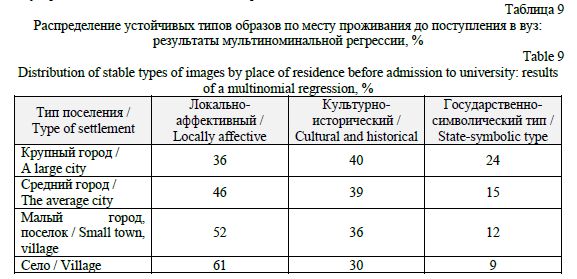
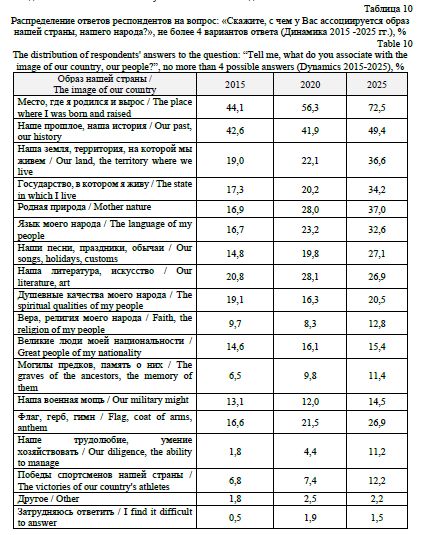
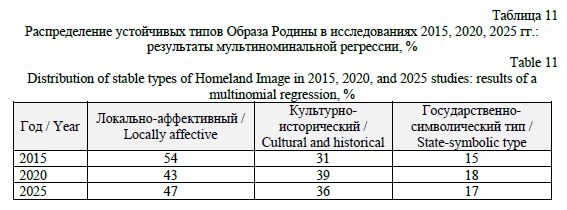
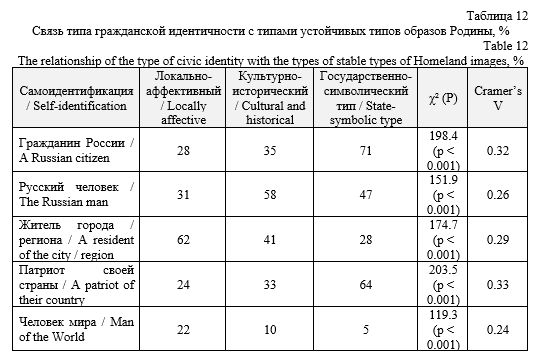
In the context of increasing digitalization, atomization, and the rising complexity of the socialization process, the problem of constructing civic identity is particularly important for ensuring social and state integrity and the conflict-free reproduction of the existing system. The article presents the results of a study regarding the image of the Motherland as a potential foundation for the formation of all-Russian civil identity and substantiates its key role in the integration of atomized identities. The relevance of this work is determined by the need of the state and society for sustainable mechanisms to counter the fluid, temporary, and conflictual forms of youth self-determination. The novelty of the study lies in the empirical recording of the structure of student ideas about the Motherland and the identification of stable types of the Motherland image, defined as local-affective, cultural-historical, and state-symbolic. The results are based on a multivariate statistical analysis of associations, including frequency distribution data, Jaccard distance clustering, and multinomial regression. This allows us to identify social determinants associated with gender, educational profile, region of residence, and settlement type. The study reveals individual-biographical and cultural-historical components dominate over state-institutional ones, while the concept of the Motherland itself remains primarily emotionally rooted. The obtained results also demonstrate the stability of the cultural-affective core of the identity of Russian student youth over the period 2015-2025, with a moderate increase in the cultural-symbolic component. The image of the Motherland is presented as a space of personal rootedness, cultural memory, and ethnocultural affiliation, which confirms the thesis of its fundamental role in the construction of all-Russian civic identity. The conclusions substantiate the need for educational and upbringing practices that integrate the personal and cultural meanings characteristic of young people with civic and social actions, which opens up prospects for strengthening civic solidarity and the formation of stable identity models in modern conditions.
Figures
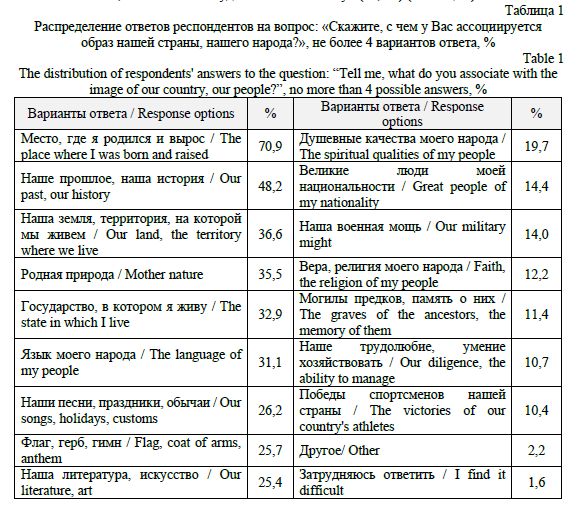
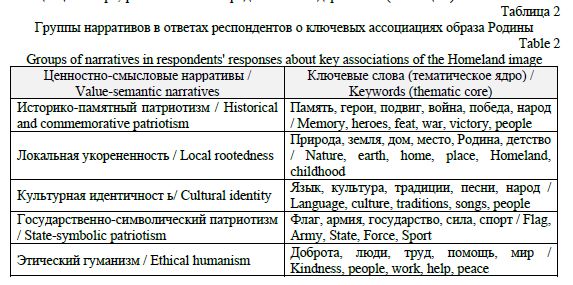
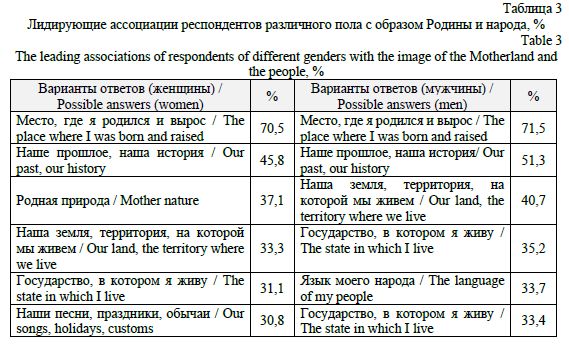
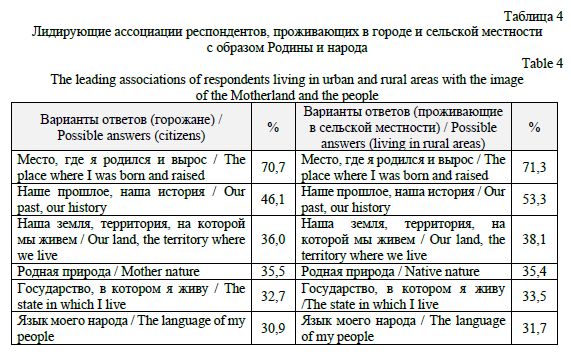
Detochenko, L. S. (2026), “The image of the Motherland as a foundation for the construction of all-Russian civil identity”, Research Result. Sociology and Management, 12 (2), 227-245, DOI: 10.18413/2408-9338-2026-12-2-1-4.















While nobody left any comments to this publication.
You can be first.
Avksentiev, V. A. and Aksyumov, B. V. (2022), “The “Identity Portfolio” of youth in Southern Russia 12 years later”, Sociological Studies, (7), 76-87, DOI: 10.31857/S013216250019645-2, EDN: HEOCFJ. (In Russian)
Arutyunova, E. M. (2023), “Russian civic identity in a regional context: the case of the Sakha Republic (Yakutia)”, Respublica Literaria, 4(4), 114-125, DOI: 10.47850/RL.2023.4.4.114-125, EDN: EDAQPX. (In Russian)
Arutyunova, E. M. (2025), “Russian identity and patriotic attitudes of youth in a regional context (using the Republic of Sakha (Yakutia) as an example)”, Bulletin of the Institute of Sociology, 16 (1), 13-29, DOI: 10.19181/vis.2025.16.1.3, EDN: OEXSDX. (In Russian)
Anderson, B. (2001), Voobrazhaemye soobshchestva. Razmyshleniya ob istokakh i rasprostranenii natsionalizma [Imagined communities. Reflections on the origin and spread of nationalism], Translated by Gromov, V. V., Kanon-Press-Ts; Kuchkovo pole, Moscow, Russia. (In Russian)
Bauman, Z. (2005), Individualizirovannoe obshchestvo [The Individualized Society], Logos, Moscow, Russia. (In Russian)
Bauman, Z. (2008), Tekuchaya sovremennost [Liquid Modernity], Translated by Komarov, S. A., in Asochakov, Yu. V. (ed.), Piter, St. Petersburg, Russia. (In Russian)
Vorobieva, I. N. (2023), “Territorial identity of the population as a factor and consequence of social participation”, Sotsiologicheskaya nauka i sotsialnaya praktika, 11 (1), 70-85, DOI: 10.19181/snsp.2023.11.1.4, EDN: URTMTB. (In Russian)
Volkov, Yu. G., Guskov, I. A. and Gurba, V. N. (2022), “Regional identity in the space of social and managerial activities”, Humanities of the South of Russia, 11 (4), 40-54, DOI: 10.18522/2227-8656.2022.4.2, EDN: AZLBNM. (In Russian)
Volkov, Yu. G., Gurba, V. N. and Guskov, I. A. (2024), “Regional and civic identity as a factor in the consolidation of Russian society”, Humanities of the South of Russia, 13 (3), 14-24, DOI: 10.18522/2227-8656.2024.3.1, EDN: CKORWZ. (In Russian)
Guzenina, S. V. (2013), Obraz Rodiny kak predmet nauchnogo analiza [The Image of the Motherland as an Object of Scholarly Analysis], Belgorod Publishing House, Belgorod State National Research University, Belgorod, Russia. (In Russian)
Guzenina, S. V. (2016), Obraz Rodiny kak dukhovnaya osnova sotsialnogo povedeniya [The Image of the Motherland as a Bases of Social Behavior»], D. Sc. Thesis (Sociology of Culture, 22.00.06), Tambov, Russia, EDN: GVDUDQ. (In Russian)
Drobizheva, L. M. (2018), “Russian Identity: Debates in the Political Space and Dynamics of Mass Consciousness”, Polis. Political Studies, (5), 100-115, DOI: 10.17976/jpps/2018.05.09, EDN: YAEHZR. (In Russian)
Klimenko, L. V. and Zhade, Z. A. (2022), “Regional features of identity of the population of the South of Russia: ethno-gender aspect”, The humanities of the South of Russia, 11 (3), 167-175, DOI: 10.18522/2227-8656.2022.3.14, EDN: GIKHTI. (In Russian)
Kulbachevskaya, O. V. (2023), “Youth patriotism as a strategic resource for Russias development: potential, challenges, and risks”, Herald of Anthropology, (4), 20-36, DOI: 10.33876/2311-0546/2023-4/20-36, EDN: PUKQAL. (In Russian)
Lubskiy, A. V. (2019), “Patriotism and civic consciousness in Russian society, or how to overcome the deficit of civic consciousness in Russian patriotism”, The humanities of the South of Russia, 8 (36), 2, 47-66, DOI: 10.23683/2227-8656.2019.2.3, EDN: QFUDDU. (In Russian)
Lyausheva, S. A. (2023), “Regional identity politics in the Republic of Adygea and Krasnodar Krai (based on focus group research)”, The humanities of the South of Russia, 12 (1 (59)), 189-201, DOI: 10.18522/2227-8656.2023.1.14, EDN: MRQGFU. (In Russian)
Lyausheva, S. A. (2025), “Macroregional North Caucasian identity in the structure of multi-level identity: expert assessments”, Kavkaz v sotsialno-ekonomicheskom prostranstve i na politicheskoy karte Evrazii: Materialy XIX Mezhdunarodnoy nauchno-prakticheskoy konferentsii (v ramkah prazdnovaniya 30-letiya deyatelnosti Instituta Druzhby narodov Kavkaza) [The Caucasus in the socio-economic space and on the political map of Eurasia: Proceedings of the XIX International Scientific and Practical Conference (as part of the celebration of the 30th anniversary of the Institute of Friendship of the Peoples of the Caucasus)], Institute of Friendship of Peoples of the Caucasus, Stavropol, Russia, 222-226, ISBN 978-5-903174-56-0. (In Russian)
Maklashova, E. G. (2024), “Patriotism as an integration resource: the meaningfulness of fixation in the context of polyethnicity (based on the materials of the Republic of Sakha (Yakutia))”, Respublica Literaria, 5 (4), 101-111, DOI: 10.47850/RL.2024.5.4.101-111. (In Russian)
Murashchenkova, N. V., Gritsenko, V. V., Kalinina, N. V., Konstantinov, V. V., Kulesh, E. V., Malenova, A. Yu. and Malyshev, I. V. (2023), “Attitudes toward patriotism and patriotic self-identity of Russian student youth in the context of social polarization”, Social Psychology and Society, 14 (4), 68-88, DOI: 10.17759/sps.2023140405, EDN: DPRDPD. (In Russian)
Zhade, Z. A., Ilinova, N. A., Kireeva, I. V., Kukva, E. S., Lyausheva, S. A. and Shadzhe,
A. Yu. (2022), Politika identichnosti: regionalnye praktiki i vektory razvitiya: monografiya [Identity Politics: Regional Practices and Development Vectors: A Monograph], by Lyausheva,
S. A. (ed.), Adyghe State University, Maykop, Russia, ISBN: 978-5-6041243-7-6, EDN: VPBACR. (In Russian)
Berezina, N. V., Bogdanov, I. Ya., Velikaya, N. M., Gadzhiev, Kh. A. et al. (2023), Rossiyskoe obshchestvo i gosudarstvo v usloviyakh globalnoy mnogopolyarnosti. Sotsialno-politicheskoe polozhenie Rossii v 2022 godu [Russian Society and the State in a Global Multipolar World: Russia’s Sociopolitical Situation in 2022], Federal Research Sociological Center of the Russian Academy of Sciences, Moscow, Russia, DOI: 10.19181/monogr.978-5-89697-409-3.2023, ISBN: 978-5-89697-409-3, EDN: ORTSAQ. (In Russian)
Ryabov, O. V. (2001), “Matushka-Rus”: opyt gendernogo analiza poiskov natsionalnoi identichnosti Rossii v otechestvennoi i zapadnoy istoriosofii [“Mother-Rus”: A Gender Analysis of Searches for Russias National Identity in Russia and Western Historiosophy], Ladomir, Moscow, Russia. (In Russian)
Ryabov, O. V. (2007), “Rossiya-matushka”: natsionalizm, gender i voina v Rossii XX veka [“Mother-Russia”: Nationalism, Gender and War in Russia of the 20th Century], Ibidem, Stuttgart and Hannover, Germany, ISBN: 3-89821-487-7, EDN: UDYXIV. (In Russian)
Sandomirskaya, I. I. (2001), Kniga o Rodine: opyt analiza diskursivnykh praktik [A book about the Motherland: analyzing discursive practices], Ges. zur Forderung slawistischer Studien, Wien, Austria (Wiener Slawistischer Almanach. Sonderband; 50). (In Russian)
Sapryka, V. A., Dorokhova, Yu. V. and Khatnyuk, N. N. (2025), “Formation of civic identity and patriotism among student youth in the region”, Bulletin of the Institute of Sociology, 16 (2), 86-107, DOI: 10.19181/vis.2025.16.2.11, EDN: RDURSZ. (In Russian)
Semchenko, I. V. and Makhmutova, K. A. (2025), “Patriotism in the context of the life strategies of the youth of the Belgorod region”, Research Result. Sociology and Management, 11 (3), 79-92, DOI: 10.18413/2408-9338-2025-11-3-0-5. (In Russian)
Simonyan, R. Kh. (2023), “The specifics of students identity in the borderlands of Russia and Ukraine (using the example of Belgorod and Kharkiv universities)”, Sociological Studies, (5), 108-116, DOI: 10.31857/S013216250025806-9, EDN: BVMOZP. (In Russian)
Solovyeva, A. N. and Solovyeva, T. A. (2015), “Family Symbolism in the Structure of Russians Social Representations of the Motherland”, Labirint. Zhurnal sotsialno-gumanitarnykh issledovanii, (4), 113-125, EDN: VOADPL. (In Russian)
Chernysheva, N. S., Andreeva, A. S. and Kuziner, E. N. (2023), “Rethinking local identities in the Russian North: youth in search of purity”, Sociological Studies, (12), 136-145, DOI: 10.31857/S013216250029343-0, EDN: ZXFNMC. (In Russian)
Shcherbakova, L. I. and Filonenko, V. I. (2019), “Active patriotism as a factor in the creative development of Russian youth in the context of changing social reality: contradictions in the formation”, Vlast, 27 (1), 112-119, DOI: 10.31171/vlast.v27i1.6237, EDN: YZPVKH (In Russian)