

The formation of historical narratives about the Great Patriotic War in university settings: an empirical study
of student assessments and expectations
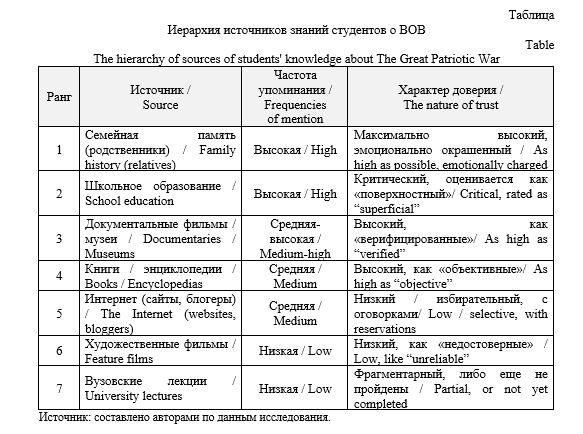
The relevance of the research is dictated by the defining role of higher education as a key agent in transmitting reliable historical knowledge about the Great Patriotic War. This knowledge is necessary for forming attitudes and civic identities, and for consolidating student youth that are adequate to modern reality. This is important in the context of modern attempts by unfriendly countries to offset the results of the Great Patriotic War. The purpose of the study was to identify the mechanisms and features of perception, interpretation and retransmission of historical narratives about the Great Patriotic War by university students, as well as to determine the ratio of official (university) and informal (family, media) sources in the formation of their civic identity. This empirical study was conducted using focus groups with first-, second- and third-year undergraduate students from a range of disciplines (N = 8 groups). The data analysis confirmed the hypothesis about the dominant family narrative: personal (family) history acts as the main emotional filter for the perception of the official version of events, however, with the loss of living memory, university discourse becomes basic, but is perceived by students as insufficiently personalized and internalized. The personalization of the perception of the war is revealed through the images of specific heroes and symbols that act as “symbolic anchors” of identification. It was recorded that students face competing narratives in the digital environment, but their critical reflection is intuitive rather than systematic. There is a rejection of formal, compulsory educational activities, while there is a demand for dialogic, research-based, and emotionally engaging work formats. The study confirmed the existence of a gap between the ritualized “cultural memory” transmitted by the university and the family's memory. To bridge the gap, we need a dialogue platform, academic integration of family narratives, and teaching students to critically evaluate sources and combat the distortion of historical memory. The practical significance of this work lies in providing recommendations for improving the educational policies of universities in order to preserve historical memory as a resource for national unity.
Figures
Semchenko, I. V., Kovalchuk, O. V. (2026), “The formation of historical narratives about the Great Patriotic War in the university environment: an empirical study of student assessments and expectations”, Research Result. Sociology and management, 12 (2), 198-211, DOI: 10.18413/2408-9338-2026-12-2-1-3.















While nobody left any comments to this publication.
You can be first.
Assman, A. (2024), Zabvenie istorii – oderzhimost istoriey [Oblivion of history – obsession with history], transl. by Khlebnikov, B., Novoe literaturnoe obozrenie, Moscow, Russia, ISBN: 978-5-4448-2515-0. (In Russian)
Assman, J. (2004), Kulturnaya pamyat: Pismo, pamyat o proshlom i politicheskaya identichnost v vysokikh kulturakh drevnosti [Cultural Memory: Writing, Memory of the Past, and Political Identity in the High Cultures of Antiquity], transl. by Sokolskaya, M. M., Yazyki slavyanskoy kultury, Moscow, Russia, ISSN 1726-135X, ISBN 5-94457-176-4. (In Russian)
Vasiliev, A. G. (2014), “The cult of the hero and national identity: the study of collective memory in the sociology of culture
of S. Czarnowski”, Dialog so vremenem, (49), 44-65, EDN: RGWYXW. (In Russian)
Vishnevsky, Yu. R., Mansurov, V. A., Kulminskaya A. V. (2025), “Russian students about the Great Patriotic War: results of the Federal research of the Russian society of sociologists (2005–2025)”, Sotsiologicheskie issledovaniya, (7), 33-46. DOI 10.7868/S3034601025070043. (In Russian)
Lebedev, S. D., Shapovalova, I. S., Roshchupkina, N. A. and Shkapenko, A. A. (2020), “Social trauma and generational values: The Great Patriotic War in the historical memory of students”, Research Result. Sociology and Management, 6 (2), 3-18, DOI: 10.18413/2408-9338-2020-6-2-0-1. (In Russian)
Mannheim, K. (1998), “Problema pokoleniy” [The problem of generations], Novoe literaturnoe obozrenie, (2), available at: https://magazines.gorky.media/nlo/1998/2/problema-pokolenij.html (Accessed 28 December 2025). (In Russian)
Mead, G. H. (2014), Filosofiya nastoyashchego [The Philosophy of the Present], Izdatelskiy dom NIU VShE, Moscow, Russia. (In Rusian)
Minyar-Belorucheva, A. P. (2025), “Historical narrative as a means of recreating historical memory”, Moscow University Bulletin. Series 19. Linguistics and Intercultural Communication, 28 (1), 186-197, DOI: 10.55959/MSU-2074-1588-19-28-1-13. (In Russian)
Nora, P. (2005), “Worldwide celebration of memory”, Neprikosnovennyy zapas, 2-3 (40-41), available at: http://magazines.russ.ru/nz/2005/2/nora22.html (Accessed 22 December 2025). (In Russian)
Olick, J. and Khlevnyuk, D. (2012), Figuratsii pamyati: protsesso-relyatsionnaya metodologiya, illyustriruemaya na primere Germanii [Configurations of memory: process-relational methodology illustrated by the example of Germany], Sociological Review, 11 (1), 40-74, URL: https://clck.ru/3SY7Z4 (Accessed 28 December 2025). (In Russian)
Spasibo pradedu za Pobedu…: monografiya po materialam monitoringa «Rossijskoe studenchestvo o Velikoj Otechestvennoj vojne» (2005–2010–2015–2020 gg.) [Thank you to my great-grandfather for the Victory...: a monograph based on the monitoring data “Russian Students on the Great Patriotic War” (2005-2010-2015-2020)] (2020), ed. by Yu. R. Vishnevsky; Ministry of Science and Higher Education of the Russian Federation, Ural Federal University named after the First President of Russia B. N. Yeltsin, Russian Society of Sociologists, Ural University Press, Yekaterinburg, Russia, ISBN 978-5-7996-3087-4. (In Russian)
Tulchinsky, G. L. (2019), “Philosophy of history and narratives of historical memory”, Philosophy Journal, 12 (1), 117-129, DOI: 10.21146/2072-0726-2019-12-1-117-129. (In Russian)
Tiukina, L. A. (2020), “Memory and historical memory: correlation of concepts”, Verhnevolzhski Philological Bulletin, 1 (20), 181-187, DOI: 10.20323/2499-9679-2020-1-20-181-187. (In Russian)
Khalbwachs, M. (2005), “Collective and historical memory”, Neprikosnovennyy zapas, 2-3
(40-41), available at: https://magazines.gorky.media/nz/2005/2/kollektivnaya-i-istoricheskaya-pamyat.html (Accessed 28 December 2025). (In Russian)
Shestakova, M. A. (2022), “Historical memory: a narrative approach”, Moscow University Bulletin. Series 7. Philosophy, (1), 94-104, EDN: DTHWHJ. (In Russian)