

Historical memory of the Great Patriotic War among university and college students in the region: a comparative sociological analysis
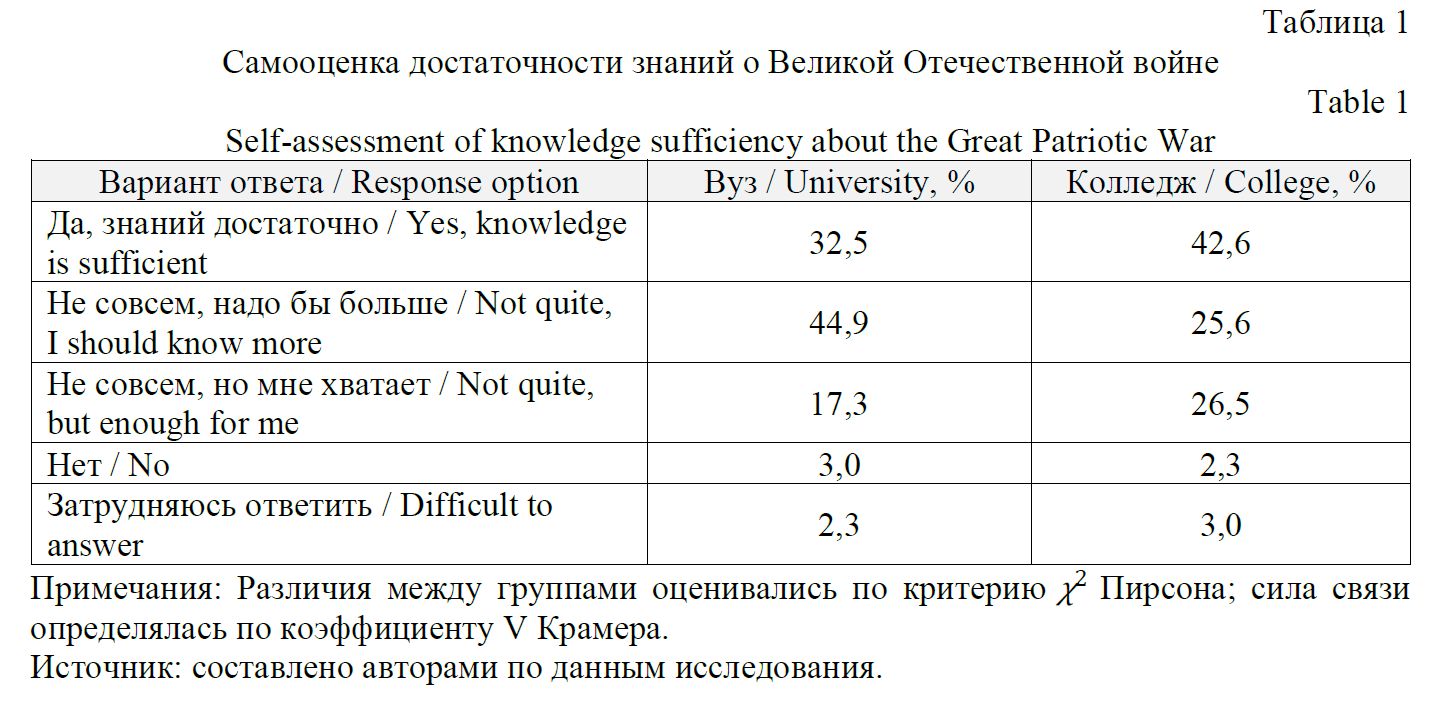
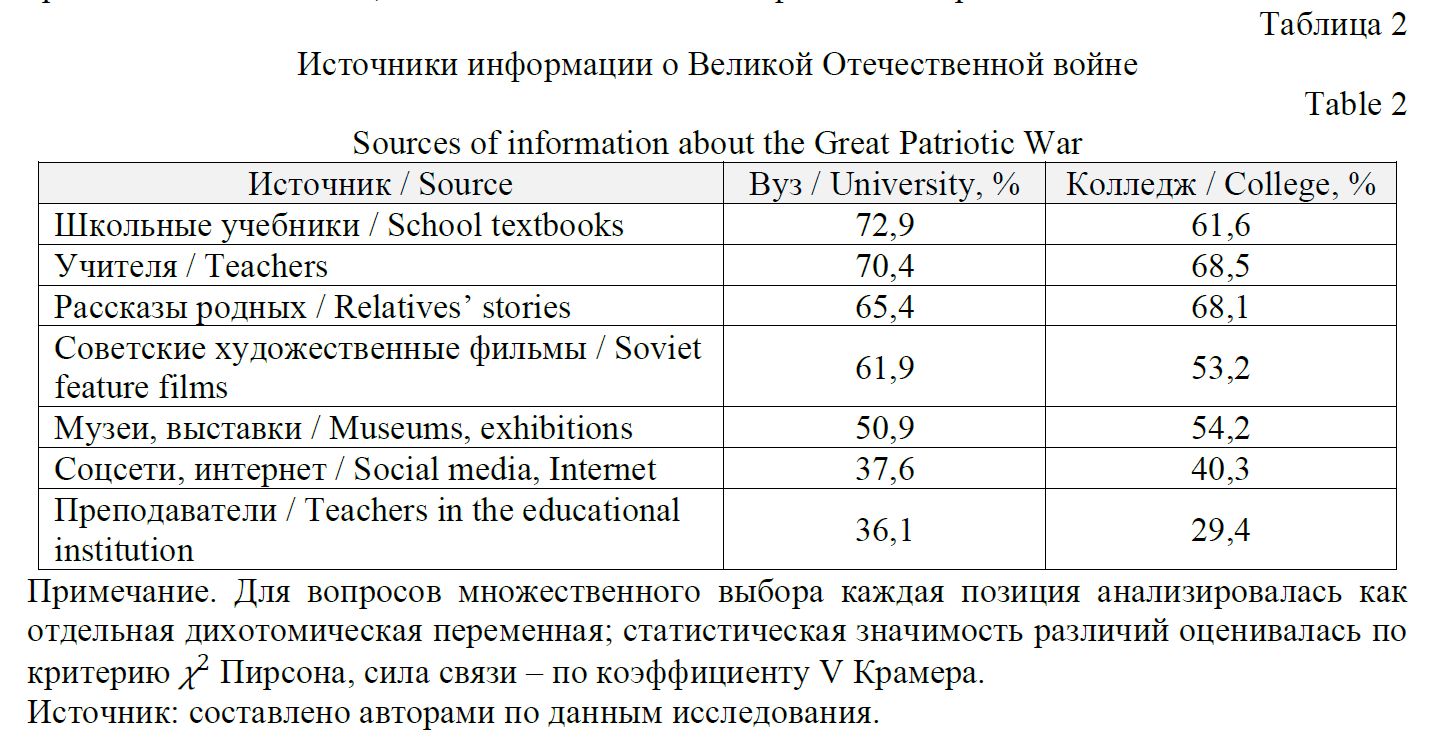
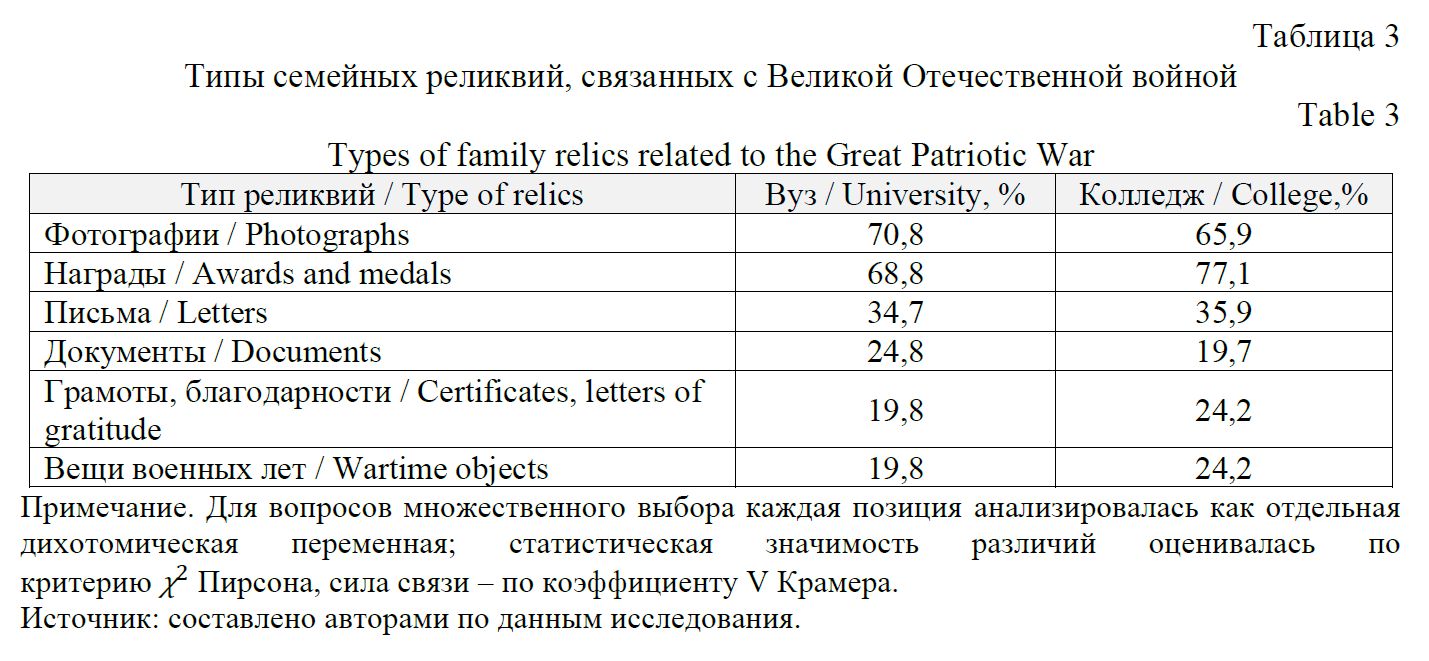
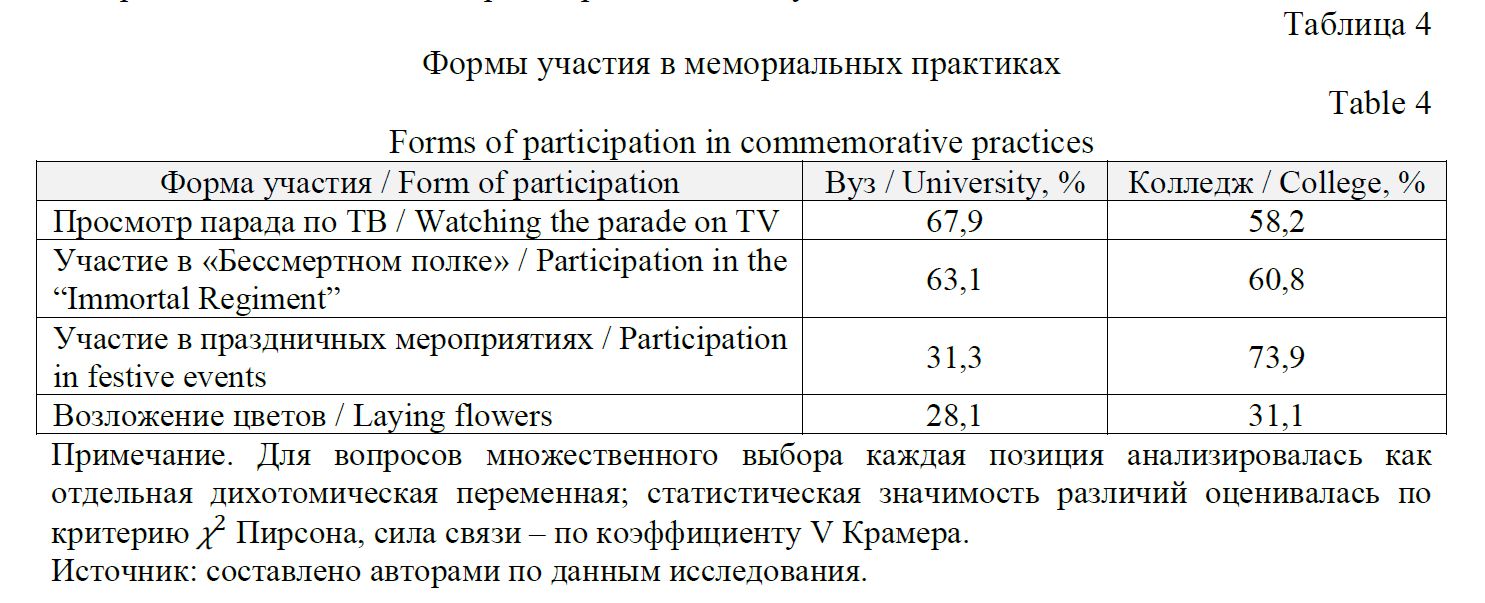
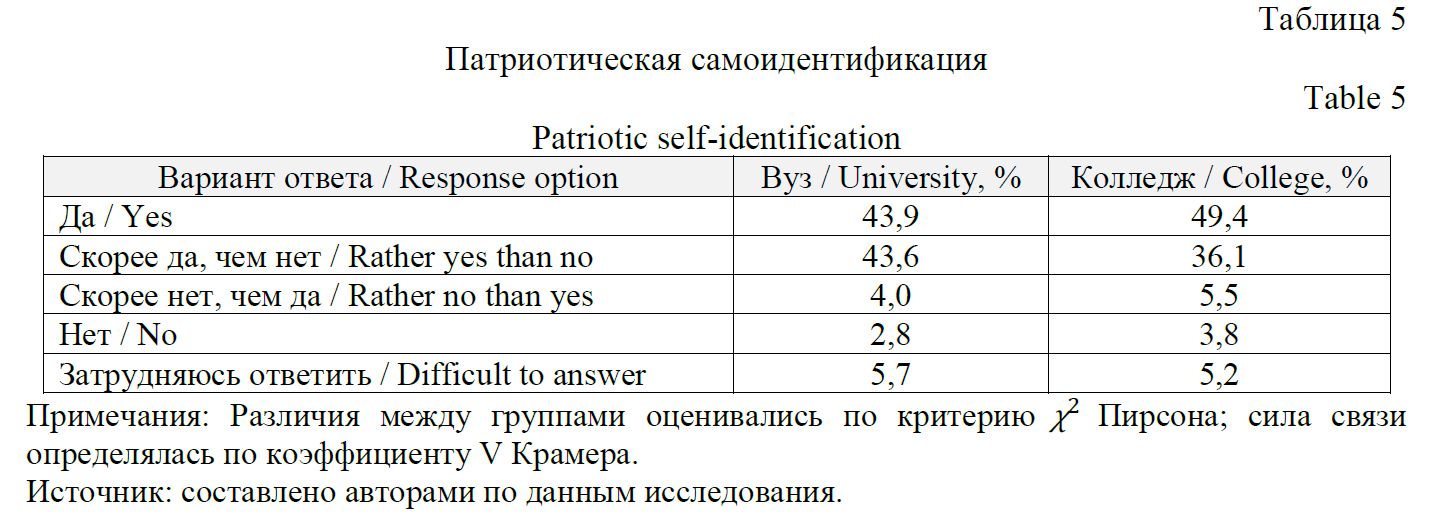
The historical memory of the Great Patriotic War plays a significant role in the socialisation of young people, promoting symbolic integration and intergenerational continuity. However, it is formed in unequal ways depending on educational background. The research problem is related to the insufficient development of the question of how differences between university and college educational environments influence the content, sources, and forms of reproduction of young people’s historical memory. The purpose of the article is to conduct a comparative analysis of the features of historical memory of the Great Patriotic War among university and college students in the region. The methodological framework of the study is based on a sociological approach to historical memory as a multidimensional social phenomenon including cognitive, axiological, and behavioral components. The empirical basis consists of data from a mass sociological survey of student youth in the region. A total of 875 people were included in the sample, of whom 399 were university students and 476 were college students. The analysis was based on the comparison of key indicators of historical memory: self-assessment of knowledge about the war, sources of information, family memory, participation in memorial practices, and patriotic self-identification. The study shows that the educational trajectory is a significant factor in the differentiation of historical memory. University students more often demonstrate a critical self-assessment of their knowledge, a more pronounced orientation toward institutionally legitimized sources, a documentary-biographical character of family memory, and a more reflective form of patriotic identification. College students, by contrast, are more often characterized by greater confidence in the sufficiency of their knowledge, a stronger role of family-local and object-symbolic channels of memory, higher involvement in collective festive and memorial practices, and a more categorical form of patriotic self-identification. As a result of the comparative analysis, two predominant forms of historical memory in the regional youth environment were identified: reflective-academic and practical-symbolic. The former is more typical of university students and is associated with the verification of knowledge, analytical distance, and an orientation toward meaningful correlation between the past and the future. The latter is more often manifested among college students and is based on emotional involvement, family-local transmission of experience, and collective ritual practices of memory reproduction. The scientific novelty lies in identifying how the historical memory of young people is internally differentiated depending on their educational trajectory and the institutional context of their socialisation. The practical significance of the study is connected with the possibility of using the results to develop differentiated educational, civic-patriotic, and memorial practices in universities and colleges.
Figures
Merkulov, P. A., Prokazina, N. V. (2026), “Historical memory of the Great Patriotic War among university and college students in the region: a comparative sociological analysis”, Research Result. Sociology and Management, 12 (2), 89-104, DOI: 10.18413/2408-9338-2026-12-2-0-6.















While nobody left any comments to this publication.
You can be first.
Aksenova, O. V. (2025), “The Great Patriotic War and the civilizational development of Russia”, Vestnik Instituta sotsiologii, 16 (3), 10-14. DOI: 10.19181/vis.2025.16.3.1. (In Russian)
Assman, J. (2004), Kulturnaya pamyat: Pismo, pamyat o proshlom i politicheskaya identichnost v vysokikh kulturakh drevnosti [Cultural Memory: Writing, Memory of the Past, and Political Identity in the High Cultures of Antiquity], transl. by Sokolskaya, M. M., Yazyki slavyanskoy kultury, Moscow, Russia, ISSN 1726-135X, ISBN 5-94457-176-4. (In Russian)
Badaraev, D. D., Vinokurova, A. V. and Nolev, E. V. (2025), “The Memory of the Great Patriotic War in the regions of the Far East: commemorative practices of student youth”, Vestnik Instituta sotsiologii, 16 (3), 52-68. DOI: 10.19181/vis.2025.16.3.3. (In Russian)
Berger, P. and Lukman, T. (1995), Sotsialnoe konstruirovanie realnosti: traktat po sotsiologii znaniya [The Social Construction of Reality: A Treatise in the Sociology of Knowledge], Medium, Moscow, Russia. (In Russian)
Burde, P. (2002), “The forms of capital”, Ekonomicheskaya sotsiologiya, 3 (5), 60-74. (In Russian)
Merkulov, P. A., Alekseenok, A. A., Prokazina, N. V. et al. (2025), Velikaya Otechestvennaya voyna v predstavleniyakh sovremennoy studencheskoy molodezhi [The Great Patriotic War in the Representations of Modern Student Youth], Rossiyskaya akademiya narodnogo khozyaystva i gosudarstvennoy sluzhby pri Prezidente Rossiyskoy Federatsii, Orel, Russia, EDN: TIQSZQ. (In Russian)
Vishnevskii, Yu. R., Kulminskaya, A. and Mansurov, V. A. (2025), “Students about the Great Patriotic War: Results of the Federal Study of the Russian Sociological Society (2005–2025)”, Sotsiologicheskie issledovaniya, (7), 33-46, DOI: 10.7868/S3034601025070043, EDN:GZWLVT. (In Russian)
Voyna byla pozavchera… Rossiyskoe studenchestvo o Velikoy Otechestvennoy voyne : materialy monitoringa «Sovremennoe rossiyskoe studenchestvo o Velikoy Otechestvennoy voyne» [The war was the day before yesterday... Russian students on the Great Patriotic War: materials from the monitoring “Modern Russian students on the Great Patriotic War”] (2015), by Y. R. Vishnevskiy (ed.), Ural University Publishing House, Yekaterinburg, Russia, ISBN: 978-5-7996-1472-0, EDN: TVCTZD. (In Russian)
Gorshkov, M. K. and Barash, R. E. (2024), “Historical memory of modern Russians (the history of Russia of the twentieth century through the prism of family stories)”, Sotsiologicheskie issledovaniya, (9), 125-137. DOI: 10.31857/S0132162524090119. (In Russian)
Lebedev, S. D., Shapovalova, I. S., Roshchupkina, N. A. and Shkapenko, A. A. (2020), “Social trauma and values of generations: the Great Patriotic War in the historical memory of student youth”, Research Result. Sociology and Management, 6 (2), 3-18. DOI: 10.18413/2408-9338-2020-6-2-0-1. (In Russian)
Nora, P. (1999), “The problematics of sites of memory”, by Nora, P., Ozuf, M., Pyuimezh, Zh. de and Vinok, M. (eds.), Frantsiya-pamyat [France-Memory], Izd-vo Sankt-Peterburgskogo universiteta, Saint Petersburg, Russia, 17-50. (In Russian)
Nora, P., Ozuf, M., Pyuimezh, Zh. de and Vinok, M. (1999), Frantsiya-pamyat [France-Memory], Izd-vo Sankt-Peterburgskogo universiteta, Saint Petersburg, Russia. (In Russian)
Ponomareva, E. G. (2020), “World War II and the problem of falsification of its history in the representations of Russian youth”, Vestnik Rossiyskogo universiteta druzhby narodov. Seriya: Sotsiologiya, 20 (2), 307322. DOI: 10.22363/2313-2272-2020-20-2-307-322. (In Russian)
Prokazina, N. V. (2014), “A sociological approach to the study of the historical memory of the Great Patriotic War”, Kazanskaya nauka, (7), 201-204, EDN: SKCWFR. (in Russian)
Prokazina, N. V. (2025), “Historical memory of the Great Patriotic War in the representations of student youth”, Srednerusskiy vestnik obshchestvennykh nauk, 20 (4), 87-107. DOI: 10.22394/2071-2367-2025-20-4-87-107, EDN: NLLUGG. (In Russian)
Prokazina, N. V., Dorokhova, Yu. V. and Khatnyuk, N. N. (2017), “Historical memory of the Great Patriotic War as a resource of patriotic and civic education”, Srednerusskiy vestnik obshchestvennykh nauk, 12 (3), 260–271. DOI: 10.22394/2071-2367-2017-12-3-260-271. (In Russian)
Sarallieva, Z. Kh.-M., Kutyavina, E. E. and Shinkarenko, E. A. (2025), “The space of school events in Nizhny Novgorod dedicated to the 80th anniversary of Victory in the Great Patriotic War”, Vestnik Instituta sotsiologii, 16 (3), 69-86. DOI: 10.19181/vis.2025.16.3.5. (In Russian)
Spasibo pradedu za Pobedu…: monografiya po materialam monitoringa «Rossijskoe studenchestvo o Velikoy Otechestvennoy voyne» (2005–2010–2015–2020 gg.) [Thank you to my great-grandfather for the Victory...: a monograph based on the monitoring data “Russian Students on the Great Patriotic War” (2005-2010-2015-2020)] (20202), ed. by Yu. R. Vishnevsky, Ministry of Science and Higher Education of the Russian Federation, Ural Federal University named after the First President of Russia B. N. Yeltsin, Russian Society of Sociologists, Ural University Press, Yekaterinburg, Russia, ISBN 978-5-7996-3087-4. (In Russian)
Toshchenko, Zh. T. (2020), “What is happening to the historical memory of the Great Patriotic War?”, Sotsiologicheskie issledovaniya, (5), 18-22. DOI: 10.31857/S013216250009419-3. (In Russian)
Khalbvaks, M. (2007), Sotsialnye ramki pamyati [Social Frameworks of Memory], Novoe izdatelstvo, Moscow, Russia, ISBN: 978-5-98379-088-9. EDN: QXSOXF. (In Russian)
Shirokalova, G. S. (2021), “Historical memory of the Great Patriotic War: reasons for pluralism”, Vestnik Instituta sotsiologii, 12 (2), 19-35. DOI: 10.19181/vis.2021.12.2.709. (In Russian)
Alexander, J. C. (2012), Trauma: A Social Theory, Polity Press, Cambridge, UK.
Assmann, J. (2011), Cultural Memory and Early Civilization: Writing, Remembrance, and Political Imagination, Cambridge University Press, Cambridge, UK.
Berger, P. and Luckmann, T. (1966), The Social Construction of Reality: A Treatise in the Sociology of Knowledge, Anchor Books, New York, USA.
Bourdieu, P. (1986), “The Forms of Capital”, in Richardson, J. (ed.), Handbook of Theory and Research for the Sociology of Education, Greenwood Press, New York, USA, 241-258.
Olick, J.K. (2007), The Politics of Regret: On Collective Memory and Historical Responsibility, Routledge, New York, USA.
Zerubavel, E. (2003), Time Maps: Collective Memory and the Social Shape of the Past, University of Chicago Press, Chicago, USA.