

Social networks in the structure of channels for broadcasting the historical memory of the Great Patriotic War
among Moscow students
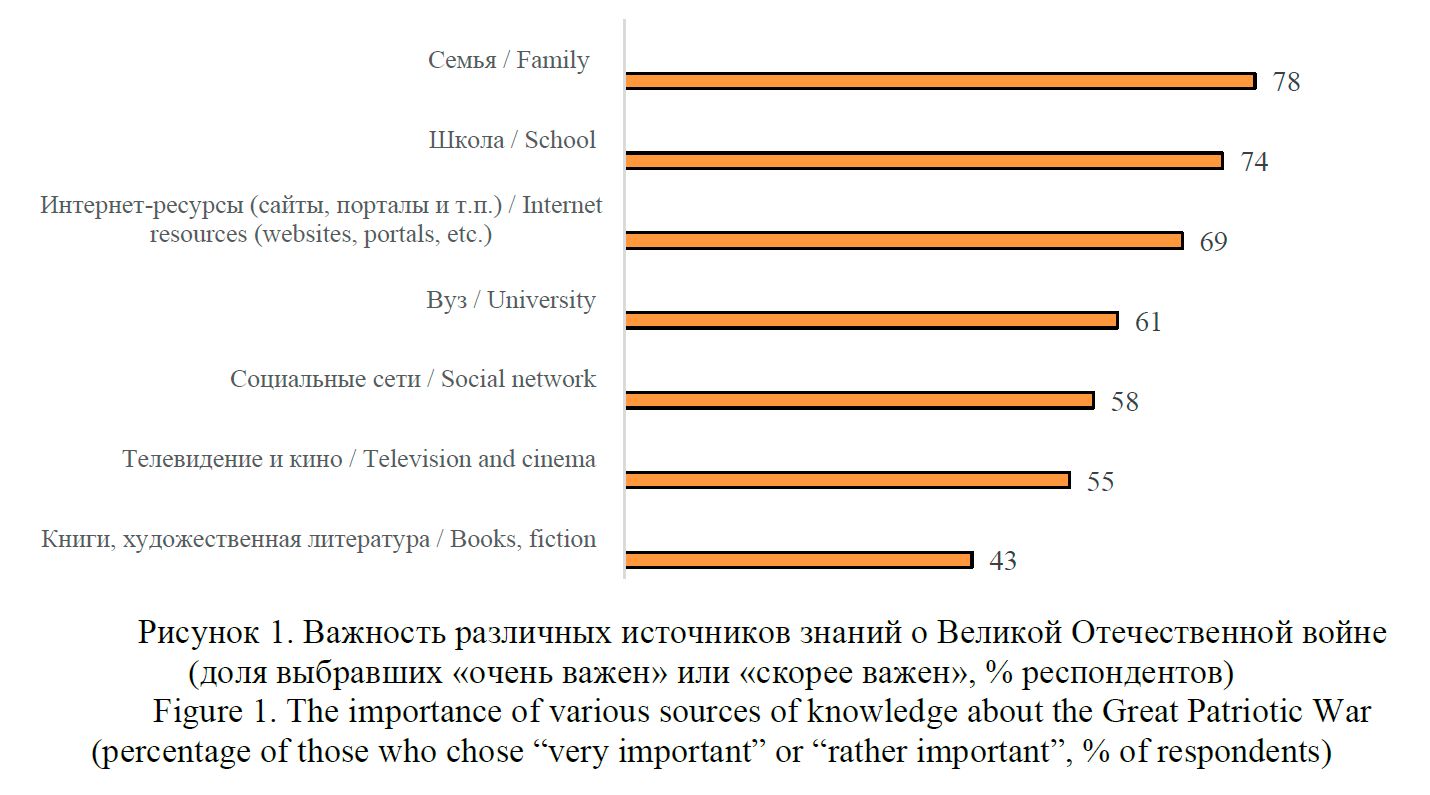
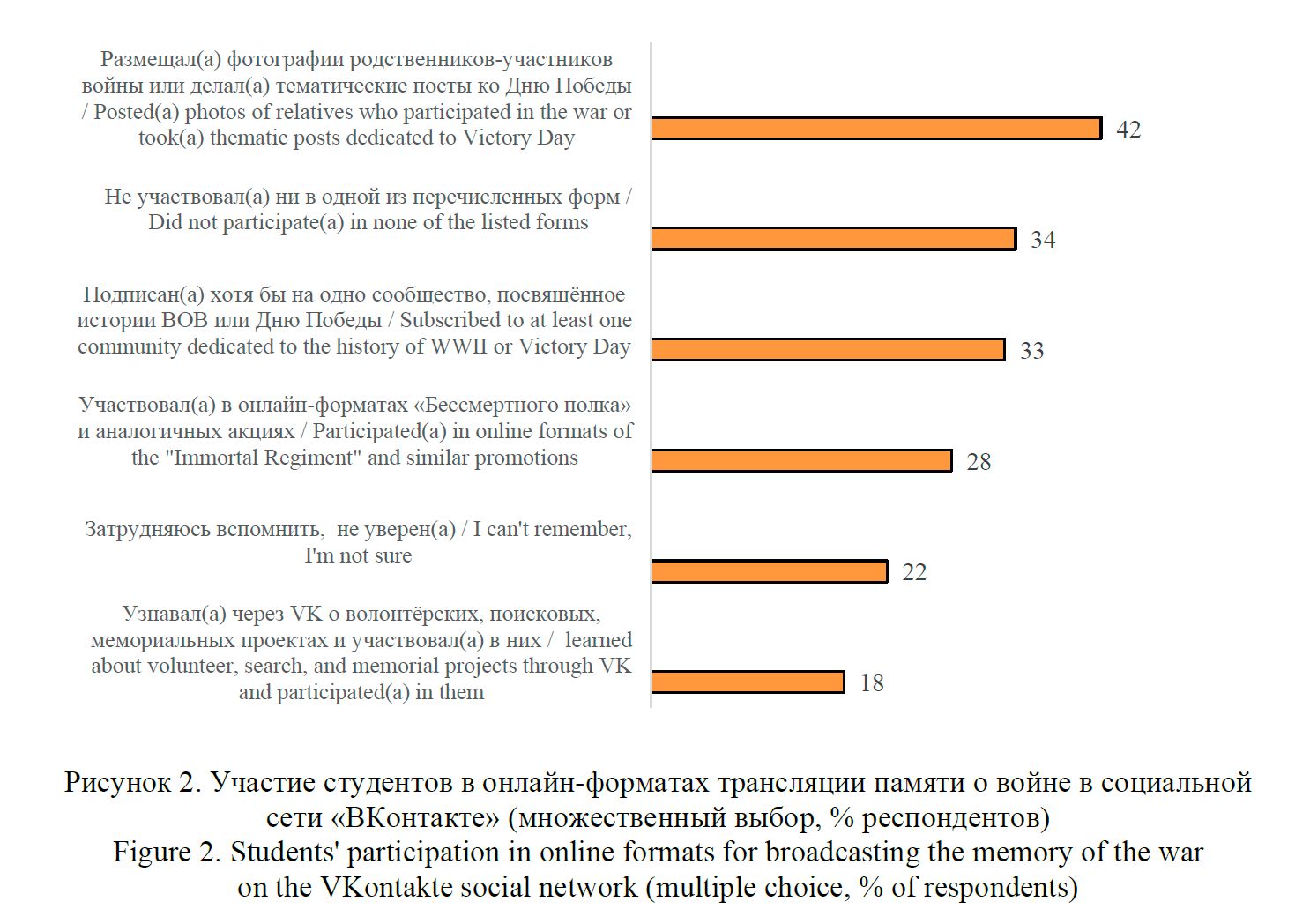
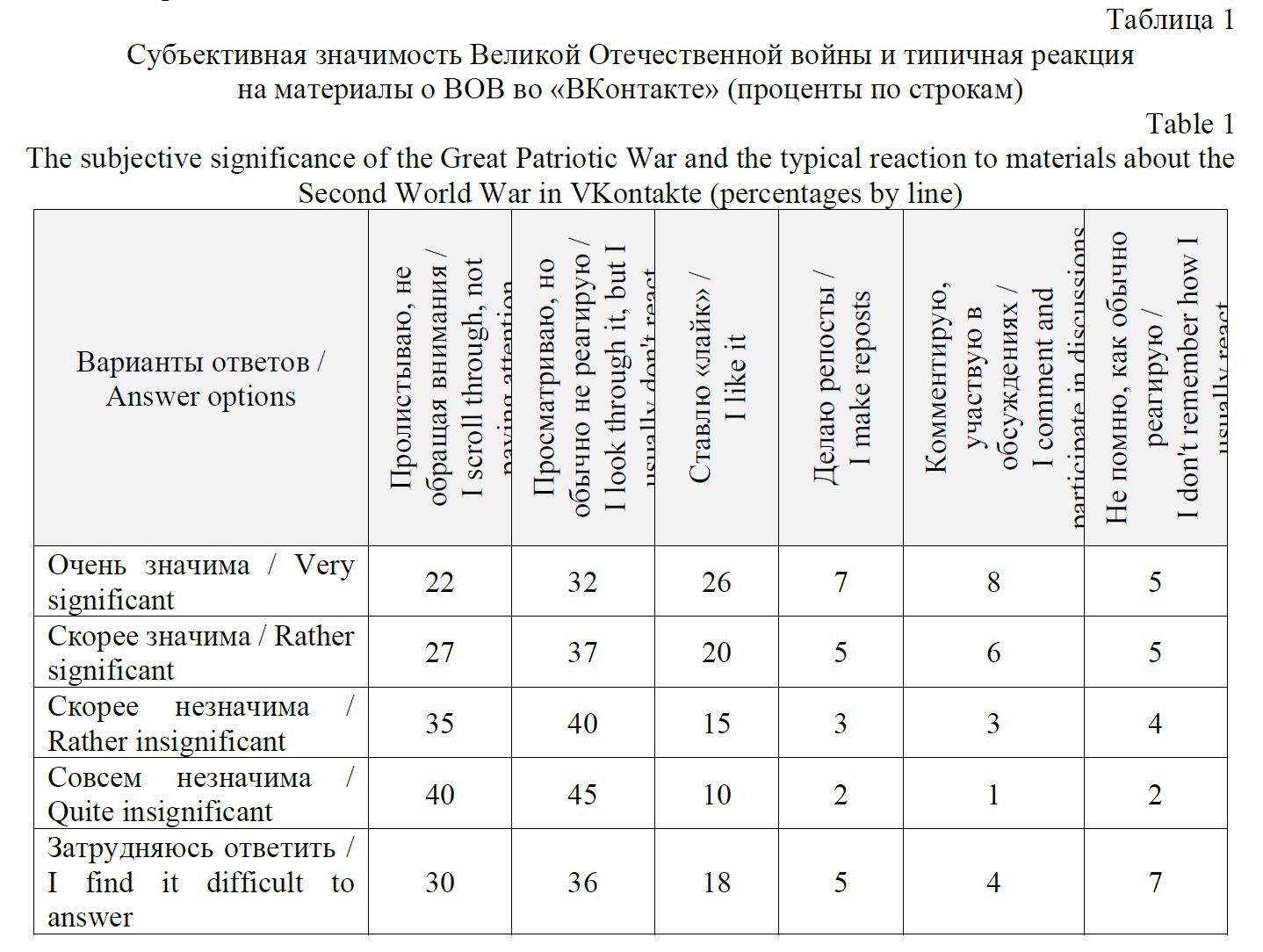
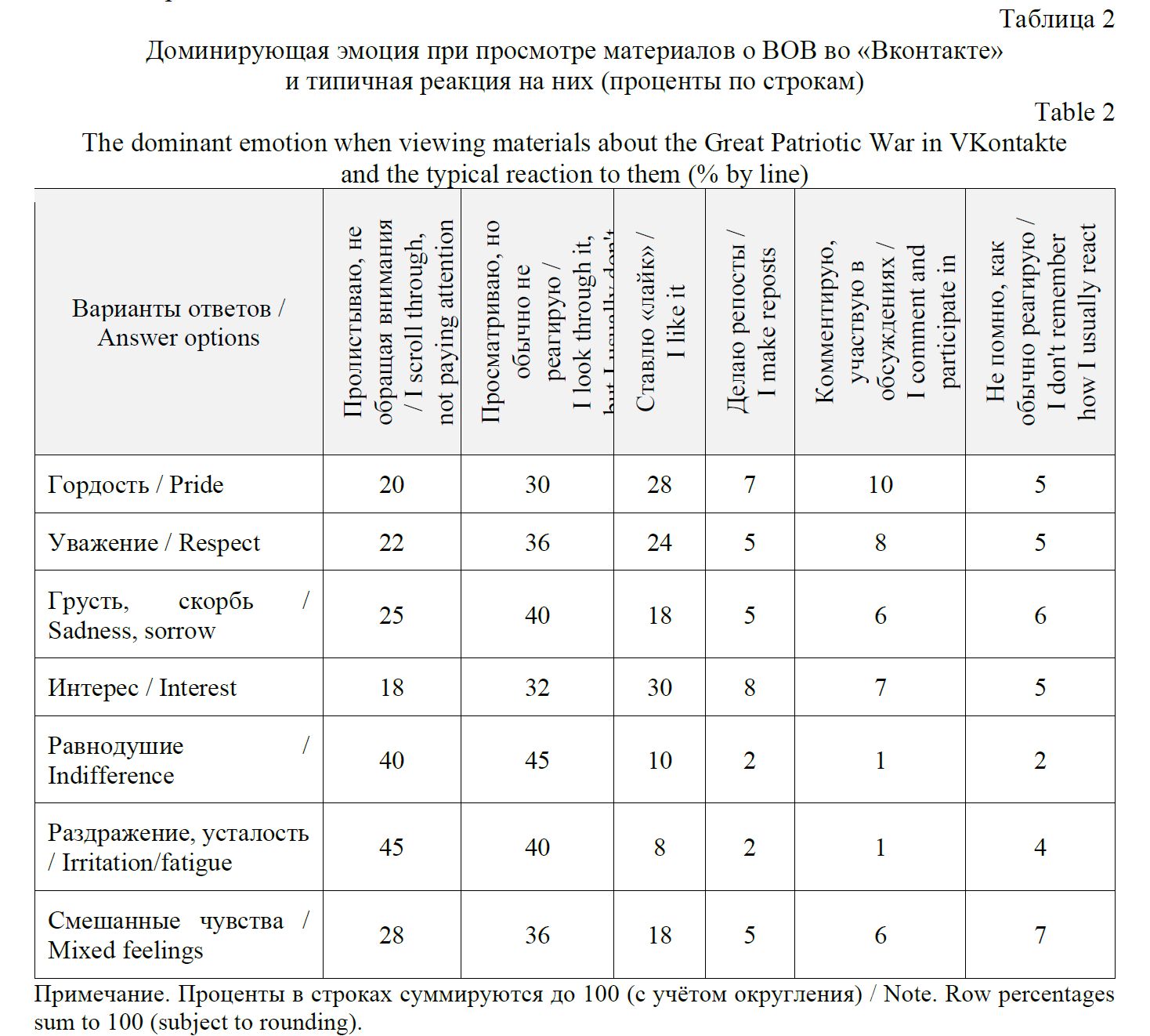
The Great Patriotic War remains one of the key events defining Russian historical memory and national identity. For young people today, the connection with this past is formed mainly through family narratives, educational practices, and media environments, including digital platforms. In the context of accelerating digitalization, social networks are becoming particularly important as one of the main communication channels for young people. The article analyzes the place of the social network VKontakte among the channels of broadcasting historical memory of the war and describes the emerging forms and modes of digital engagement of young people. The theoretical and methodological basis of the research is the concepts of social and cultural memory, a typological approach to the analysis of the historical memory of youth, as well as ideas about digital media as an infrastructure of memorial practices. The empirical basis of the study is data from a mass survey of Moscow university students aged 18-25 years, conducted according to a quota sample by level of education and areas of study. The analytical part uses descriptive statistics methods, cross-distribution comparison of indicators, and cluster analysis. The results of the study show that for the majority of respondents, the memory of the war is still rooted in family biographies and educational practices at the school and university levels, while social networks serve as an additional channel expanding the presence of the theme of war in everyday life. An analysis of the significance of the war, emotional reactions and features of digital behavior on the VKontakte social network revealed a pronounced heterogeneity: against the background of high declared significance and the predominance of positive value emotions, a significant part of students is limited to passive consumption of content, while sustained participation in online forms of war memory transmission and reflexive use of thematic material is typical for relatively small groups. On this basis, several modes of digital engagement were identified, differing in the degree of involvement and the nature of interaction with memorial content: ritually engaged users, distanced observers, critically selective and minimally involved users. It was established that rich family practices of preserving the memory of the war and meaningful participation in school and university memorial events increase the likelihood of both ritual participation and critically meaningful access to digital content about the Great Patriotic War. On the contrary, weak or formalized offline channels of historical memory transmission are more often associated with a fragmentary and minimal presence of the theme of war in the digital experience of students. It is concluded that social networks are being integrated into the existing structure of historical memory transmission channels as a special digital layer that reinforces already established trajectories of attitudes to the past and creates new formats for both symbolic participation and critical reflection on socially accepted ideas about war.
Figures
Zimova, N. S. (2026), “Social networks in the structure of channels for broadcasting the historical memory of the Great Patriotic War among Moscow students”, Research Result. Sociology and Management, 12 (2), 47-67, DOI: 10.18413/2408-9338-2026-12-2-0-4.













While nobody left any comments to this publication.
You can be first.
Aleksander, Dzh. (2012), Kulturnaya travma i kollektivnaya identichnost [Cultural Trauma and Collective Identity], Praksis, Moscow, Russia, EDN: PELCHZ. (In Russian)
Assman, Ya. (2010), Kulturnaya pamyat: Pismo, pamyat o proshlom i politicheskaya identichnost v vysokikh kulturakh drevnosti [Cultural Memory: Writing, Remembrance, and Political Imagination in the High Cultures of Antiquity], Yazyki slavyanskoi kultury, Moscow, Russia. (In Russian)
Vishnevsky, Yu. R., Kulminskaya, A. and Mansurov, V. A. (2025), “Students about the Great Patriotic War: Results of the Federal Study of the Russian Sociological Society (2005-2025)”, Sotsiologicheskie issledovaniya, (7), 33-46, DOI: 10.7868/S3034601025070043, EDN:GZWLVT. (In Russian)
Voina byla pozavchera… Rossiyskoe studenchestvo o Velikoy Otechestvennoy voyne: materialy monitoringa «Sovremennoe rossiyskoe studenchestvo o Velikoy Otechestvennoy voyne» [The war was the day before yesterday... Russian students on the Great Patriotic War: materials from the monitoring “Modern Russian students on the Great Patriotic War”] (2015), by Y. R. Vishnevsky (ed.), Ural University Publishing House, Yekaterinburg, Russia, ISBN: 978-5-7996-1472-0, EDN: TVCTZD. (In Russian)
Gudkov, L. D. (1997), “Victory in the War: Towards a Sociology of a National Symbol”, Monitoring obshchestvennogo mneniya: ekonomicheskie i sotsialnye peremeny, (5), 12-19, EDN: HTLTQH. (In Russian)
Denisov, Yu. P. (2013), “Russian-Language Social Networks as a Source of the Image of the Great Patriotic War in Russians Social Memory”, Sovremennye problemy nauki i obrazovaniya, (5), 507, EDN: RRJXIF. (In Russian)
Dubin, B. (2008), “Memory, War, Memory of War: Constructing the Past in the Social Practice of Recent Decades”, Strana OZ, (4), 17-27, EDN: JVPCHZ. (In Russian)
Dyakova, V. V., Kargapolova, E. V. and Davydova, Yu. A. (2020), “Students about the Great Patriotic War (Based on a Survey of Students of Universities in Moscow and Astrakhan)”, Vestnik Tyumenskogo gosudarstvennogo universiteta. Sotsialno-ekonomicheskie i pravovye issledovaniya, 6 (3), 29-45, DOI: 10.21684/2411-7897-2020-6-3-29-45, EDN: UNECUD. (In Russian)
Bondarenko, N. V., Varlamova, T. A., Gokhberg, L. M. et al. (2023), Indikatory obrazovaniya: 2023 [Education Indicators: 2023], National Research University Higher School of Economics, Moscow, Russia, ISBN 978 5 7598 2746 7. (In Russian)
Ilin, A. Yu. and Rozhneva, S. S. (2022), “Youth about the Great Patriotic War: A View from Russian Regions”, Studia Humanitatis Borealis / Severnye gumanitarnye issledovaniya, (3), 44-70, DOI: 10.15393/j12.art.2022.3861, EDN: UHUQHF. (In Russian)
Kiryukhin, D. V. (2019), “Functioning of Internet resources and communities in the social network VKontakte devoted to the Great Patriotic War”, Istoricheskiy byulleten, 2 (3), 5-13, available at: https://hb-journal.ru/wp-content/uploads/2020/02/kirjuhin.pdf (Accessed 02 March 2025). (In Russian)
Lebedev, S. D., Shapovalova, I. S., Roshchupkina, N. A. and Shkapenko, A. A. (2020), “Social Trauma and Generational Values: The Great Patriotic War in the Historical Memory of Student Youth”, Research Result. Sociology and Management, 6 (2), 3-18, DOI: 10.18413/2408-9338-2020-6-2-0-1, EDN: KFEVFG. (In Russian)
Lofichenko, O. P. and Tebloeva, I. R. (2025), “Representation of Historical Memory in the Media Space of the North Caucasus Federal District: Potential Threats and Prospects”, Rossiya v globalnom dialoge, 11 (2), 165-179, DOI: 10.48612/rg/RGW.28.4.10, EDN: RQQKLN. (In Russian)
Merkulov, P. A., Alekseenok, A. A., Prokazina, N. V. et al. (2025), Velikaya Otechestvennaya voina v predstavleniyakh sovremennoi studencheskoy molodezhi [The Great Patriotic War in the Views of Contemporary Student Youth], RANKhiGS, Orel, Russia, 124, ISBN 978-5-93179-854-7, EDN: TIQSZQ. (In Russian)
Mititsina, E. A. (2025), “The Image of the Great Patriotic War in the Context of Historical Memory of Contemporary Student Youth”, Psikhologo-pedagogicheskii poisk, 3 (75), 30-41, DOI: 10.37724/RSU.2025.75.3.003, EDN: RJKGGY. (In Russian)
Obrazovanie v Rossii – 2023: statisticheskiy byulleten [Education in Russia – 2023: Statistical Bulletin] (2023), MIREA – Russian Technological University, Moscow, Russia, available at: https://vk.com/wall-130201643_15088 (Accessed 05 December 2025). (In Russian)
Puzanova, Zh. V., Narbut, N. P., Larina, T. I. and Tertyshnikova, A. G. (2020), “Typology of Historical Memory of the Second World War: Methodological Aspects of Study (the Case of RUDN Students)”, Vestnik Rossiiskogo universiteta druzhby narodov. Seriya: Sotsiologiya, 20 (2), 292-306, DOI: 10.22363/2313-2272-2020-20-2-292-306, EDN: GUMBKF. (In Russian)
Spasibo pradedu za Pobedu…: monografiya po materialam monitoringa «Rossijskoe studenchestvo o Velikoj Otechestvennoj vojne» (2005–2010–2015–2020 gg.) [Thank you to my great-grandfather for the Victory...: a monograph based on the monitoring data “Russian Students on the Great Patriotic War” (2005-2010-2015-2020)] (2020), ed. by Yu. R. Vishnevsky; Ministry of Science and Higher Education of the Russian Federation, The First President of Russia B. N. Yeltsin Ural Federal University, Russian Society of Sociologists, Ural University Press, Yekaterinburg, Russia, ISBN 978-5-7996-3087-4. (In Russian)
Toshchenko, Zh. T. (2000), “Historical Consciousness and Historical Memory: Analysis of the Current State”, Novaya i noveishaya istoriya, (4), 3-16, EDN: RGEDNB. (In Russian)
Toshchenko, Zh. T. (2020), “What Is Happening to the Historical Memory of the Great Patriotic War?”, Sotsiologicheskie issledovaniya, (5), 18-22, DOI: 10.31857/S013216250009419-3, EDN: KWGMND. (In Russian)
Trubnikova, N. V. and Sarkisova, A. Yu. (2022), “Heroes of national narratives in the mirror of the Runets historical memory (based on big data from the VKontakte social network)”, Rusin, 69, 282-305, DOI: 10.17223/18572685/69/16. (In Russian)
Ustinkin, S. V., Danilova, N. M. and Kukonkov, P. I. (2020), “The memory of students about the Great Patriotic War: general and specific features”, Rossiya reformiruyushchayasya: ezhegodnik [Russia Reforming: Yearbook], 18, 299-330, DOI: 10.19181/ezheg.2020.13, ISBN 978-5-94881-487-2. (In Russian)
Fadeev, P. V. (2021), “The Historical Memory of Russians in Sociological Surveys: Foundations, Reality, Problems”, Vestnik Instituta sotsiologii, 12 (2), 36-54, DOI: 10.19181/vis.2021.12.2.710, EDN: QTGDDT. (In Russian)
Filonenko, V. I. and Magranov, A. S. (2021), “The Image of the Great Patriotic War in the Perceptions of Contemporary Russian Students”, Sotsiologicheskie issledovaniya, (5), 148-149, DOI: 10.31857/S013216250013849-6, EDN: FYWEOW. (In Russian)
Alexander, J. C. (2012), Trauma: A Social Theory, Polity Press, Cambridge, UK.
Assmann, J. (2010), Cultural Memory and Early Civilization: Writing, Remembrance, and Political Imagination, Cambridge University Press, Cambridge, UK.
Bernstein, S. (2016), “Remembering war, remaining Soviet: Digital commemoration of World War II in Putins Russia”, Memory Studies, 9 (4), 422-436.
Halbwachs, M. (1992), On Collective Memory, University of Chicago Press, Chicago, IL.
Hoskins, A. (2009), “Digital network memory”, by Erll, A. and Rigney, A. (eds.), Mediation, Remediation, and the Dynamics of Cultural Memory, Walter de Gruyter, Berlin and New York, 91-106.
Krawatzek, F. and Friess, N. (2022), “A Foundation for Russia? Memories of World War II for Young Russians”, Nationalities Papers, 50 (4), 678-698.
Makhortykh, M. (2020), “Remediating the past: YouTube and Second World War memory in Ukraine and Russia”, Memory Studies, 13 (4), 493-515, DOI: 10.1177/1750698017730867, EDN: WRZZMP.