
Digital well-being for seniors: opportunities and risk
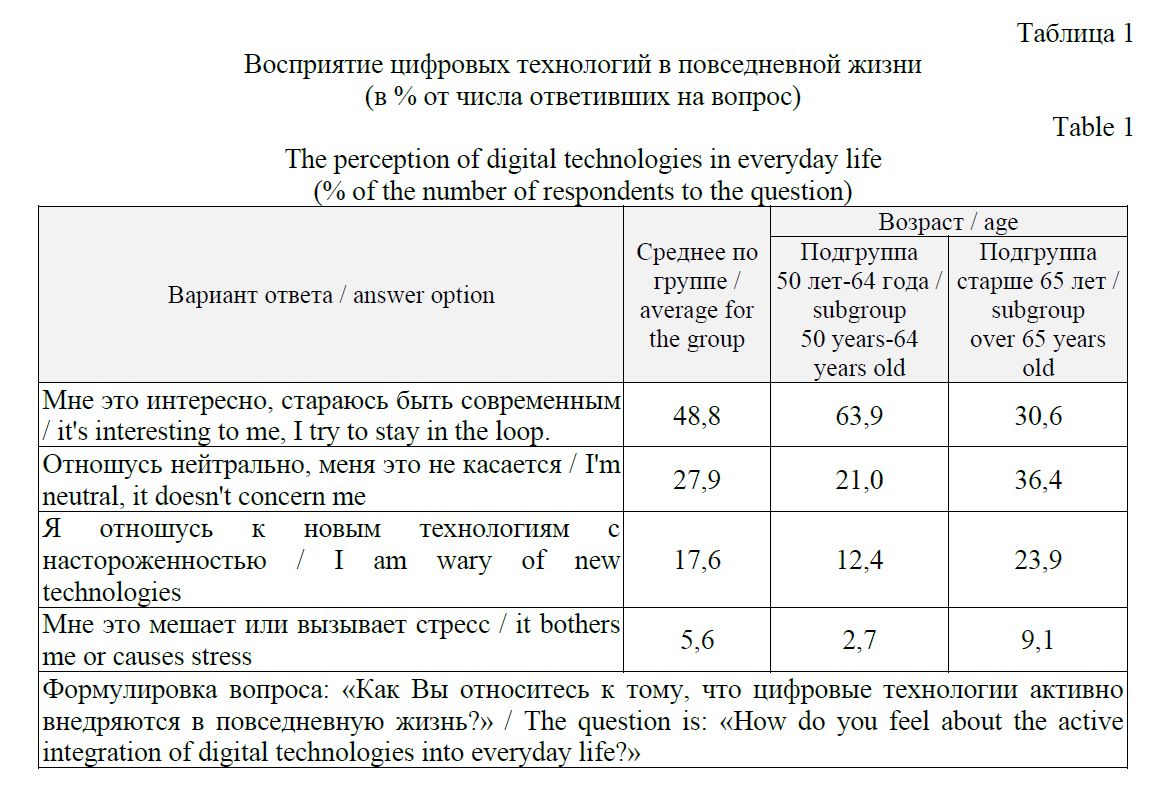
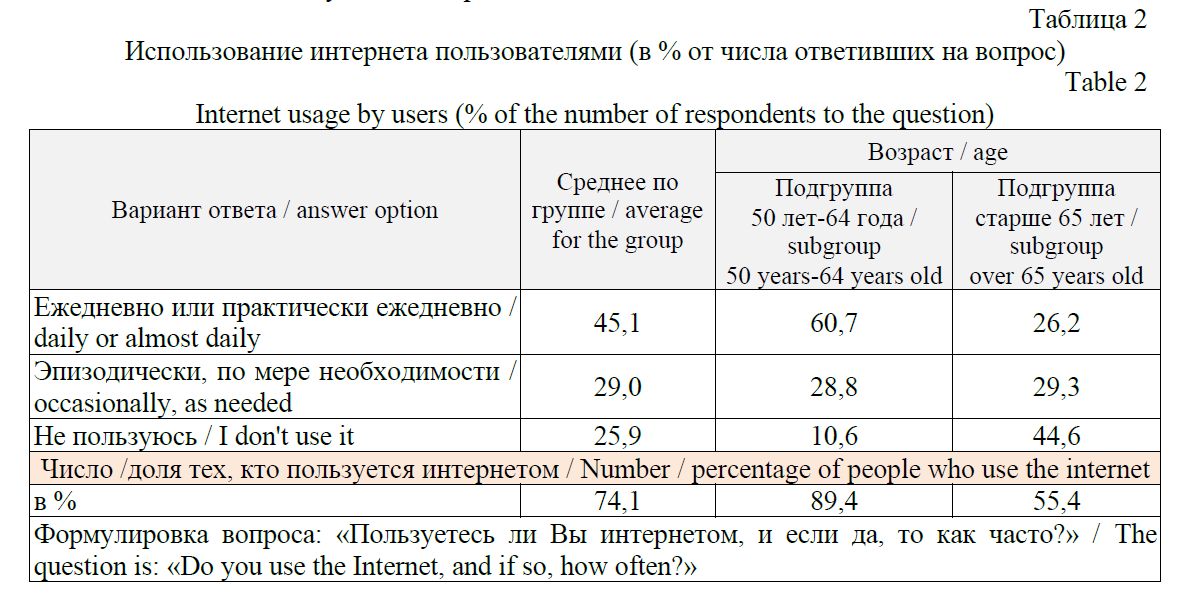
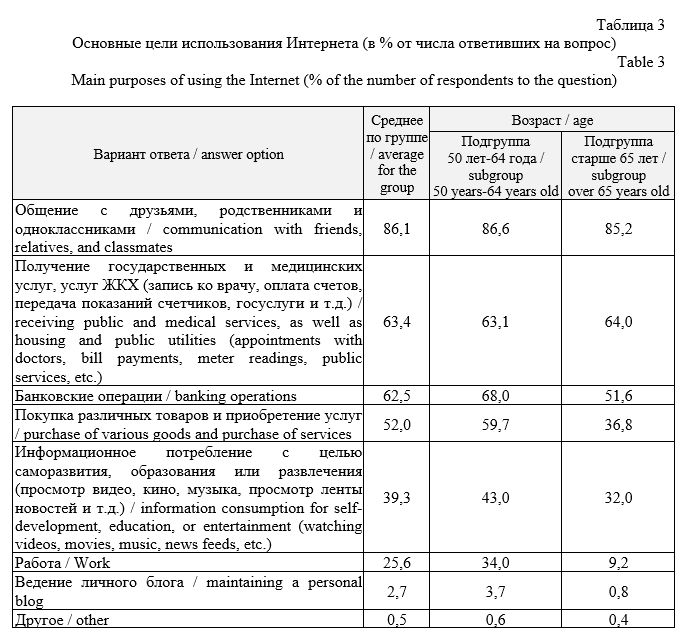
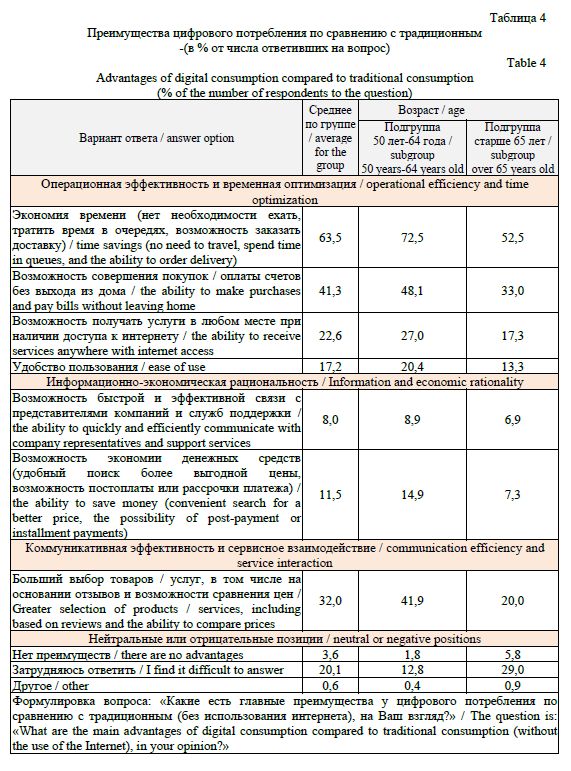
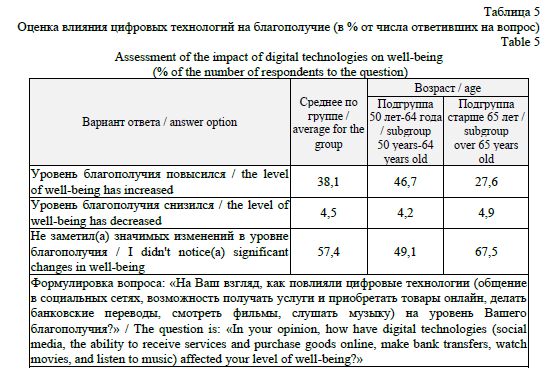
The relevance of the study is determined by the accelerated digitalization of public life, which poses significant challenges, especially for representatives of the “silver” age. The age-related “digital divide” affects not only access to technologies but also competencies, motivation, and subjective well-being. Scientific problem. Despite the growing interest in digital well-being, the experience of the older generation, their subjective perception of the benefits and risks of the digital environment, as well as the connection between digital practices and the overall assessment of well-being remain insufficiently studied, especially from a regional perspective and considering the internal differentiation within this age cohort itself. Methods. The study is based on data from a representative survey of the population of Vologda oblast aged 50 and older (N=1000, 2025). Age stratification into two subgroups (50-64 years old and 65+ years old) and comparative analysis were applied to identify differences in attitudes, practices, and perceptions of digital technologies. Scientific results. Two behavioral models were identified: a model of “digital integration” (in the 50-64 age group), characterized by a positive attitude towards technologies, daily internet use, and a wide range of online practices. The digital environment is perceived as a source of opportunities, contributing to time savings, autonomy, and social connections. Almost half of the respondents in this group note an increase in personal well-being thanks to technologies. A model of “digital pragmatism/exclusion” (predominant in the 65+ age group): characterized by a neutral or cautious attitude, low frequency or complete absence of internet use. Online practices are limited to basic socio-domestic functions. The positive impact of digitalization on well-being is noted less by this older age group. Conclusions. The digital well-being of the older generation is of a differentiated nature, determined by age boundaries. The advantages and main barriers to digital inclusion are identified.
Figures
Kosygina, K. E. (2026), “Digital well-being for seniors: opportunities and risks”, Research Result. Sociology and Management, 12 (1), 185-199. DOI: 10.18413/2408-9338-2026-12-1-1-0.















While nobody left any comments to this publication.
You can be first.
Aseeva, I. A. (2023), “Digital Well-Being of Society: An Interdisciplinary Approach”, Vestnik Tomskogo gosudarstvennogo universiteta. Filosofiya. Sotsiologiya. Politologiya, (71), 138-148, DOI: 10.17223/1998863X/71/14, EDN: GRXZGJ. (in Russian)
Borovskikh, N. V. (2022), “Population Engagement in the Digital Space: Trends and Development Prospects", Concept, (9), 101-106, DOI: 10.24412/2304-120X-2022-13009. (in Russian)
Varlamova, Yu. A. (2022), "Intergenerational Digital Divide in Russia”, Mir Rossii, 31 (2), 51-74, DOI: 10.17323/1811-038X-2022-31-2-51-74 (in Russian)
Gladkova, A. A., Garifullin, V. Z., Ragnedda, M. A. (2019), “Model of Three Levels of Digital Inequality: Current Opportunities and Limitations (Based on a Study of the Republic of Tatarstan)”, Vestnik Moskovskogo universiteta. Seriya 10. Zhurnalistika, (4), 41-72, DOI: 10.30547/vestnik.journ.4.2019.4172, EDN: GZLUXO. (in Russian)
Gruzdeva, M. A. (2022), “Age Factor of the Digital Divide: Facets of Inequality”, Ekonomicheskie i sotsialnye peremeny: fakty, tendentsii, prognoz, 15 (4), 228-241, DOI: 10.15838/esc.2022.4.82.14. (in Russian)
Gruzdeva, M. A., Gordievskaya, A. N. (2025), “Criteria for the Digital Well-Being of the Population: Status and Challenges”, Ekonomicheskie i sotsialnye peremeny: fakty, tendentsii, prognoz, 18 (5), 187-199, DOI: 10.15838/esc.2025.5.101.10. (in Russian)
Koroleva, D. O. (2016), "Always Online: The Use of Mobile Technologies and Social Networks by Modern Teenagers at Home and at School”, Voprosy obrazovaniya, (1), 205-224, DOI: 10.17323/1814-9545-2016-1-205-224, EDN: VSARVR. (in Russian)
Nestik, T. A., Soldatova, G. U. (2016), “Main Models of Digital Competence, Nauka. Kultura. Obshhestvo, (1), 107-119, EDN: ZYKSJF. (in Russian)
Soldatova, G. U., Rasskazova, E. I. (2023), "Digital Socialization of Russian Adolescents: Through the Prism of Comparison with Adolescents in 18 European Countries”, Sotsialnaya psikhologiya i obshhestvo, 14 (3), 11-30, DOI: 10.17759/sps.2023140302. (in Russian)
Chigarkova, S.V., Soldatova, G.U. (2026), “Formula for Digital Well-Being of an Individual”, Natsionalny psikhologicheskiy zhurnal, 21 (1), 44-53, DOI: 10.11621/npj.2026.0104. (in Russian)
Büchi, M. (2024), "Digital well-being theory and research”, New Media & Society, (26), 172-189, DOI: 10.1177/14614448211056851.
DiMaggio, P., Hargittai, E. (2001), From the 'Digital Divide' to 'Digital Inequality': Studying Internet Use as Penetration Increases, Princeton University, Woodrow Wilson School of Public and International Affairs, Center for Arts and Cultural Policy Studies, Working Papers.
Hargittai, E. (2002), Second level digital divide: Differences in people’s online skills, First Monday, 7 (4), available at: https://firstmonday.org/article/view/942/864 (Accessed 23 Yanuary 2026).
Meier, A., Reinecke, L. (2020), “Computer-mediated communication, social media, and mental health: A conceptual and empirical meta-review”, Communication Research, 48(8), 1182-1209.
Ragnedda, M. (2018), “Conceptualizing digital capital”, Telematics and Informatics,
35 (8), 2366-2375.
Sundberg, L. (2024), “Towards the Digital Risk Society: A Review”, Human Affairs, 34(1), 151-164, DOI: 10.1515/humaff-2023-0057.
Van Dijk, J. (2020), The Digital Divide, Cambridge, Polity Press.
Van Dijk, J. (2005), The Deepening Divide: Inequality in the Information Society, SAGE Publications, California.
Van Deursen, A., Van Dijk, J. (2014), Digital Skills: Unlocking the Information Society, Palgrave Macmillan.
This research was supported by the Russian Science Foundation grant № 25-28-01422 «Conceptual Foundations and Practices for Achieving Digital Well-being of the Older Generation in the Sphere of Consumption», https://rscf.ru/en/project/25-28-01422/.