

Russian state family policy in the regional dimension:
material incentives and value orientations of the young generation
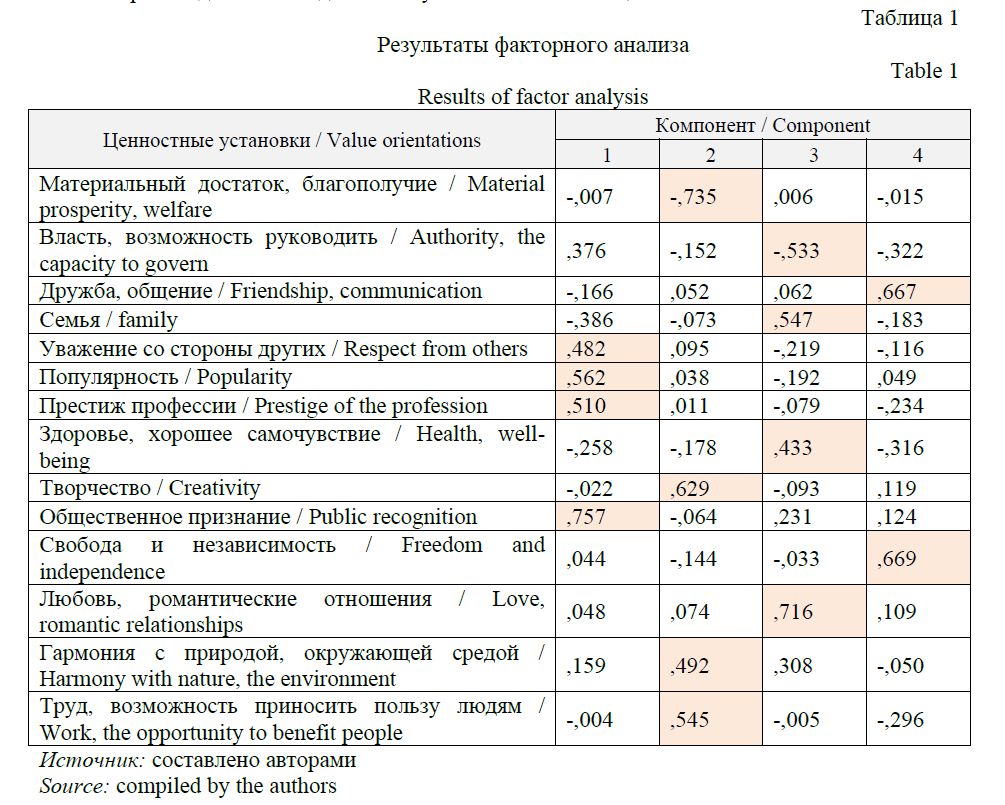
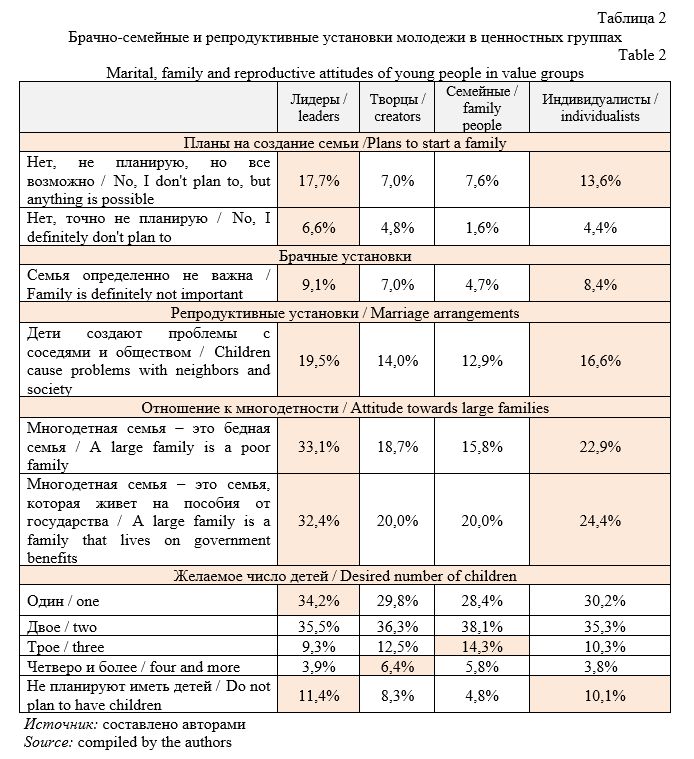
Relevance. Despite the existing set of measures, the birth rate in Russia remains significantly below the level of simple reproduction. The current model of state family policy focuses on material incentives, which is a necessary but insufficient condition for addressing demographic issues. The purpose of this article is to describe and analyze the implementation of state family policy at the regional level in relation to the value orientations of young people, their family and reproductive attitudes. The scientific problem lies in the discrepancy between the current material-oriented model of state family policy in the Russian Federation and the value diversity of modern youth. Methods. An analysis of regulatory, as well as a sociological survey among young people, were used. Scientific results. The analysis demonstrated that the model of family and demographic policy in Russia focuses primarily on material incentives to support the birth rate among young people. At the same time, a significant relationship between reproductive attitudes and the value orientations of young people was revealed. Only about a third (34.8%) of young people are oriented toward traditional family values, while the majority (about two-thirds) prioritize freedom, independence, creativity, and self-realization. Conclusions. Young people are a heterogeneous social group with varying motivations and responses to external stimuli. Understanding the value and motivational attitudes of different categories of youth (based on their focus on starting a family, the number of children they want, etc.) allows us to more effectively adapt social mechanisms and public policy strategies, fostering sustainable reproductive attitudes and support for family values among the younger generation.
Figures
Geger, A. E., Antoncheva, O. A., Lyashko, S. V., Kuznetsova, E. I. (2026), “Russian state family policy in the regional dimension: material incentives and value orientations of the young generation”, Research Result. Sociology and Management, 12 (1), 169-184. DOI: 10.18413/2408-9338-2026-12-1-0-9.















While nobody left any comments to this publication.
You can be first.
Aleksandrova, O. A. (2024), “Infantile or responsible: students about new trends in the marriage and family and reproductive spheres”, Narodonaselenie, 27 (S1), 107-119, DOI: 10.24412/1561-7785-2024-S1-107-119, EDN: YXWVNE. (In Russian)
Vishnevsky, A. G. (1986), “Processes of self-organization in the demographic system”, Sistemnye issledovaniya. Metodologicheskie problemy. Ezhegodnik, Nauka, Moscow, Russia, 233-245. (In Russian)
Vishnevsky, A. G. (2005), Izbrannye demograficheskie trudy [Selected demographic works], Nauka, Moscow, Russia, ISBN: 5-02-033776-5. (In Russian)
Vyalshina, A. A. (2022), “Types of reproductive orientations of modern students”, Narodonaselenie, 25(3), 176-188, EDN: ZGVPSL. (In Russian)
Gareeva, I. A. (2023), “Social Conditioning of the Reproductive Behavior of the Population”, Vlast i upravlenie na Vostoke Rossii, (1), 101-110, DOI: 10.22394/1818-4049-2023-102-1-101-110, EDN: JWDPOR. (In Russian)
Zhuravleva, E. K. and Koptseva, O. A. (2024), “Reference points of large families in the context of the transformation of modern Russia”, Narodonaselenie, 27 (S1), 28-37, DOI: 10.24412/1561-7785-2024-S1-28-37, EDN: PABRMG. (In Russian)
Kasyanov, V. V., Manucharyan, A. K. and Samygin, P. S. (2024), “The young Russian family as the most important resource in state policy”, Gumanitarnye, sotsialno-ekonomicheskie i obshhestvennye nauki, (7), available at: https://online-science.ru/catalogs/sociologicheskie-nauki-7-2024-g -/ (Accessed 27 September 2025). (In Russian)
Klupt, M. A. (2008), Demografiya regionov Zemli: sobytiya noveishey demograficheskoy istorii [Demography of the regions of the Earth: events of modern demographic history], Peter, Moscow, Russia, 346, ISBN: 978-5-91180-584-5. (In Russian)
Makarentseva, A. O., Galieva, N. I. and Rogozin, D. M. (2021), “(Not) the desire to have children in the mirror of population surveys”, Monitoring public opinion: economic and social changes, (4), 492-515, DOI: 10.14515/monitoring.2021.4.1871. (In Russian)
Nazarova, I. B. and Zelenskaya, M. P. (2017), “Research of reproductive attitudes of student youth: a value aspect (review article)”, RUDN Journal of Sociology, 17 (4), 555-567, DOI: 10.22363/2313-2272-2017-17-4-555-567. (In Russian)
Neznanova, V. S. (2025), “Comparison of social development indicators of Saint Petersburg and Russia as a source for finding positive management practices”, Teoriya i praktika obshhestvennogo razvitiya, (4) 82-94, DOI: 10.24158/tipor.2025.4.8. (In Russian)
Ovchinnikova, N. V. (2024), “Reproductive attitudes of youth”, Sotsialnye i gumanitarnye znaniya, 10 (2), 202-217, available at: https://scinetwork.ru/articles/9733 (Accessed 23 September 2025). (In Russian)
Parshina, V. V. (2013), “State family policy in relation to a young family: basic principles and directions”, Problemy sovremennoy nauki i obrazovaniya, (4), 131-134, EDN: SCPLDZ. (In Russian)
Popova, N. M., Popov, A. V. and Ivanova, M. A. (2025), “Characteristics of family values and reproductive attitudes of medical university students”, Sotsialnye aspekty zdorovya naseleniya, 71(1):10, DOI: 10.21045/2071-5021-2025-71-1-10. (In Russian)
Rostovskaya, T. K., Kuchmaeva, O. V., Solovyova, N. A. and Azarova E. S. (2024), “Reproductive potential of a young family: an analysis of a sociological study”, Zhenshhina v rossiyskom obshhestve, (4), 35-50, DOI: 10.21064/WinRS.2024.4.3. (In Russian)
Senenko, A. Sh., Armashevskaya, O. V., Sokolovskaya, T. A. and Shelgunov, V. A. (2024), “Reproductive attitudes of youth: a regional study”, Profilakticheskaya meditsina, (27), 74-81, DOI: 10.17116/profmed20242704174. (In Russian)
Rostovskaya, T. K., Zolotareva, O. A. and Vasilyeva, E. N. (2022), “Models of matrimonial and reproductive behavior of Russian youth”, Ekonomicheskie i Sotsialnye peremeny: fakty, tendentsii, prognoz, 15 (3), 184-199, DOI: 10.15838/esc.2022.3.81.10. (In Russian)
Rostovskaya, T. K. and Knyazkova, E. A. (2020), Molodezhnaya politika v sovremennoy Rossii [Youth policy in modern Russia], Yurait, Moscow, Russia, ISBN: 978-5-534-13287-8. (In Russian)
Rostovskaya, T. K. and Knyazkova, E. A. (2021), “Reproductive attitudes in Russian society: according to the All-Russian sociological research”, Bulletin of the South Russian State Technical University (NPI). Series: Socio-economic sciences, 14 (2), 121-129, DOI: 10.17213/2075-2067-2021-2-121-129. (In Russian)
Rostovskaya, T. K. and Sitkovsky, A. M. (2025), “A large multigenerational family as a key resource of a new long-term strategy for Russia's demographic development”, Herald of the Russian Academy of Sciences, (4), 63-74, DOI: 10.21064/WinRS.2024.4.3. (In Russian)
Semenova V. G. (2006), Demograficheskiy krizis v Rossii s pozitsiy obratnogo epidemilogicheskogo perekhoda [The demographic crisis in Russia from the position
of the reverse epidemiological transition], abstract of D. Sc. dissertation (Economy), Moscow, Russian Federation. (In Russian)
Senenko, A. Sh., Armashevskaya, O. V., Sokolovskaya, T. A., Shelgunov, V. A. (2024), “Reproductive attitudes of young people: a regional study, Profilakticheskaya meditrsina, (27), 74-81, DOI: 10.17116/profmed20242704174. (In Russian)
Sivoplyasova, S. Y. (2022), “Reproductive attitudes of modern youth towards having many children: patterns and contradictions”, Ekonomicheskie i Sotsialnye peremeny: fakty, tendentsii, prognoz, 15 (1), 223-242, DOI: 10.15838/esc.2022.1.79.12. (In Russian)
Sigareva, E. P. and Sivoplyasova, S. Y. (2018), “Large families in Russia: state and prospects”, SOTIS – Sotsialnye tekhnologii, issledovaniya, (2), 83-94, EDN: OVBJSL. (In Russian)
Soboleva, S. V., Smirnova, N. E. and Chudaeva, O.V (2016), “Demographic security of Russia: regional measuring instruments, evaluation of results”, Mir novoy ekonomiki, (4), 142-153, EDN: XIRSQR. (In Russian)
Soboleva, S. V., Smirnova, N. E. and Chudaeva O. V. (2023), “Features of changes in the number and age structure of reproductive contingents of women in Russia under conditions of depopulation”, Region: ekonomika i sotsiologiya, (1), 138-169, DOI: 10.15372/REG20230105. (In Russian)
Soboleva, S. V., Smirnova, N. E. and Chudaeva O.V. (2008), “Demographic security of Russia and its regions: factors, problems, indicators”, Region: ekonomika i sotsiologiya, (3), 147-167, EDN: JVIVEL. (In Russian)
Filippenko, V. A. (2024), “Features of reproductive behavior of student youth on the example of the Tambov region of the Russian Federation”, Vestnik universiteta, (11), 224-236, DOI: 10.26425/1816-4277-2024-11-224-236. (In Russian)
Esping-Andersen, G. (1999), Social foundations of postindustrial economies, Oxford University Press, Oxford.
Esping-Anderson, G. (1990), The three worlds of welfare capitalism, Polity Press, Cambridge, ISBN 0-7456-0665-2.
Gauthier, Anne H. and Stuart, Gietel‐Basten (2025), “Family policies in low fertility countries: Evidence and reflections”, Population and Development Review, 51 (1), 125-161, DOI: 10.1111/padr.12691.
Huczewska, I., Kruk, K. and Mynarska, M. (2025), “Understanding the link between parentification and desire to have children: moderating role of perceived fairness”, Journal of Reproductive and Infant Psychology, 1-16, DOI: 10.1080/02646838.2025.2480388.
Lesthaeghe, R.A. (1983), “Century of demographic and cultural change in Western Europe: An exploration of underlying dimensions”, Population and development Review, 411-435, DOI: 10.2307/1973316.
Schwartz, S. H. (2005), Basic human values: Their content and structure across countries, in A. Tamayo and J.B. Porto (eds), Valores e comportments nas organizações [Values and behavior in organizations], Petropolis, Vozes, Brazil, 21-55.
Tartakovsky, E. and Mizrahi, M. (2025), ‘The motivational foundations of childbearing: Investigating relationships between childbearing attitudes, value preferences, and parental bonding”, PLoS One, 20 (5), e0324243, DOI: 10.1371/journal.pone.0324243.
Van de Kaa, D. J. (2002), “The idea of a second demographic transition in industrialized countries”, Birth, 35 (3), available at: https://www.semanticscholar.org/paper/The-Idea-of-a-Second-Demographic-Transition-in-Kaa/17c8c2c3b43d447474107554926eb289d269c939 (Accessed: 23.09.2025).
The article was written on the basis of the RANEPA State Assignment Research Programme 1.7-2026-1.