

Social portrait of a substitute parent and typology of substitute parenthood models
(based on the results of a survey in the Rostov region)
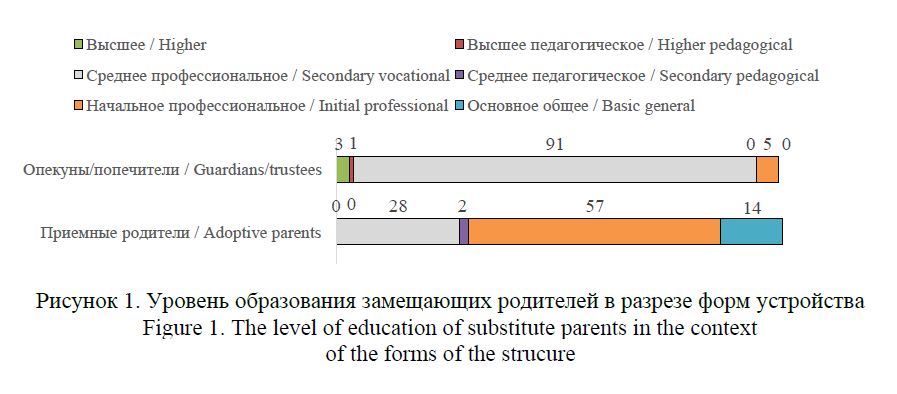
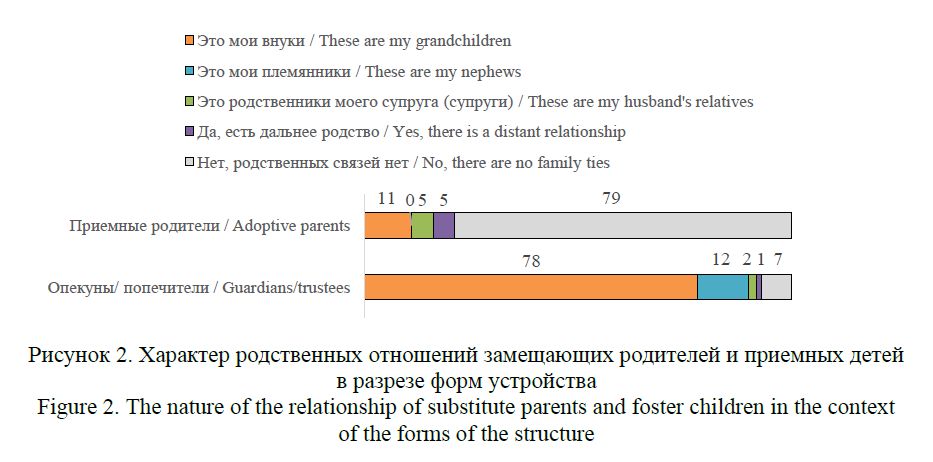
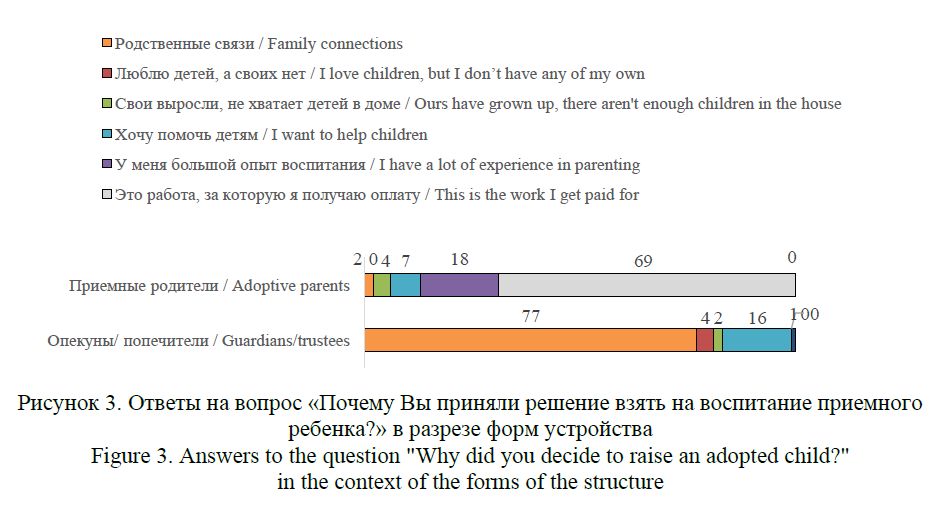
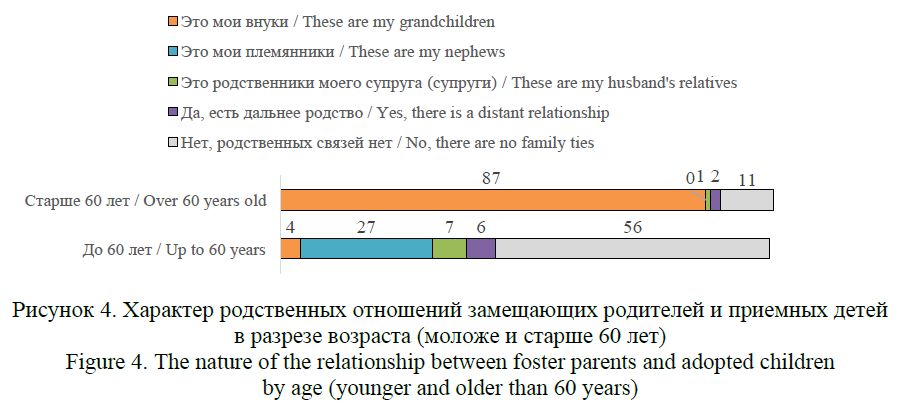
The article substantiates the need for a flexible social policy for substitute parenthood in Russia, targeted social support tools, and support technologies taking into account the social profile and status of substitute parent. The materials of a questionnaire survey in the Rostov region show that a typical substitute parent is an оlder retired woman raising her own grandchildren, who has the status of a trustee or guardian (substitute grandparents). Operating with a social portrait and the status of substitute parents in different configurations, we have identified three typical models: professional, related substitute parenthood and substitute grandparenthood. On the one hand, substitute parents experience general problems (insufficient pedagogical and communicative competence due to a low level of education, low material, professional, employment status), which are aggravated by environmental and institutional factors (ambivalent attitude, devaluation, stigmatization of substitute parenthood, object orientation of social support, its focus on the interests of children without taking into account the problems of parents). On the other hand, the forms of device, kinship statuses and combinations of social statuses of parents (educational, housing, family, age and health status, etc.) cause differences in motivation, perception of their parenthood and experience, problems and needs. Our data demonstrate that substitute parents are not a monolithic group; their characteristics, needs, and resources vary depending on their social profile and various status combinations. The proposed typology of substitute parenthood models can serve as a basis for further research and the development of differentiated social policies and support systems.
Figures
Martynova, E V., Kienko, T. S. (2026), “Social portrait of a substitute parent and typology of substitute parenthood models (based on the results of a survey in the Rostov region)”, Research Result. Sociology
and management, 12 (1), 96-110. DOI: 10.18413/2408-9338-2026-12-1-0-5.
















While nobody left any comments to this publication.
You can be first.
Bezrukova, O. N., Samoylova, V. A. (2019), “Support of a substitute family or how to reduce the risk of secondary failures”, Sotsiologicheskie issledovaniya, (1), 85-95, DOI: 10.31857/S013216250003750-8. (In Russian)
Bushueva, T. N., Pisareva, L. A. (2023), “State policy on children left without parental care: the trend towards the development of foster parenting”, Biznes i obshhestvo, (2), 15-19, EDN: EAKZGS. (In Russian)
Grigorieva, I. A. (2018), “Elderly women: “down the ladder” of age and gender. Woman in Russian society”, Zhenshhina v rossiyskom obshhestve, (1), 5-18, DOI: 10.15688/lp.jvolsu.2018.2.5. (In Russian)
Dvurechenskaya, L., Ubozhenko, A., Ordina, Z., Vasilkova, E., Mishanina, N., Mitrofanova, M. (2022), «Rodnye lyudi»: programma povysheniya resursnosti zameshhayushhih semey s rodstvennoy opekoy [“Native people”: a program to increase the resourcing of substitute families with kinship care], ed. by Archakova T. O., BDF «Viktoriya», Moscow, Russia. (In Russian)
Martynova, E. V. (2021), “Analysis of the formation of the institution of a substitute family”, Sotsialnaya politika i sotsialnoe partnerstvo, (1), 58-62, DOI: 10.33920/pol-01-2101-10. (In Russian)
Mahnach, A. V., Laktionova, A. I., Postylyakova, Ju. V., Lotareva, T. Ju. (2018), Zhiznesposobnost zameshhayushhey semi: profilaktika otkazov ot priemnyh detey [The viability of a foster family: preventing abandonment of adopted children], Institut psihologii RAN, Moscow, Russia. (In Russian)
Oslon, V. N. (2006), Zhizneustroystvo detey-sirot: professionalnaya zameshhayushhaya semya [Orphanage placement: professional foster families], Genezis, Moscow, Russia. (In Russian)
Chernova, Z. V., Shpakovskaya, L. L., Garifulina, E. Sh. (2020), “Motives and practices of creating foster families (analysis of narratives)”, Sociologicheskie issledovaniya, (2), 74-83, DOI: 10.31857/S013216250008495-7. (In Russian)
Danielsbacka, M., Křenková, L. & Tanskanen, A. O. (2022), “Grandparenting, health, and well-being: a systematic literature review, Europian Journal of Ageing, (19), 341-368, DOI: 10.1007/s10433-021-00674-y.
Edwards, O. W., Benson N. F. (2010), “A Four-Factor Social Support Model to Mediate Stressors Experienced by Children Raised by Grandparents”, Journal of Applied School Psychology, 26 (1), 54-69, DOI: 10.1080/15377900903368862.
Gillis-Arnold, R., Crase, S. J., Stockdale, D. F., & Shelley, M. C., II. (1998), “Parenting Attitudes, Foster Parenting Attitudes, and Motivations of Adoptive and Nonadoptive Foster Parent Trainees”, Children and Youth Services Review, 20 (8), 715-732, DOI: https://doi.org/10.1016/s0190-7409(98)00033-4.
Goodman, C. C., Potts, M. K., Pasztor, E. M. (2007), “Caregiving Grandmothers with vs. without Child Welfare System Involvement: Effects of Expressed Need, Formal Services, and Informal Social Support on Caregiver Burden”, Children and Youth Services Review, (29), 428-441.
Kelley, S. J., Whitle, D., Sipe, T. A., Yorker, C. B. (2000), “Psychological Distress in Grandmother Kinship Care Providers: The Role of Resources, Social Support, and Physical Health”, Child Abuse & Neglect, 24 (3), 311-321.
Lopez, A. R., Nadorff, D. K., Peters, D. (2023), “The Twelve Ds: An Update to Edwards and Benson’s Reasons for Non-Parental Caregiving”, International Journal of Environmental Research and Public Health, (20), 5618, DOI: 10.3390/ijerph20095618.
Rahmatullah, A. S., Astuti, K., Warsah, I., Suyatno, S., Yaenullah, J. (2023), “Exploring the Role of Grandparenting in Enhancing the Positive Mental Health of Children from External Migrant Worker Families”, Islamic Guidance and Counseling Journal, 6 (1), 83-98, DOI: 10.25217/igcj.v6i1.3281.
Xu, Y., Wang, Y., McCarthy, L. P., Harrison, T., & Doherty, H. (2022), “Mental / Behavioural Health and Educational Outcomes of Grandchildren Raised by Custodial Grandparents: A Mixed Methods Systematic Review”, Health & Social Care in the Community, 30 (6), 2096-2127, DOI: 10.1111/hsc.13876.