

Social portrait of the youth of the Republic of Karelia in the context of the transforming geopolitical space of Northern Eurasia: results of an empirical study
The article presents the results of an empirical study of the social portrait of youth of the Republic of Karelia in the context of transformation of geopolitical space of the North of Eurasia. Karelia is not just a region of the Russian North, but also a strategic border region bordering Finland and having the longest state border with the European Union and NATO countries. The transformation of the geopolitical space is particularly intense here. This is what actualizes the study of the value attitudes of youth as a key human resource of the border region, an indicator and agent of transformation. The study makes up for the lack of comprehensive sociological data on youth in the region. The theoretical framework is the approach of Yu. A. Zubok and V. I. Chuprov to the study of youth in a risk society and the concept of regional identity by M. Keating. Methods: questionnaires (n=3024). Values, problems, life plans, implementation factors are identified and ranked, political activism and patriotism are studied. Cluster analysis made it possible to identify groups by level of participation, including the socially passive “risk group”. Key characteristics of Karelian youth: “rootedness”, adaptive pragmatism, family orientation, systemic pessimism, regional ambivalence. Differences between the capital and the districts in adaptation strategies and migration attitudes are recorded. The dominance of a traditionalist identity, while maintaining trends, may lead to a loss of stability for Russia on its northern borders.
Figures
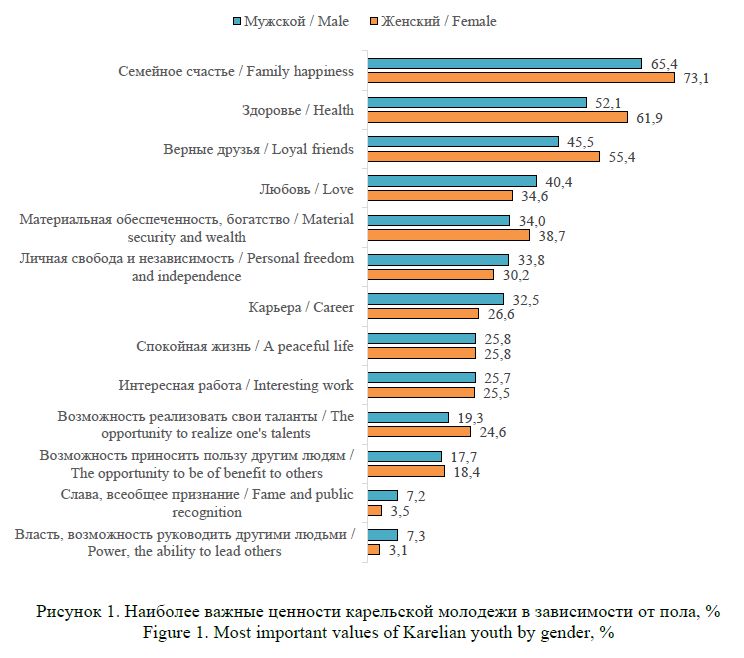
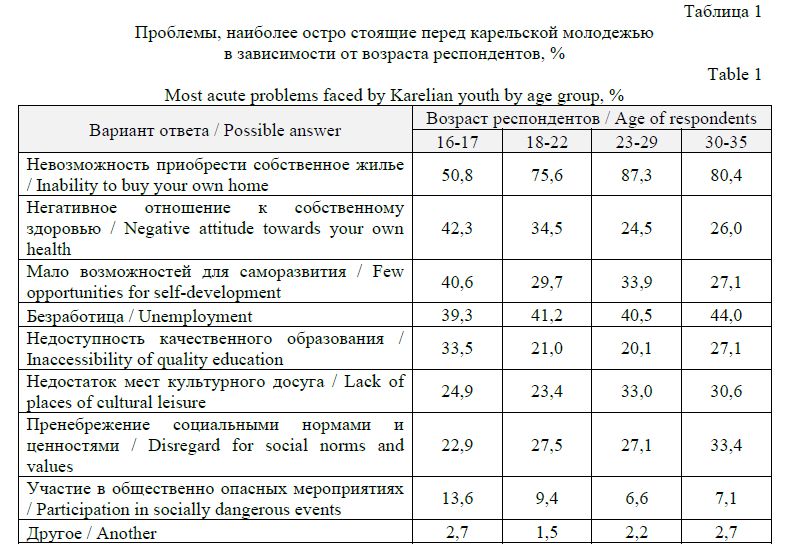
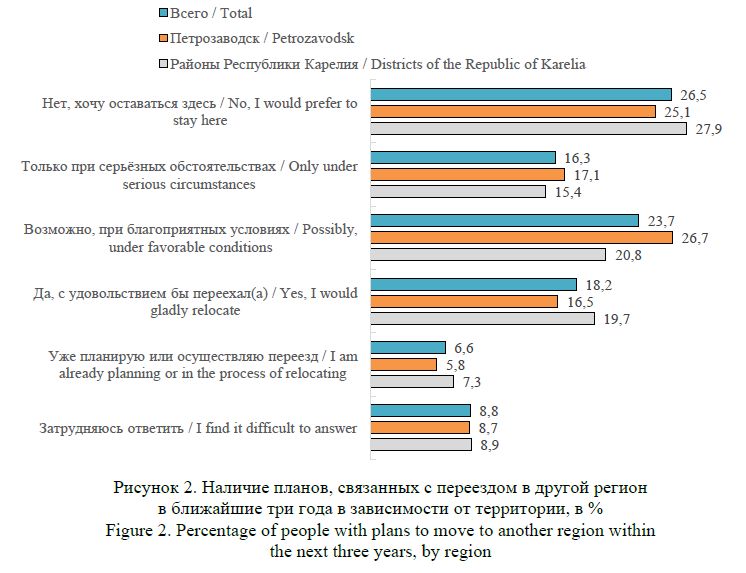
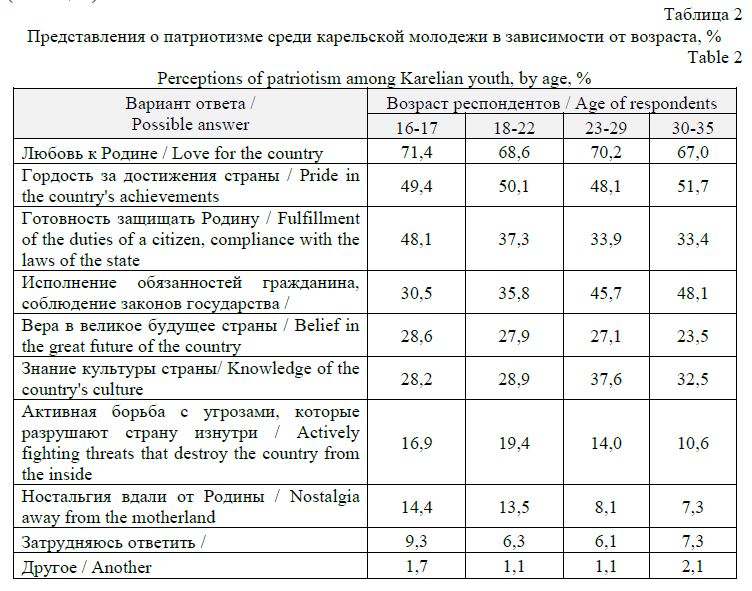
Petrovskaya, Yu. A., Fedoseeva, O. V., Fadeeva, N. L., Sachuk, D. I., Andreeva, N. O. (2026), “Social portrait of the youth of the Republic of Karelia in the context of the transforming geopolitical space of Northern Eurasia: results of an empirical study”, Research Result. Sociology and Management, 12 (4), 201-214. DOI: 10.18413/2408-9338-2026-12-4-1-3.














While nobody left any comments to this publication.
You can be first.
Gavrilyuk, V. V., Trikoz, N. A. (2000), “Dynamics of value orientations in the period of social transformation (generational approach)”, Sociological Research, (12), 104-108, [Online], available at: https://belbsi.by/library/dinamika-cennostnyh-orientacii-v-period-socialnoj-transformacii/?ysclid=mklcjxhg9z873594884 (Accessed 19 January 2026). (In Russian)
“Annual monitoring of the value orientations of modern youth” (2022), Institute of Education. [Online], available at: https://институтвоспитания.рф/upload/medialibrary/1d6/mmszf6z2737imxwxgg32297kfqu94gz8.pdf (Accessed 19 January 2026). (In Russian)
Zubok, Yu. A., Chuprov, V. I. (2019), “Self-regulation of meaningful values in the cultural space of youth”, Vestnik Instituta sotsiologii, 10(4), 164-186. DOI: 10.19181/vis.2019.31.4.614, EDN: SBTVHF. (In Russian)
Ivchenkоv, S. G., Sayganova, E. V. and Shakhmatova, N. V. (2022), “Dynamics of social well-being of Saratov youth: employment, values and concerns”, Izvestiya Saratovskogo universiteta. Novaya seriya. Seriya: Sotsiologiya. Politologiya, 22 (1), 51-59, DOI: 10.18500/1818-9601-2022-22-1-51-59, EDN: WMHVKI. (In Russian)
Kalinnikova, M. V. and Tolok, E. S. (2024), “Value orientations of regional students: a sociological analysis”, Izvestiya Saratovskogo universiteta. Novaya seriya. Seriya: Sotsiologiya. Politologiya, 24 (2), 124-131, DOI: 10.18500/1818-9601-2024-24-2-124-131, EDN: PUJEVU. (In Russian)
Keating, M. (2003), “The New Regionalism in Western Europe”, Logos, (6(40)), 67-116. (In Russian)
Menshikova, O. I. (2006), “Higher education as an element of the formation of social and labour potential”, Znanie. Ponimanie. Umenie, (4), 65-73, EDN: JVIDAX. (In Russian)
“Monitoring the value orientations of children and youth” (2025), Institute of Education, [Online], available at: https://институтвоспитания.рф/upload/medialibrary/f49/rtgj08mg2rdakpolos53kv631m8ztas5.pdf (Accessed 25 January 2026). (In Russian)
“Monitoring of youth's value orientations: results, conclusions, suggestions” (2023), Institute of Education, [Online], available at: https://институтвоспитания.рф/upload/medialibrary/225/92v94a62ylydo1fr8ldrxi7xg1sayn5p.pdf (Accessed 19 January 2026). (In Russian)
Stepus, I. S., Averyanov, A. O., Khoteeva, E. A., Simakova, A. V. and Shabaeva, S. V. (2024), “Motivational drivers of population migration (the case of youth in the Arctic zone of Russia)”, Region: ekonomika i sotsiologiya, (3), 98-125, DOI: 10.15372/REG20240305, EDN: AKRTJM. (In Russian)
Omelchenko, D. A. and Omelchenko, E. L. (2022), “In search of home. Regional identity of young people in Kaliningrad: life strategies and migration intentions”, Monitoring obshchestvennogo mneniya: ekonomicheskie i sotsialnye peremeny, (6), 309-332, DOI: 10.14515/monitoring.2022.6.2317, EDN: XZDGTM. (In Russian)
Potyomkin, V. K. (2018), “Youth in the system of modern social relations”, Zhurnal pravovykh i ekonomicheskikh issledovaniy, (2), 270-276. (In Russian)
Simakova, A. V., Khoteeva, E. A., Stepus, I. S. and Averyanov, A. O. (2024), “Regional aspect of migration attitudes among youth in the Russian Arctic”, Narodonaselenie, 27 (1), 136-152, DOI: 10.24412/1561-7785-2024-1-136-152, EDN: CQTIQX. (In Russian)
Simakova, A. V., Averyanov, A. O., Stepus, I. S., Khoteeva, F. A. (2025), “Northern Identity as a Factor of Restraining Youth Migration: Attitudes in the Russian Arctic Zone”, Sociological Journal, 31 (1), 25-46, DOI: 10.19181/socjour.2025.31.1.2, EDN: JUONVY. (In Russian)
Chuprov, V. I., Zubok, Yu. A., Pevtsova, E. A. (2009), Molodezh i krizis: dialektika neopredelennosti i opredelennosti v sotsialnom razvitii [Youth and crisis: the dialectic of uncertainty and certainty in social development], JSC “TID “Russian word – RS”, Moscow, Russia. (In Russian)
Chuprov, V. I., Zubok, Yu. A., Wiliams, K. (2003), Molodezh v obshhestve riska [Youth in a society at risk], Science, Moscow, Russia. (In Russian)
Scherbakova, V. P. (2013), “Transformation of youth's value orientations as an indicator of their social adaptation”, Izvestiya TulGU. Gumanitarnye nauki, (3-1), 220-230, EDN: RCRYZJ. (In Russian)
Schulz, W. (2024), “Young people’s trust in institutions, civic knowledge and their dispositions toward civic engagement”, Large-scale Assessments in Education, 12, 23, DOI: 10.1186/s40536-024-00210-1, EDN: YVCYOH.
The study was conducted within the framework of the “Region for the Young” program of the National project “Youth and Children” with support from the Department of Youth Policy of the Republic of Karelia.