

Regional infrastructure in the formation of adaptation and demographic strategies of international migrants
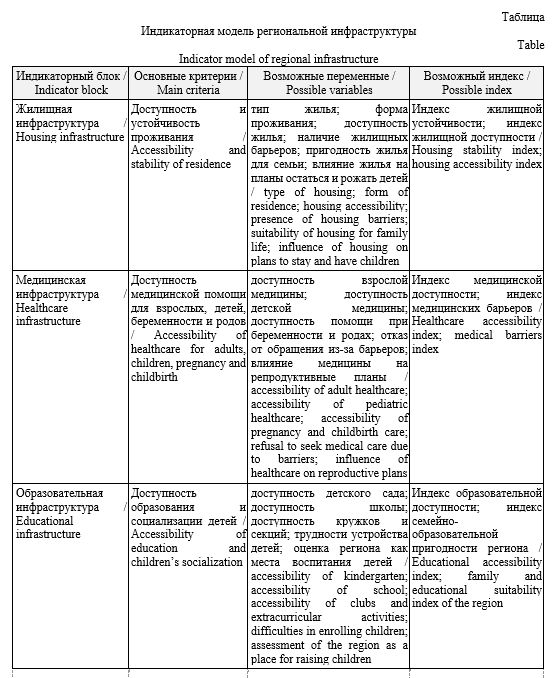
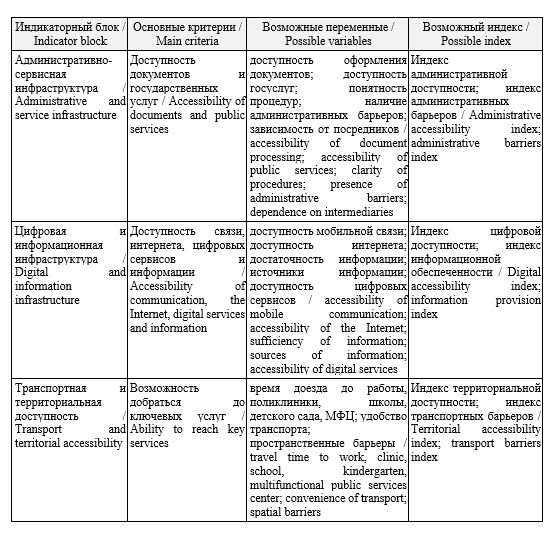
The article examines regional infrastructure as a factor in the formation of adaptation and demographic strategies of international migrants. It substantiates the need to move from analyzing migration mainly at the level of federal regulation and individual adaptation trajectories to studying the regional environment as a condition of migrants' adaptation and demographic behavior. It is shown that regional infrastructure is not only a complex of social facilities, but also a set of resources, institutions and services available to migrants in their everyday stay and interaction with the host society. The author proposes to consider regional infrastructure as a combination
of housing, medical, educational, administrative-service, digital, information, transport and territorial conditions. The purpose of the article is to reveal regional infrastructure as a sociological category for analyzing adaptation and demographic strategies
of international migrants and to substantiate an approach to its operationalization, as well as to develop an integral model of regional infrastructure. The proposed theoretical and methodological approach analyzes how access to housing, healthcare, education, administrative services, digital information and territorial mobility, as well as the migrant's legal status, influence family and reproductive decisions, attitudes toward settlement, integration or segregation. The conclusion is made about the need to use the infrastructural approach in developing regional mechanisms of migration policy and assessing the adaptive potential of the constituent entities of the Russian Federation.
Figures
Ledeneva, V. Yu. (2026), “Regional infrastructure in the formation of adaptation and demographic strategies of international migrants”, Research Result. Sociology and Management, 12 (4), 185-200. DOI: 10.18413/2408-9338-2026-12-4-1-2.
















While nobody left any comments to this publication.
You can be first.
Aleksandrov, D. A., Ivanyushina, V. A. and Kazartseva, E. V. (2012), “Migrant children and parents in interaction with the Russian school”, Voprosy obrazovaniya, (1), 176-199, DOI: 10.17323/1814-9545-2012-1-176-199, EDN: OXIMQV. (In Russian)
Brednikova, O. E. and Sabirova, G. A. (2015), “Children in migrant families: parental strategies in transnational contexts”, Antropologichesky forum, (26), 127-152, EDN: UZNOJN. (In Russian)
Zheleznyakova, E. A. (2023), “Language adaptation of children from migrant families in Russian school”, Vestnik Vyatskogo gosudarstvennogo universiteta, 3 (149), 109-116, DOI: 10.25730/VSU.7606.23.041, EDN: GDXIMF. (In Russian)
Ilimbetova, A. A. (2021), “Adaptation and integration of migrants: conditions, goals, approaches”, Vestnik Instituta ekonomiki Rossyskoy akademii nauk, (2), 144-155, DOI: 10.52180/2073-6487_2021_2_144_155, EDN: TSSPGZ. (In Russian)
Kononov, L. A. and Ledeneva, V. Yu. (2021), “Adaptation and integration of international migrants: theoretical and methodological problems”, Mirovaya ekonomika i mezhdunarodnye otnosheniya, 65 (4), 103-112, DOI: 10.20542/0131-2227-2021-65-4-103-112, EDN: BDHOAF. (In Russian)
Lakomova, A. A. (2016), “Social adaptation of migrants in the Nizhny Novgorod region: problems and ways of solution”, Nauka. Mysl, (6-2), 119-124, EDN: WADNYH. (In Russian)
Ledeneva, V. Yu. and Kononov, L. A. (2021), Gosudarstvennoe i munitsipalnoe regulirovanie protsessov adaptatsii i integratsii migrantov v sovremennoy Rossii [State and municipal regulation of adaptation and integration of migrants in contemporary Russia], RUDN University, Moscow, Russia, ISBN: 978-5-209-10212-0. EDN: XSUKPP. (In Russian)
Mukomel, V. I. and Grigorieva, K. S. (eds.) (2022), Adaptatsiya i integratsiya migrantov v Rossii: vyzovy, realii, indikatory [Adaptation and integration of migrants in Russia: challenges, realities, indicators], FCTAS RAS, Moscow, Russia, DOI: 10.19181/monogr.978-5-89697-407-9.2022, ISBN: 978-5-89697-407-9, EDN: YKKOSI. (In Russian)
Omelchenko, E. A. (2021), “Children from migrant families in the Ryazan and Kaluga regions: problems of integration into Russian society”, Vestnik Chuvashskogo universiteta, (2), 142-157, DOI: 10.47026/1810-1909-2021-2-142-157, EDN: IYAHVE. (In Russian)
Osadchaya, G. I., Yudina, T. N. and Kocherbaeva, A. A. (2023), “Reproductive behavior of migrants from Central Asia in the Moscow agglomeration”, DEMIS. Demograficheskie issledovaniya, 3 (4), 78-91, DOI: 10.19181/demis.2023.3.4.5, EDN: OFLPIM. (In Russian)
Putulyan, N. S. and Zakirova, V. G. (2021), “Adaptation of migrant children in Russian school: experience of applying expert assessment method in diagnosing adaptation”, Kazansky pedagogichesky zhurnal, 3 (146), 165-172, DOI: 10.51379/kpj.2021.147.3.023, EDN: JHCPVO. (In Russian)
Savoskul, M. S. (2012), “Adaptation of ethnic migrants in Russian regions”, Vestnik Moskovskogo universiteta. Seriya 5: Geografiya, (2), 59-64, EDN: PAOSXT. (In Russian)
Saryglar, S. A. (2021), “The image of a migrant in the perceptions of the population of a border region”, Society and Security Insights, 4 (2), 136-152, DOI: 10.14258/ssi(2021)2-03, EDN: YQKJZZ. (In Russian)
Trufanov, D. O., Vasilieva, O. V. and Rafikov, R. G. (2024), “Factors of adaptation of foreign labor migrants in a Russian region: based on sociological studies in Krasnoyarsk Krai”, Rossiya i sovremenniy mir, (3), DOI: 10.31249/rsoc/2024.03.02, EDN: HIUSGA. (In Russian)
Yudina, T. N. (2025), “Adaptation of adolescents with a migration history through the prism of parental perception: key barriers and expectations from the support system”, Society and Security Insights, 8 (3), 39-64, DOI: 10.14258/SSI(2025)3-02, EDN: KUKARS. (In Russian)
Ager, A. and Strang, A. (2008), “Understanding Integration: A Conceptual Framework”, Journal of Refugee Studies, 21 (2), 166-191, DOI: 10.1093/jrs/fen016.
Berry, J. W. (1997), “Immigration, acculturation, and adaptation”, Applied Psychology: An International Review, 46 (1), 5-68, DOI: 10.1111/j.1464-0597.1997.tb01087.x.
Massey, D. S., Arango, J., Hugo, G., Kouaouci, A., Pellegrino, A. and Taylor, J. E. (1993), “Theories of International Migration: A Review and Appraisal”, Population and Development Review, 19 (3), 431–466, DOI: 10.2307/2938462.
Penninx, R. and Garcés-Mascareñas, B. (2016), “The concept of integration as an analytical tool and as a policy concept”, Integration Processes and Policies in Europe: Contexts, Levels and Actors, Springer Open, Cham, 11-29, DOI: 10.1007/978-3-319-21674-4_2.
Piore, M. J. (1979), Birds of Passage: Migrant Labor and Industrial Societies, Cambridge University Press, Cambridge, UK, DOI: 10.1017/CBO9780511572210.
Ward, C., Bochner, S. and Furnham, A. (2001), The Psychology of Culture Shock, 2nd ed., Routledge, London and New York.
Zhou, M. (1997), “Segmented Assimilation: Issues, Controversies, and Recent Research on the New Second Generation”, The International Migration Review, 31 (4), 975-1008, DOI: 10.2307/2547421, EDN: GWSNBJ.
The study was supported by the Russian Science Foundation within the framework of the research project “The specificity of regional infrastructure and local sociocultural practices in the formation of models of demographic behavior of international migrants in the constituent entities of the Russian Federation”, No. 25-28-02801.