

Digital social capital as a factor of spatial adaptation: regional communities of Russia in a new geopolitical context
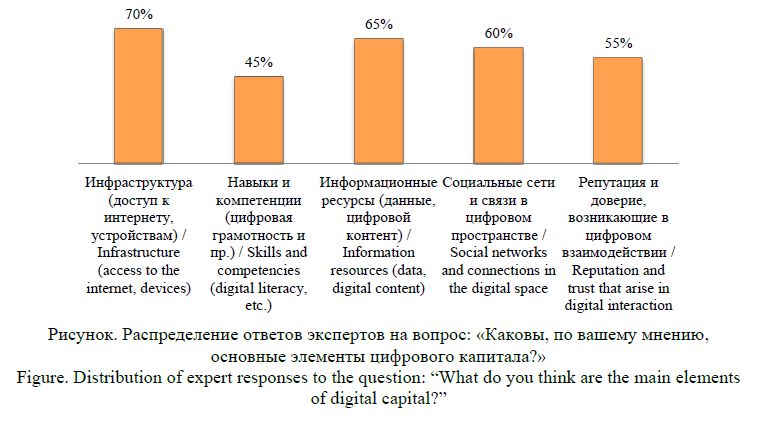
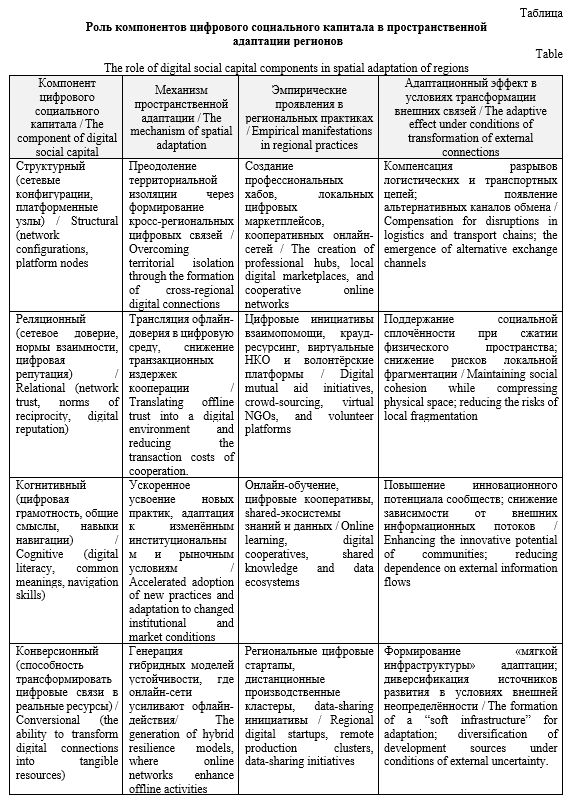
Relevance. In the context of the transformation of geopolitical space and the restriction of traditional channels of interregional interaction, digital practices are becoming a key factor in the restructuring of territorial connectedness. Digital social capital acts not merely as a technological supplement, but as a mechanism for the spatial adaptation of regional communities, compensating for the deficit of physical mobility and external economic ties. The scientific problem lies in identifying the conditions under which digital capital transforms from a tool of individual communication into a resource of collective resilience, as well as in assessing the contradiction between its adaptive potential and the risks of digital fragmentation of territories. Scientific results. Based on an interdisciplinary theoretical analysis and expert survey data, a working definition of digital social capital is formulated as a resource of regional communities that integrates digital competencies, platform-mediated connections, and norms of network trust. It is revealed that its adaptive function is realized through hybrid online-offline practices, enabling communities to overcome spatial constraints and diversify channels of resource exchange. It is shown that the effectiveness of digital capital depends on its embeddedness in local norms of reciprocity, while its limitation remains the uneven digital development of regions, which creates risks of spatial marginalization.
Figures
Khripkova, D. V., Khripkov, K. A., Soloviev, D. Yu., Yurkova, O. N., Solovieva, N. E. (2026), “Digital social capital as a factor of spatial adaptation: regional communities of Russia in a new geopolitical context”, Research Result. Sociology and Management, 12 (4), 116-129. DOI: 10.18413/2408-9338-2026-
12-4-0-8.
















While nobody left any comments to this publication.
You can be first.
Bourdieu, P. (2002), “Forms of Capital”, Ekonomicheskayasotsiologiya, 3 (5), 60-74, EDN: OYUVRD. (In Russian)
Vartanova, E. L., Gladkova, A. A. (2021), “Digital Inequality, Digital Capital, Digital Inclusion: The Dynamics of Theoretical Approaches and Political Decisions”, Vestnik Moskovskogo universiteta. Seriya 10: Zhurnalistika, 10 (1), 3-29, DOI: 10.30547/vestnik.journ.1.2021.329, EDN: LEKEML. (In Russian)
Grishaeva, S. A. (2020), “Social Transformations in the Digital Environment”, Vestnik Moskovskogo universiteta. Seriya 18. Sotsiologiya i politologiya, (26) 1, 70-81, DOI: 10.24290/1029-3736-2020-26-1-70-81, EDN: DWLIGU. (In Russian)
Zhukovskaya, O. Yu. (2020), “Social Capital and Social Networks in the Context of Digitalization: Mutual Influence and Implementation Features”, Tsifrovaya transformatsiya, (4), 21-33, DOI: 10.38086/2522-9613-2020-4-21-33, EDN: SDYOIK. (In Russian)
Igumnov, O. A. (2022), “Digitalization of the Economy and the Transformation of Social Relations: Digital Capital vs. Social Capital”, Nauka i innovatsii – sovremennye kontseptsii: Sbornik nauchnykh statey po itogam raboty Mezhdunarodnogo nauchnogo foruma, Moskva, 09 sentyabrya 2022 goda [Science and Innovation – Modern Concepts: Collection of Scientific Articles Based on the Results of the International Scientific Forum, Moscow, September 9], Infinity, Moscow, Russia, 28-36, EDN: BQZMYF. (In Russian)
Nasybullina, K. I. (2023), “Human and Social Capital in the Context of the Digital Economy”, Biznes i obshhestvo, (2), EDN: ESJINY. (In Russian)
Poddyachaya, E. A. (2024), “The Impact of Digital Transformations on Social Capital”, Kulturno-antropologicheskie issledovaniya, (1), 60-66, EDN: SJQQKL. (In Russian)
Pustovalova, E. V. (2024), “Social Capital of an Individual in the Digital Space of Modern Society”, Sotsiologiya v sovremennom mire: nauka, obrazovanie, tvorchestvo, (16), 30-33, EDN: DZVGFX. (In Russian)
Rozhentsova, M. R. (2024), “Digital Inequality and Access to Information for Villagers and Rural Residents: Ways to Overcome the Digital Divide”, Molodoy issledovatel: ot idei k proektu: Materialy VIII studencheskoy nauchno-prakticheskoy konferentsii [Young Researcher: From Idea to Project: Proceedings of the VIII Student Scientific and Practical Conference], Mari State University, Yoshkar-Ola, Russia, 409-411, EDN: UGUPJN. (In Russian)
Ryabkova, G. V., Garipov, A. A., Gareeva, A. A. (2024), “Digital Capital and Digital Value in the New Economic Paradigm”, Diskussiya, (6), 122-128, DOI: 10.46320/2077-7639-2024-6-127-122-128, EDN: NHZFEH. (In Russian)
Toropova, N.V., Sokolova, E.S., Guseinov, Sh.R. (2020), “Digital Inequality Trends in the Digital Economy: Features of International Discrimination”, Ekonomika: vchera, segodnya, zavtra, 10 (8-1), 456-463, DOI: 10.34670/AR.2020.37.94.052, EDN: BUJXHR. (In Russian)
Chistov, R.S., Savochkin, D. V. (2024), “The Problem of Subjectivity and the Development of Human and Social Capital in the Digital Society”, Sotsiologiya, (9), 87-93, EDN: JMZFNS. (In Russian)
Calderon, Gomez D. (2021), “The Third Digital Divide and Bourdieu: Bidirectional Conversion of Economic, Cultural, and Social Capital to (and from) Digital Capital among Young People in Madrid”, New Media & Society, 23 (9), 2534-2553, DOI: 10.1177/1461444820933252, EDN: HROIUH.
Julien, C. (2015), “Bourdieu, Social Capital and Online Interaction”, Sociology, 49 (2), 356-373, DOI: 10.1177/0038038514535862.
Mandarano, L., Meenar, M., Steins, C. (2010), “Building social capital in the digital age of civic engagement”, Journal of planning literature, 25 (2), 23-135, DOI: 10.1177/0885412210394102.
Nahapiet, J., Ghoshal, S. (1998), “Social capital, intellectual capital, and the organizational advantage”, Academy of management review, 23 (2), 242-266, DOI: 10.2307/259373, EDN: ENXSWH.
Putnam, R. (2000), Bowling Alone: The Collapse and Revival of American Community, Touchstone book by Simon & Schuster, NY.
Ragnedda, M. (2018), “Conceptualizing digital capital”, Telematics and informatics, 35 (8), 2366-2375, DOI: 10.1016/j.tele.2018.10.006.
Ragnedda, M., Ruiu, M. L. (2020), “Defining Digital Capital”, Digital Capital: a bourdieusian perspective on the digital divide, Emerald Publishing Limited, 9-38, DOI: 10.1108/978-1-83909-550-420201002.
The study was carried out within the framework of the State Assignment Project, FZWG-2026-0048, “Digital Social Capital as a Factor in Enhancing the Resilience and Innovation Potential of Regional Communities in Russia: Formation, Construction, and Reproduction”.