

Social consolidation and mobilization of regional women's and youth network communities in Siberia
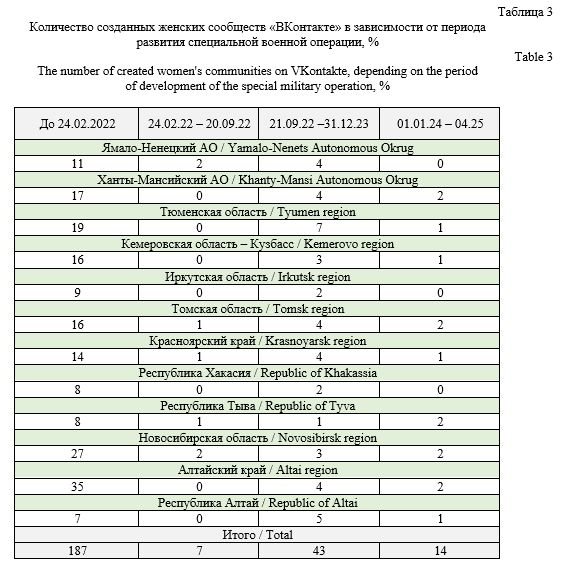
In the context of the active digitalization of government-public communication, the processes of consolidation and mobilization of online communities are particularly important, reflecting society's capacity for self-organization in crisis situations. The relevance of this study stems from the need to understand how women's and youth online communities adapt to new social conditions and build forms of collective action, including in the current context of a special military operation. The problem with this study is that regional women's and youth online communities are actively involved in social consolidation and mobilization processes, yet the relationship between these processes and their manifestations in the current socio-political situation remains insufficiently studied. This article utilizes quantitative and qualitative methods of analyzing the online activity of regional women's and youth communities in Siberia. The study included 251 women's and 301 youth communities on the VKontakte social network across the following regions: the Yamalo-Nenets Autonomous Okrug, the Khanty-Mansi Autonomous Okrug, the Tyumen Region, the Kemerovo Region-Kuzbass, the Irkutsk Region, the Tomsk Region, the Krasnoyarsk Territory, the Republic of Khakassia, the Republic of Tyva, the Novosibirsk Region, the Altai Territory, and the Altai Republic. The results show that the dynamics of community formation vary across regions. During the start of the special military operation (2022-2023), women's communities focusing on the special military operation were actively formed. They often formed self-organized and gradually institutionalized, developing into sustainable mutual aid structures. Youth communities more often demonstrated administrative consolidation, implemented through established forms of participation and government initiatives. The study's findings emphasize that consolidation is a prerequisite for the mobilization readiness of regional online communities. Communities can be activated not only to implement current initiatives, such as humanitarian aid, but also to subsequently address other socially significant issues for the region.
Figures
Brandt, Ya. A., Burmakina, A. L., Rybakova, O. S., Kranzeeva, E. A. (2026), “Social consolidation and mobilization of regional women's and youth network communities in Siberia”, Research Result. Sociology and Management, 12 (4), 83-102. DOI: 10.18413/2408-9338-2026-12-4-0-6.















While nobody left any comments to this publication.
You can be first.
Babintsev, V. P., Gaidukova, G. N., Serkina, Ya. I. and Shapoval, Zh. A. (2025), “Problems of consolidation of regional communities: the position of social realism”, Sotsiologicheskaya nauka i sotsialnaya praktika, 13 (1), 48-73, DOI: 10.19181/snsp.2025.13.1.3, EDN: QDYPZC. (In Russian)
Gorshkov, M. K. and Tyurina, I. O. (2023), “Consolidation of Russian society in the face of modern challenges: historical-sociological and value-ideological contexts”, RUDN Journal of Sociology, 23 (4), 720-739, DOI: 10.22363/2313-2272-2023-23-4-720-739, EDN: FQZJXO. (In Russian)
Zaborova, E. N. (2024), “Interaction between government and population: electronic realities”, Research Result. Sociology and Management, 10 (2), 122-134, DOI: 10.18413/2408-9338-2024-10-2-0-9, EDN: KPVQJZ. (In Russian)
Zyablikov, A. V., Maksimenko, A. A., Akhunzianova, F. T. and Zaitsev, A. V. (2023), “Interaction between authorities and society in online dialogue: a case study of the Kostroma region”, Izvestiya Yugo-Zapadnogo gosudarstvennogo universiteta. Seriya: Istoriya i parvo, 13 (6), 28-46, DOI: 10.21869/2223-1501-2023-13-6-28-46, EDN: UWZJTB. (In Russian)
Krivopuskov, V. V. (2024), “The role of the regional community as a factor in the consolidation of Russia”, Humanitarians of the South of Russia, 13 (1), 44-55, DOI: 10.18522/2227-8656.2024.1.2, EDN: DHEIWQ. (In Russian)
Leontyeva, M. M. and Sanina, A. G. (2025), “From informing to interaction? Features of the development of digital communication channels between citizens and authorities in the regions of Russia”, Mir Rossii, 34 (2), 49-74, DOI: 10.17323/1811-038X-2025-34-2-49-74, EDN: GKHJHB. (In Russian)
Merzlyakov, A. A. (2024), “Problems of interaction between government and population in the implementation of national projects”, Russia Reforming, (22), 308-338, DOI: 10.19181/ezheg.2024.12, EDN: THYNQV. (In Russian)
Murzina, I. A. and Retinskaya, V. N. (2024), “Society and state in the digital reality of modern Russia”, Social and Humanitarian Knowledge, (9), 62-66. (In Russian)
Myslivets, N. L. (2023), “Social consolidation of society in the context of modern social practices”, Sotsiologicheskiy almanakh, (14), 217-224. (In Russian)
Nikovskaya, L. I. (2024), “Request for change: public expectations and the modality of presentation”, Sociopolitical Sciences, 14 (4), 27-33, DOI: 10.33693/2223-0092-2024-14-4-27-33, EDN: NMZKXW. (In Russian)
Revyakin, S. A. (2018), “On the effectiveness of electronic platforms for citizen participation in public administration”, Public Administration Issues, (2), 94-112, EDN: UTSSIR. (In Russian)
Kranzeeva. E. A., Golovatsky. E. V. and Burmakina A. L. [et. al.] (2025), Setevaya sotsialno-politicheskaya mobilizatsiya v sibirskikh regionakh resursnogo tipa: kollektivnaya monografiya [Network socio-political mobilization in the resource-type Siberian regions: collective monograph], Kemerovo State University, Kemerovo, Russia. (In Russian)
Trotsuk, I. V. and Dursina, A. N. (2025), “The digital vector of communication development between authorities and the population in modern Russian society”, RUDN Journal of Sociology, 25 (1), 182-202, DOI: 10.22363/2313-2272-2025-25-1-182-202, EDN: ETHFJQ. (In Russian)
Khunagov, R. D. (2023), “Consolidation processes in the regional society: stages of formation and resource potential”, Humanitarians of the South of Russia, 12 (5), 45-58, DOI: 10.18522/2227-8656.2023.5.3, EDN: FNDCQS. (In Russian)
Chigrin, V. A. and Uzunov, V. V. (2022), “Features of social consolidation of regional communities in the South of Russia”, Humanitarians of the South of Russia, 11 (1), 150-159, DOI: 10.18522/2227-8656.2022.1.11, EDN: ZYZNSE. (In Russian)
Aiken, M. (1969), “Community Power and Community Mobilization”, The ANNALS of the American Academy of Political and Social Science, 385 (1), 76-88, DOI: 10.1177/000271626938500108, EDN: JLBOYF.
Dempsey, S. (2026), “Mobilizing Potential: Pathways to Engaged Citizenship”, Qualitative Sociology, (49), 137-159, DOI: 10.1007/s11133-025-09622-z, EDN: GZBPFZ.
Luguzan, C. (2017), “Information technology and social cohesion: A tale of two villages”, Journal of Rural Studies, (54), 426-434.
Üblacker, J., Liebig, S., Hamad, H. (2024), “Catalysts of connection. The role of digital information and communication technology in fostering neighbourhood social cohesion: A systematic review of empirical findings”, Urban Studies, 61(16), 3167-3186.
The research was carried out using a grant from the Russian Science Foundation for the project “Social and political mobilisation of women's and youth communities in the Siberian macroregion in the context of the special military operation”. № 25-28-01459, https://rscf.ru/project/25-28-01459 /.