

Features of the formation of reproductive attitudes of student youth
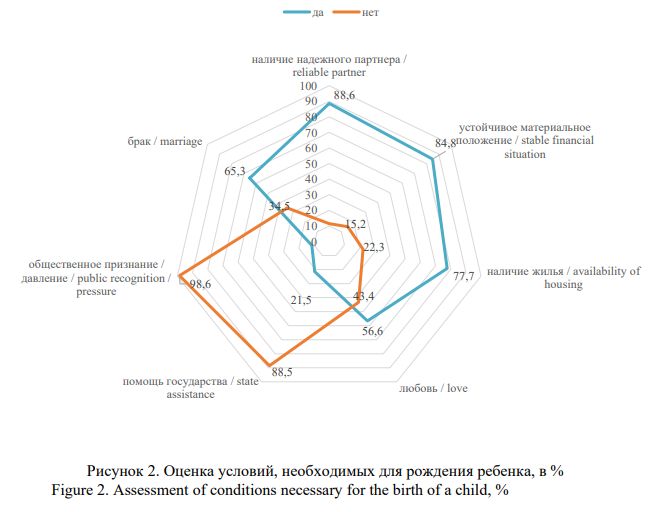
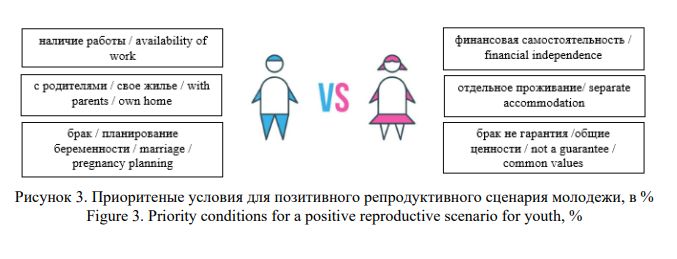
The article reveals some features of reproductive attitudes of student youth as preferred parenting scenarios that determine the connection between the behavior of young people and the need for childbearing. The aim of the study is to determine the reproductive attitudes of student youth, to identify the conditions and factors of their formation. The key research method was a questionnaire survey of students of Moscow universities (N = 475, target sample, pilot study in spring 2025). Semi-structured interviews (n = 10) were used as an additional method. The novelty of the obtained results is the systematization of favorable conditions that are considered by student youth as significant for childbearing. The differences in how young people perceive the conditions for having a child (e.g. financial situation, availability of housing, reliability of a partner) are presented. This made it possible to analyse the data in detail according to the gender characteristics of the respondents. In particular, young men are more likely to focus on having children within the framework of a family scenario; for girls, on the contrary, the importance of official marriage as a guarantee of long-term cohabitation is somewhat devalued, emphasizing shared values with the child's father. The influence of “uncertainty about the future” on the formation of young people's reproductive attitudes was established, the main sources of which are the difficulty of choosing a partner for a long-term relationship and the inability to meet social expectations. The novelty of the obtained results is the established inverse relationship between such a personal reproductive choice of young people as voluntary childlessness and the low level of acceptance of this choice among other young people. It is also concluded that positive experiences of parental family are perceived by young people as natural conditions of growing up, which do not create the need to implement compensatory (in relation to experience) models of reproductive behavior. Moreover, among young people from large families, the recognition of the influence of family patterns on the formation of reproductive attitudes (three or more children) is higher, which can be considered a predicate for a shift towards the popularization of successful large families. The practical significance of the obtained results is related to the possibility of their use for developing the design of a study on the transformation of reproductive attitudes of young people and increasing the effectiveness of demographic policy.
Figures
Rogach, O. V. (2026), “Features of the formation of reproductive attitudes of student youth”, Research Result. Sociology and Management, 12 (1), 111-126. DOI: 10.18413/2408-9338-2026-12-1-0-6.
Research result. Sociology and Management is included in the scientific database of the RINTs (license agreement No. 765-12/2014 dated 08.12.2014).
Журнал включен в перечень рецензируемых научных изданий, рекомендуемых ВАК















While nobody left any comments to this publication.
You can be first.
Aleksandrova, O. A., Yarasheva, A. V. (2024), “Section “The institute of family in modern Russia: traditions and innovations in marital and reproductive behavior, interfamily relations, and intergenerational connections” at the XIV International Grushinsky sociological conference”, Narodonaseleniye, (27), 192-197, DOI: 10.24412/1561-7785-2024-4-192-197. (In Russian)
Ambarova, P. A., Zborovsky, G. E. (2022), “What awaits students after…”, Monitoring of public opinion: economic and social changes, (3), 67-91, DOI: 10.14515/monitoring.2022.3.2142. (In Russian)
Borisov, V. A. (1970), Demografiya i sotsialnaya psikhologiya [Demography and social psychology], Mysl, Moscow, Russia. (In Russian)
Galieva, E. R. (2021), “Traditional and modern reproductive behavior models”, Kazanskiy sotsialno-gumanitarny vestnik, (1),
12-15, EDN: XDVANW. (In Russian)
Garipova, R. R., Kuznetsov, V. O. (2024), “Reproductive attitudes and family values of modern student youth (based on the author's sociological research)”, Kazanskiy sotsialno-gumanitarny vestnik, (2), 31-37, DOI: 10.26907/2079-5912.2024.2.31-37, EDN: EROCXB. (In Russian)
Grigorieva, N. S. (2020), “Students' life plans: family versus career”, Vestnik Rossiyskogo fonda fundamentalnyh issledovaniya. Gumanitarnye i obshhestvennye nauki, (5), 156-165, DOI: 10.22204/2587-8956-2020-102-05-156-165. (In Russian)
Dankova, V. V. (2023), “Family and reproductive attitudes of Moscow youth: analysis of the results of a sociological study”, Sotsiologiya, (2), 25-35, EDN: JXFKLF. (In Russian)
Zhuravleva, E. K., Koptseva, O. A. (2024), “Supporting points of large families in the transformation of modern family”, Narodonaselenie, 27 (S1), 28-37, DOI: 10.24412/1561-7785-2024-S1-28-37. (In Russian)
Zubok, Yu. A., Seliverstova, N. A. (2024), “Sociocultural attitudes in the self-regulation of youth’s ideas about the future”, Nauka. Kultura. Obshchestvo, 30 (4), 112-133, DOI:10.19181/nko.2024.30.4.8. (In Russian)
Kalabikhina, I. E., Kazbekova, Z. G., Banin, E. P., Klimenko, G. A. (2023), “Demographic values and socio-demographic profile of the VKontakte users: is there a connection?”, Vestnik Moskovskogo universiteta. Seriya 6. Ekonomika, (58), 157-180, DOI:10.55959/MSU0130- 0105-6-58-3-8. (In Russian)
Kroshilin, S. V., Medvedeva, E. I. (2025), “Family patterns in achieving performance indicators for the heads of constituent entities of the Russian Federation”, Narodonaselenie, 28 (2), 16-28, DOI: 10.24412/1561-7785-2025-2-16-28. (In Russian)
Malygina, A. P., Ivanov, D. V. (2020), “The relationship between role expectations and aspirations of spouses and marital satisfaction”, Byulleten nauki i praktiki, 6 (12), 386-395, DOI: 10.33619/2414-2948/61/44, EDN: AFGSBV/. (In Russian)
Polenova, M. E., Lazurenko, N. V., Podporinova, N. N., Koroleva, K. Yu. (2023), “Matrimonial behavior of student youth in the context of social health studying (gender aspect)”, Problemy sotsialnoy gigieny, zdravookhraneniya i istorii meditsiny, 31 (S1), 765-773, DOI: 10.32687/0869-866X-2023-31-s1-765-773. (In Russian)
Rogach, O. V., Frolova, E. V. (2024), “The Phenomenon of the Family in Modern Russia”, Sotsialnaya politika i sotsiologiya, 23 (3), 112-117, DOI: 10.17922/2071-3665-2024-23-3-112-117. (In Russian)
Rostovskaya, T. K., Vasilyeva, E. N., Knyazkova, E. A., Kalachikova, O. N., Smirnova, I. N., Kuchmaeva, O. V., Malygin, A. A., Rychikhina, N. S., Shabunova, A. A. (2024), Studencheskaya semya v Rossii: bariery i
vozmozhnosti blagopoluchiya [Student family in Russia: barriers and opportunities for well-being], Institut demograficheskikh issledovaniy Federalnogo nauchno-issledovatelskogo sotsiologicheskogo tsentra Rossiyskoy akademii nauk, Ivanovskiy gosudarstvenny universitet, Ivanovo, Russia. (In Russian)
Rostovskayа, T. K., Kuchmaeva, O. V., Solovyeva, N. A., Azarova, E. S. (2024), “Reproductive potential of young families: results of a sociological study”, Zhenshhina v rossiyskom obshhestve, (4), 35-50, DOI: 10.21064/WinRS.2024.4.3. (In Russian)
Trusova, E. A. (2021), “Family reproductive attitudes: comprehensive analysis in the regional context”, Vlast i upravlenie na Vostoke Rossii, (2), 114-121, DOI 10.22394/1818-4049-2021-95-2-114-121. (In Russian)
Rezaei, F., Amiri-Farahani, L., Haghani, Sh., Pezaro, S., Behmanesh, F. (2023), “Comparing reproductive intentions before and during the COVID-19 pandemic: a cross-sectional study”, BMC Health Services Research, 23 (1), 545, DOI: 10.1186/s12913-023-09551-z/
Taneva, D, Kirkova A. (2020), “Formation of the reproductive behavior of healthcare students depending on their mothers’ realized plans”, Folia Med (Plovdiv), (62), 477-481, DOI: 10.3897/folmed.62.e50484.