
Old age through the eyes of residents of the region: associations, beliefs, and the image of a prosperous old age
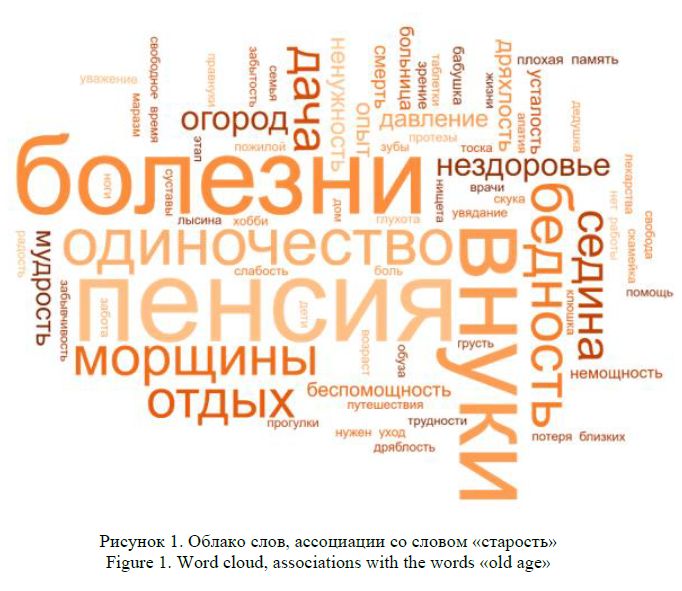
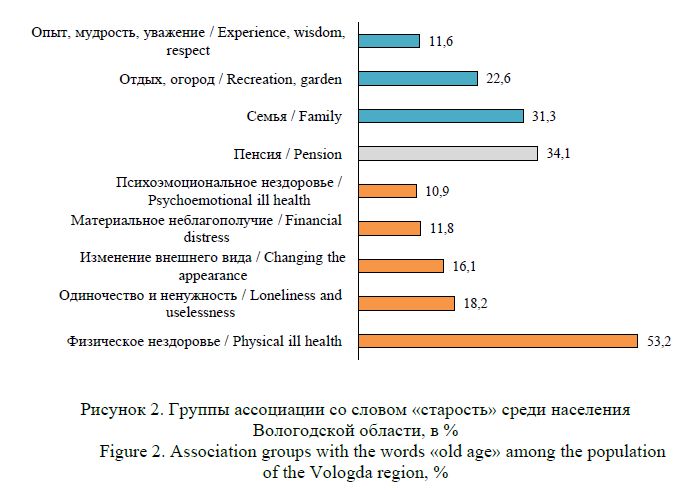
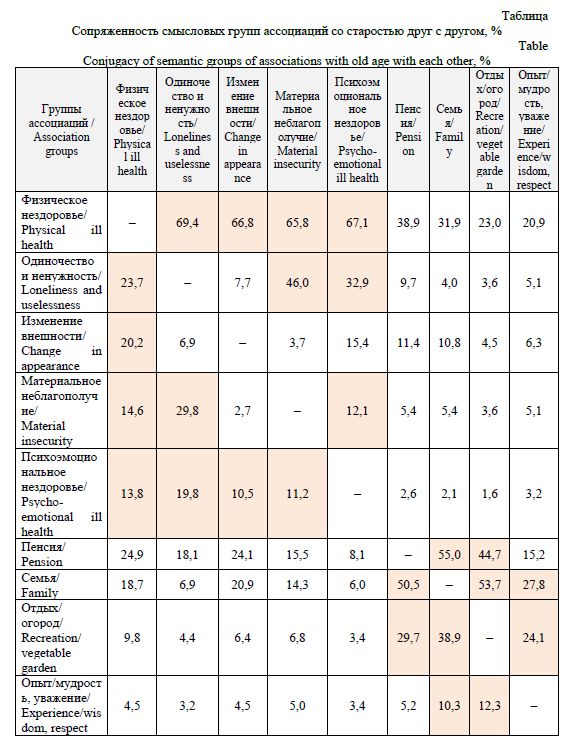
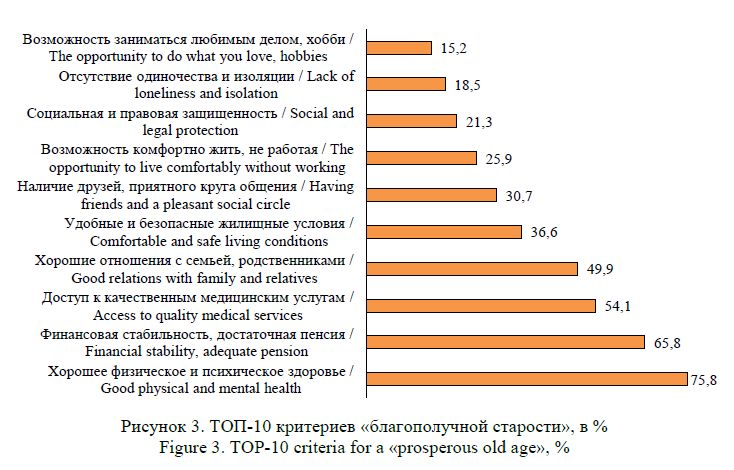
The global aging of the population actualizes the problem of public perception of old age, since the emerging stereotypes affect the health, social activity and life expectancy of older people, can provoke their social exclusion and self-discrimination. Questions remain insufficiently studied about how socio-demographic characteristics are related to the structure of ideas about old age, what semantic complexes form these ideas and what factors form a positive or negative image of old age, which amounted to the content of this study. The empirical basis was the data of a representative survey of the population of the Vologda oblast (N = 1500, 2025). Three blocks of questions were used: an open question about associations with the word “old age” (followed by grouping answers into nine semantic categories), a closed block of 16 judgments about old age and the elderly (5-point consent scale), a closed question about the components of “prosperous old age”. The analysis was carried out by socio-demographic groups (gender, age, marital status, education, income, type of settlement, life satisfaction, psychological state) using descriptive statistics and conjugacy analysis methods. The ambivalence of the perception of old age was revealed: the topic of physical ill-health prevails in open associations (53%), however, in the answers to closed questions, a respectful attitude towards the elderly is highlighted. It has been established that negative ideas form stable semantic connectives (diseases – loneliness – poverty), as well as positive ideas are intertwined with each other (family – rest – wisdom). Risk factors (old age, low level of education and income, symptoms of anxiety and/or depression, absence of a spouse and children, feeling of loneliness) and protective factors (marriage, having children, higher education, life satisfaction, material wealth) of the formation of a negative image of old age. It was shown that the components that make up a prosperous old age are primarily health, financial security, access to medicine, family relations, comfortable and safe housing; socio-demographic differences in the selection of these components were highlighted. The results obtained demonstrate that the perception of old age is structured and not reducible to simple categories “negative”, “neutral”, “positive”. The identified semantic blocks of associations and their relationship with socio-demographic characteristics can become the basis for the development of personalized preventive measures and measures to form a positive public discourse about old age.
Figures
Shmatova, Yu. E., Gordievskaya, A. N. (2026), “Old age through the eyes of residents of the region: associations, beliefs, and the image of a prosperous old age”, Research Result. Sociology and Management, 12 (1), 22-44. DOI: 10.18413/2408-9338-2026-12-1-0-2.















While nobody left any comments to this publication.
You can be first.
Antonov, A. I., Nazarova, I. B., Karpova, V. M., Lyalikova, S. V. (2023), “The threshold of old age: objective signs and subjective perception”, Narodonaselenie, 26 (3), 131-143, DOI: 10.19181/population.2023.26.3.11. (In Russian)
Illarionova, V. L. (2022), “Socio-psychological aspects of the study of old age”, Aktualnyye voprosy psikhologii razvitiya i obrazovaniya: Sbornik materialov IV Vserossiyskoy nauchno-prakticheskoy konferentsii Sankt-Peterburg, 28-29 sentyabrya 2021 goda [Actual issues of developmental psychology and education: Collection of materials of the IV All-Russian scientific and practical conference St. Petersburg, September 28-29 2021], A.S. Pushkin Leningrad State University, St. Petersburg, Russia, 79-86, EDN: TEBIQI. (In Russian)
Kozlova, N. D., Zhdanova, S. Yu. (2020), “Attitudes towards aging among teachers in connection with socio-psychological characteristics of personality”, Psikholog, (4), 20-22, DOI: 10.25136/2409–8701.2020.4.3278. (In Russian)
Kolpina, L. V. (2015), Eidzhizm v obsluzhivanii pozhilykh grazhdan uchrezhdeniyami zdravookhraneniya i sotsialnoy zashchity [Ageism in the service of elderly citizens by health and social protection institutions], Zebra, Ulyanovsk, Russia, ISBN: 978-5-9907022-5-7, EDN: ULKPWL. (In Russian)
Krasnova, O. V. (2004), Psikhologiya starosti [Psychology of old age], Bakhrakh-M, Moscow, Russia. (In Russian)
Krupina, K. M., Petrash, M. D. (2024), “Lifestyle and psychological well-being as predictors of positive perceptions of aging”, Izvestiya Saratovskogo universiteta. Novaya seriya. Seriya Akmeologiya obrazovaniya. Psikhologiya razvitiya, 13 (4), 334-345, DOI: 10.18500/2304-9790-2024-13-4-334-345. (In Russian)
Krupina, K. M., Petrash, M. D. (2023), “The concept of aging and lifestyle”, St. Petersburg Psychological Journal, (42), 1-21, EDN: BMBUOI. (In Russian)
Lyalikova, S. V., Nazarova, I. B., Karpova, V. M. (2023), “Features of the perception of older people in Russian society”, Sociological research, (10), 104-115, DOI: 10.31857/S013216250028308-1. (In Russian)
Petrash, M. D., Strizhitskaya, O. Yu., Krupina, K. M. (2024), “Adaptation of the Russian-language version of the Aging Perceptions Questionnaire (APQ)”, Vestnik of Saint Petersburg University. Psychology, 14 (2), 223-240, DOI: 10.21638/spbu16.2024.202. (In Russian)
Romanychev, I. S. (2024), “Fears of Aging: Towards a Mobilizing Role”, Russian Economic Bulletin, 7 (3), 39-46, DOI: 10.58224/2658-5286-2024-7-3-39-46. (In Russian)
Strizhitskaya, O. Yu. (2018), Psikhologiya pozitivnogo stareniya: usloviya, faktory i sotsialnye effekty gerotranstsendentnosti [Psychology of Positive Aging: Conditions, Factors and Social Effects of Gerotranscendence], Ph.D. of Psychology, St. Petersburg, Russia, EDN: YKQVQS. (In Russian)
Barnes, T. L, Musich, Sh., Wang, Sh., Kraemer, S., Yeh, Ch. (2019), “Self-perception of aging and associated characteristics among older adults”, Innovation in Aging, 3(1), 837, DOI: 10.1093/geroni/igz038.3084.
Chen, J., Zheng, K., Xia, W., Wang, Q., Liao, Z., Zheng, Y. (2018), “Does Inside Equal Outside? Relations Between Older Adults' Implicit and Explicit Aging Attitudes and Self-Esteem”, Frontiers in Psychology, 9. URL: https://www.frontiersin.org/article/10.3389/fpsyg.2018.02313 (Accessed: 10 February 2026).
Deshayes, M. et al. (2020), “«Not performing worse but feeling older» the negative effect of the induction of a negative aging stereotype”, Psychology of Sport and Exercise, 51, 101793, DOI: 10.1016/j.psychsport.2020.101793.
Diehl, M., Wurm, S., Levy, B. (2022), “Adults' views of aging as an underestimated risk factor for health, well-being, and longevity”, Innovation in Aging, 6 (1), 426, DOI: 10.1093/geroni/igac059.1674.
Giasson, H. L., Chopik, W. J., Yang, H. (2024), “Self-perceptions of aging predict adjustment during the COVID-19 pandemic”, Psychology and Aging, 39 (7), 818-828, DOI: 10.1037/pag0000855.
Hooker, K., Mejía, S. T., Phibbs, S., Tan, E.J., Stevens, J. (2019), “Effects of age discrimination on self-perceptions of aging and cancer risk behaviors”, The Gerontologist, 59 (1), 28-37, DOI: 10.1093/geront/gny183.
Ingrand, I., Paccalin, M., Liuu, E., Gil, R., Ingrand, P. (2018), “Positive perception of aging is a key predictor of quality-of-life in aging people”, PLoS One, 13 (10), DOI: 10.1371/journal.pone.0204044.
Kornadt, A. E., Rothermund, K. (2011), “Contexts of aging: Assessing evaluative age stereotypes in different life domains”, The Journals of Gerontology: Ser. B., 66B (5), 547-556, DOI: 10.1093/geronb/gbr036.
Kornadt, A. E. (2016), “Do age stereotypes as social role expectations for older adults influence personality development?”, Journal of Research in Personality, 60, 51-55, DOI: 10.1016/j.jrp.2015.11.005.
Kotter-Grühn, D., Kleinspehn-Ammerlahn, A., Gerstorf, D., Smith, J. (2009), “Self-perceptions of aging predict mortality and change with approaching death: 16-year longitudinal results from the Berlin Aging Study”, Psychology and Aging, 24 (3), 654-667, DOI: 10.1037/a0016510.
Levy, B. R., Slade, M. D., Kasl, S. V. (2002), “Longitudinal Benefit of Positive Self-Perceptions of Aging on Functional Health”, The Journals of Gerontology: Series B., 5 (5), 409-417, DOI: 10.1093/geronb/57.5.P409.
Levy, B. (2009), “Stereotype embodiment: A psychosocial approach to aging”, Current Directions in Psychological Science, 18 (6), 332-336. DOI: 10.1111/j.1467-8721.2009.01662.x.
Levy, B. R., Slade, M. D., Chang, E. S., Kannoth, S., Wang, S. Y. (2020), “Ageism amplifies cost and prevalence of health conditions”, The Gerontologist, 60(1), 174-181, DOI: 10.1093/geront/gny131.
Nah, S., Martire, L., Tate, A. (2022), “Physical function, self-perceptions of aging, and depressive symptoms among older adults”, Innovation in Aging, 6 (1), 527, DOI: 10.1093/geroni/igac059.2009.
Robertson, D. A., Kenny, R.A. (2016), “Negative perceptions of aging modify the association between frailty and cognitive function in older adults”, Personality and Individual Differences, 100, 120-125, DOI: 10.1016/j.paid.2015.12.010.
Stephan, Ya., Sutin, A. R., Terracciano, A. (2022), “Subjective aging and objectively assessed hearing function: A prospective study of older adults”, The Journals of Gerontology: Ser. B., 77 (9), 16371644, DOI: 10.1093/geronb/gbac018.
Tully-Wilson, C., Bojack, R., Millear, P.M., Stallman, H.M., Allen, A., Mason, J. (2021), “Self-Perceptions of ageing: A systematic review of longitudinal studies”, Psychology and Aging, 36 (7), 773-789, DOI: 10.1037/pag0000638.
Westerhof, G. J., Nehrkorn-Bailey, A. M., Tseng, H. Yu., Brothers, A., Siebert, J. S., Wurm, S., Wahl, H. W., Diehl, M. (2023), “Longitudinal effects of subjective aging on health and longevity: An updated meta-analysis”, Psychology and Aging, 38 (3), 147-166, DOI: 10.1037/pag0000737.
Witzel, D. D., Turner, S. G., Hooker, K. (2022), “Self-Perceptions of aging moderate associations of within- and between-persons perceived stress and physical health symptoms”, The Journals of Gerontology: Ser. B, 77 (4), 641-651, DOI: 10.1093/geronb/gbab228.
Witzel, D., Turner, Sh., Hooker, K. (2021), “Daily Perceived Stress and Physical Health Symptoms: Moderation by Self-Perceptions of Aging”, Innovation in Aging, 5 (1), 602, DOI: 10.1093/geroni/igab046.2311.
Wurm, S., Beyer, A., Wiest, M. (2016), “Who stays active in old age? interplay of self-perceptions of aging and subjective life expectancy”, The Gerontologist, 56 (3), 205, DOI:10.1093/geront/gnw162.804.
Zigmond, A. S., Snaith, R. P. (1983), “The hospital anxiety and depression scale”, Acta psychiatrica Scandinavica, 67 (6), 361-370, DOI: 10.1111/j.1600-0447.1983.tb09716.x
The research was supported by Russian Science Foundation grant 23-78-10128, https://rscf.ru/en/project/23-78-10128/